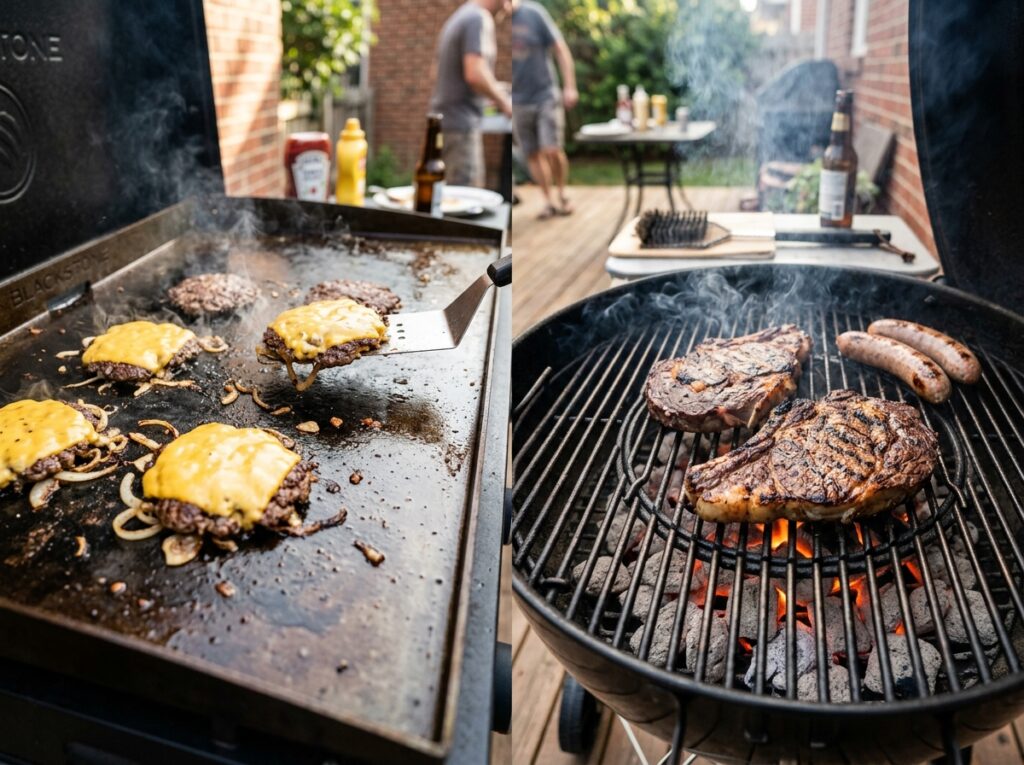
Here’s a number that surprised me — Blackstone sold over 5 million griddles in the U.S. between 2020 and 2024. That’s a lot of flat-top cooking surfaces sitting next to traditional grills in American backyards.
And that’s exactly where the confusion starts. You’ve got a budget for one solid outdoor cooking setup, and you’re staring at two very different options: a Blackstone griddle or a traditional grill. Both cook food outside. Both use propane (mostly). Both have passionate fans who’ll swear their pick is the only right answer.
But they’re not the same thing. Not even close.
A Blackstone is a flat-top griddle — think of a restaurant’s breakfast station moved to your patio. A grill, whether it’s charcoal, gas, or pellet, cooks with open flames or indirect heat, usually over grates. The way food interacts with heat, the flavors you get, the meals you can pull off — all of it changes depending on which one you choose.
So instead of giving you a generic spec sheet, let me walk you through this the way I’d explain it to a friend who just asked me, “Which one should I buy?” The honest answer depends on how you cook, what you cook, and what kind of experience you’re chasing.
How They Actually Work (And Why It Matters)
Before you compare anything else, you need to understand the fundamental difference in how these two machines cook your food. This isn’t just a technical detail — it changes everything about the results on your plate.
The Blackstone Griddle
A Blackstone is essentially a large, flat steel cooking surface heated from below by gas burners. There are no grates, no open flames touching your food, and no drip-through. The entire surface gets hot, and your food sits directly on that seasoned steel.
Think of it like cooking on a giant cast iron skillet — outdoors. The flat surface means every inch of your food makes contact with heat. That’s why Blackstone burgers get that unbelievable crust, and why eggs, pancakes, and stir-fry work so well on it. Liquids, oils, sauces, and melted cheese stay right where you put them instead of falling into a fire below.
Most Blackstone models (like the popular 36-inch and 28-inch versions) run on propane and feature multiple independent burners so you can create heat zones across the surface.
The Traditional Grill
A grill — whether it’s a gas grill, charcoal kettle, or pellet smoker — works differently. Your food sits on grates above a heat source. Flames (or hot coals, or heated wood pellets) cook from below, and fat drips down onto those heat sources, creating smoke and flare-ups that add flavor.
That dripping process is the secret behind the “grilled taste” most people crave. When meat juices hit hot coals or flavorizer bars, they vaporize and rise back up, coating your food with smoky, charred goodness. It’s a flavor a flat-top surface simply can’t replicate.
Grills also give you the option of indirect cooking — moving food away from the heat source, closing the lid, and essentially turning your grill into an outdoor oven. That’s how you slow-cook a pork butt or smoke a brisket for hours.
Quick Fact: The Maillard reaction (the chemical process that creates browning and flavor) happens on both a griddle and a grill. But the type of browning differs. A griddle gives you an even, restaurant-style sear. A grill gives you distinct grill marks with charred edges and smoky depth.
Flavor — The Dealbreaker for Most People
Let’s get to the thing that matters most for 90% of buyers. How does the food actually taste?
Grill Flavor
There’s a reason “grilled” is a flavor profile of its own. That smoky, slightly charred taste doesn’t come from the grill itself — it comes from the combination of open flame, smoke from dripping fats, and the charring that happens on grate marks. Charcoal grills add another layer of flavor from the burning briquettes or lump charcoal. Pellet grills bring wood smoke from hardwood pellets (hickory, mesquite, cherry, etc.).
If smoky flavor is non-negotiable for you, a grill wins this round without much debate. You can absolutely add smoky elements to a Blackstone — some people use smoke tubes or liquid smoke — but it’s a workaround, not the real thing.
Blackstone Flavor
Now, here’s where Blackstone fans push back, and they’re not wrong. A griddle produces a different kind of delicious. That full-surface contact with hot steel creates a uniform, caramelized crust that’s hard to achieve on grates. Smash burgers on a Blackstone? They’re legitimately better than most grilled burgers because every square millimeter of the patty gets seared.
Stir-fry, fried rice, fajitas, Philly cheesesteaks, breakfast spreads with eggs, bacon, and hash browns — a Blackstone handles these dishes with a quality that a grill can’t touch. You’re not dripping flavor away through the grates. Everything stays on the surface, mingles together, and builds layers of taste.
So the flavor question isn’t “which is better?” It’s “which flavor profile do you want more often?” If you cook steaks, ribs, and chicken thighs every weekend, grill flavor is your priority. If you love diner-style cooking, Asian-inspired dishes, and crispy breakfast platters, Blackstone flavor is going to make you happier.
What Can You Actually Cook on Each?
This is where the comparison gets really interesting, because the cooking versatility gap between these two is bigger than most people expect.
Blackstone’s Sweet Spot
A flat-top griddle gives you cooking options that are flat-out impossible (pun intended) on a grill. You can crack eggs. You can make pancakes for twelve people at once. You can do quesadillas, grilled cheese sandwiches, smash burgers, hibachi-style vegetables, and bacon without losing a single strip through the grates.
Basically, if a recipe involves loose ingredients, sauces, small-cut vegetables, cheese, or any kind of liquid component, a Blackstone handles it beautifully. It’s also fantastic for cooking large quantities at once — that 36-inch surface gives you roughly 720 square inches of cooking space, enough to feed a small party in one round.
Where a Grill Shines
A traditional grill is your go-to for anything that benefits from smoke, char, and indirect heat. Thick steaks with a smoky crust, baby back ribs slow-cooked over hours, whole chickens roasted with the lid down, cedar-plank salmon, and of course, brisket smoked low and slow until it melts in your mouth.
You can also grill vegetables, pizza, and even desserts with that beautiful smokiness that a Blackstone can’t produce. The ability to close the lid and trap heat turns your grill into a smoker-oven hybrid — something a Blackstone, with its completely open cooking surface, can’t do.
Pro Tip: If you love cooking ribs using methods like the 3-2-1 technique, you need a grill or smoker. A Blackstone can sear ribs for a nice crust, but it can’t give you that fall-off-the-bone tenderness that comes from hours of low-and-slow smoking.
Temperature Control and Heat Management
How much control you have over your cooking temperature matters a lot — especially if you’re someone who cooks different foods at different temps.
A Blackstone with multiple burners (most 36-inch models have four) gives you excellent zone control. You can run one burner on high for searing, keep another on medium for cooking vegetables, and leave one side on low to keep finished food warm. It’s like having four stovetop burners merged into one surface.
Gas grills offer similar zone control — high heat on one side, low on the other — and the added benefit of convection cooking when the lid is closed. A good gas grill can hold steady temperatures anywhere from 250°F to 600°F+, making it versatile for both grilling and indirect roasting.
Charcoal grills and kamado grills require more skill to manage temperature, but they reward you with incredible flavor range and the ability to smoke at very low temps (225°F) or blast up to 700°F+ for pizza and steaks.
Pellet grills use digital controllers that let you set an exact temperature and walk away. They’re the “set it and forget it” option for people who want precision without babysitting their cook.
One thing to note — Blackstone griddles don’t have lids (some newer models have wind guards or hoods, but they’re not designed for trapped-heat cooking). This means you can’t roast, bake, or smoke on a Blackstone. Your cooking method is always direct-heat, flat-surface contact.
The Learning Curve — How Quickly Can You Get Good?
Here’s something the comparison charts don’t tell you: one of these is significantly easier to learn than the other.
A Blackstone griddle is almost ridiculously easy to use once you get past the initial seasoning process. If you can cook on a stovetop, you can cook on a Blackstone. The flat surface is forgiving — food doesn’t fall through grates, you can easily move things around with spatulas, and temperature control is as simple as turning a knob.
The only real skill you need to develop is learning to maintain your griddle’s seasoning (that protective, non-stick layer of polymerized oil on the steel surface) and managing moisture on the cooking surface. Once you’ve got that down, you’re golden.
Grilling has a steeper learning curve, especially with charcoal. You need to learn how to manage airflow, handle flare-ups, understand when to use direct vs. indirect heat, and figure out the timing for different types of meat. It’s not rocket science, but it takes a few cooks to get comfortable.
A wireless meat thermometer can flatten that learning curve significantly — especially for thicker cuts where eyeballing doneness is unreliable.
Did You Know? The most common beginner mistake on a Blackstone isn’t burning the food — it’s cooking on a poorly seasoned surface. Without proper seasoning, food sticks, flavors suffer, and cleanup becomes a nightmare. Take 30 minutes to season your griddle correctly before your first cook, and you’ll avoid 80% of frustrations.
Maintenance and Cleanup — The Unglamorous Truth
Nobody talks about this enough, but how easy something is to clean and maintain plays a huge role in how often you actually use it.
Blackstone Maintenance
After every cook, you scrape the surface clean with a metal scraper, apply a thin layer of oil, and you’re done. It takes about five minutes. The seasoning actually improves over time — the more you cook, the more non-stick and flavorful that surface becomes (just like a cast iron pan).
The downside? Blackstone griddles are vulnerable to rust if you don’t keep them oiled and covered. Leave a bare steel surface exposed to rain or humidity for a few days and you’ll start seeing orange spots. A good cover is non-negotiable, and you’ll want to re-season periodically, especially if you live in a humid climate.
Grill Maintenance
Grills require a different kind of upkeep. Grates need to be brushed after every use to remove stuck-on food. Charcoal grills need ash cleanup. Gas grills need periodic burner tube checks and flavorizer bar replacements. Grease traps need emptying.
Deep cleaning a grill — really getting in there with soapy water, scrubbing grates, and clearing out built-up residue — is a bigger job than cleaning a Blackstone. Most people do it a few times per season, and it takes 30–60 minutes.
The upside is that grill grates (especially cast iron or stainless steel) are more durable and less finicky than a griddle surface. They don’t rust as quickly, and even if they do, they’re easier to restore or replace.
Portability and Space Considerations
Your outdoor space and how you use it should influence this decision more than most people realize.
Blackstone offers models ranging from small tabletop 17-inch griddles to the full-sized 36-inch units. The larger models aren’t light — a 36-inch Blackstone weighs around 120+ pounds and sits on a wheeled cart. It’s “movable” but not truly portable. The 22-inch and tabletop models, on the other hand, are great for tailgating, camping, or RV trips. If you’re looking for a portable griddle that travels well, Blackstone’s smaller units are genuinely solid options.
Traditional grills come in every possible size, from tiny hibachis to massive built-in outdoor kitchen setups. Kettle grills like the Weber Original are compact and relatively light. Portable pellet grills have gotten surprisingly good for on-the-go cooking. But if you’re eyeing an offset smoker or a large pellet grill, you’re looking at a permanent fixture on your patio.
Space-wise, a Blackstone griddle has a larger physical footprint relative to its cooking surface because everything is spread out flat. A grill with a lid can cook on multiple levels (using warming racks, for example) and offers more cooking capacity per square foot of patio space.
Cost Comparison — What Are You Really Paying For?
Let’s talk money, because budget matters.
A Blackstone 36-inch griddle typically costs between $300 and $400. The 28-inch models run $250–$350. Tabletop models start around $100–$150. That’s a lot of cooking surface for the price.
Gas grills vary wildly — you can get a basic 2-burner model for $200, but a quality 4-burner gas grill with good build materials runs $500–$1,000. Charcoal grills are the budget champions, with solid kettle grills available for $100–$200. Pellet grills sit at the higher end, typically $500–$1,500 for quality models.
Ongoing costs are worth considering too. Both Blackstones and gas grills burn propane, so fuel costs are similar. Charcoal grills have higher ongoing fuel costs (good lump charcoal isn’t cheap). Pellet grills fall somewhere in between, with hardwood pellets running about $15–$25 per 20-pound bag.
The real hidden cost with a Blackstone is accessories. You’ll want a good set of spatulas, a scraper, squeeze bottles for oil, a cover, and possibly a wind guard. Budget an extra $50–$100 for these. For a grill, you’ll need quality grill tools, a reliable thermometer, and heat-resistant gloves — similar ballpark.
Weather and Outdoor Conditions
This doesn’t get enough attention in most comparisons, but it should.
A Blackstone griddle is an open, flat surface with no lid. Wind is its enemy. Even a moderate breeze can create uneven heating across the surface, cool down your cooking zone, and make it frustrating to maintain temperature. If your patio is exposed to regular wind, you’ll either need a wind guard attachment or a sheltered cooking spot.
Rain is another issue. You can’t really cook on a Blackstone in the rain — water hitting a 400°F steel surface causes spattering, and moisture kills your seasoning.
Grills with lids handle weather much better. Close the lid and your cooking chamber stays insulated from wind. Many people grill year-round in cold climates because the closed-lid design retains heat effectively. A kamado grill, with its thick ceramic walls, is practically weather-proof — it’ll hold temperature in freezing conditions without breaking a sweat.
Pro Tip: If you live somewhere with frequent wind, long winters, or unpredictable weather, a grill with a lid will give you more consistent results and a longer usable season.
So Which One Should You Actually Buy?
This is where I stop sitting on the fence and give you a straight answer based on different scenarios.
Get a Blackstone if:
You love cooking breakfast outdoors. You’re a smash burger fanatic. You enjoy hibachi-style meals, stir-fry, fajitas, or any dish with small or loose ingredients. You feed large groups regularly and want to cook everything at once on one big surface. You value simplicity and a short learning curve. You already have a grill and want to expand your outdoor cooking options.
Get a traditional grill if:
Smoky flavor is what outdoor cooking means to you. You want to smoke brisket, ribs, or pork butt. You grill steaks, chicken, and burgers as your go-to meals. You cook in varied weather conditions. You like the ritual of charcoal, fire management, and the craft of grilling. You want one versatile tool that can grill, roast, and smoke.
Get both if:
Your budget allows it, and you have the patio space. Honestly, a Blackstone and a charcoal kettle grill together will cost you around $500–$600 total, and the combination covers virtually every outdoor cooking scenario imaginable. Many serious backyard cooks eventually end up with both because they solve different problems.
FAQ
Can a Blackstone griddle replace a grill completely?
It depends on what you cook. If smoky, charred flavor isn’t important to you and you mostly make burgers, breakfast, sandwiches, and stir-fry, a Blackstone can handle 80-90% of your outdoor cooking. But if you want to smoke ribs, sear steaks with grill marks, or do any kind of low-and-slow cooking, you’ll miss having a grill. A Blackstone is an addition, not a full replacement, for most grill enthusiasts.
Is food from a Blackstone healthier than grilled food?
There’s a nuance here. On a Blackstone, fats and juices stay on the cooking surface (and in your food), while on a grill, much of the fat drips away. From a calorie standpoint, grilling can be slightly leaner. On the flip side, grilling over very high heat can produce higher levels of certain compounds (like HCAs and PAHs from charred meat) that some health experts flag. Neither method is “unhealthy” — it mostly comes down to what you’re cooking and how much oil or butter you use on the griddle.
Does a Blackstone use more propane than a gas grill?
Generally, yes. A 36-inch Blackstone with four burners running on high will burn through propane faster than a comparable gas grill because the large flat surface requires sustained heat across the entire area. Expect a standard 20-pound propane tank to last about 15–20 hours of cooking on a Blackstone vs. 20–25 hours on a typical gas grill. The difference isn’t dramatic, but it’s noticeable over a full summer of regular cooking.
What’s the best beginner option — Blackstone or grill?
For absolute beginners who’ve never cooked outdoors, a Blackstone is easier to start with. The flat surface works like a big stovetop, and there’s no fire management involved. A gas grill is the next-easiest option. Charcoal and pellet grills take more practice but reward you with better flavor range once you learn the ropes.
Can you get grill marks on a Blackstone?
Not true grill marks, no. The flat surface creates an even sear rather than distinct lines. Some people use a grill press to simulate the look, but the result is aesthetic — the actual flavor difference comes from the open-flame and drip-smoke interaction that only happens on a grill with grates.
What It All Comes Down To
A Blackstone and a grill aren’t competitors in the way most articles frame them. They’re different tools built for different jobs that happen to share the same backyard.
If you forced me to pick just one for someone who’s never owned either, I’d ask one question: “What do you picture yourself cooking most weekends?” If the answer involves pancakes, eggs, smash burgers, and fried rice — grab a Blackstone. If the answer involves smoky steaks, charred chicken, and slow-smoked pulled pork — get a grill.
And if your answer is “all of it” — well, your patio just got a lot more interesting. Start with whichever style excites you more right now, use it enough to know what you’re missing, and add the other one when the time (and the budget) is right. Your backyard cooking game will never be the same.