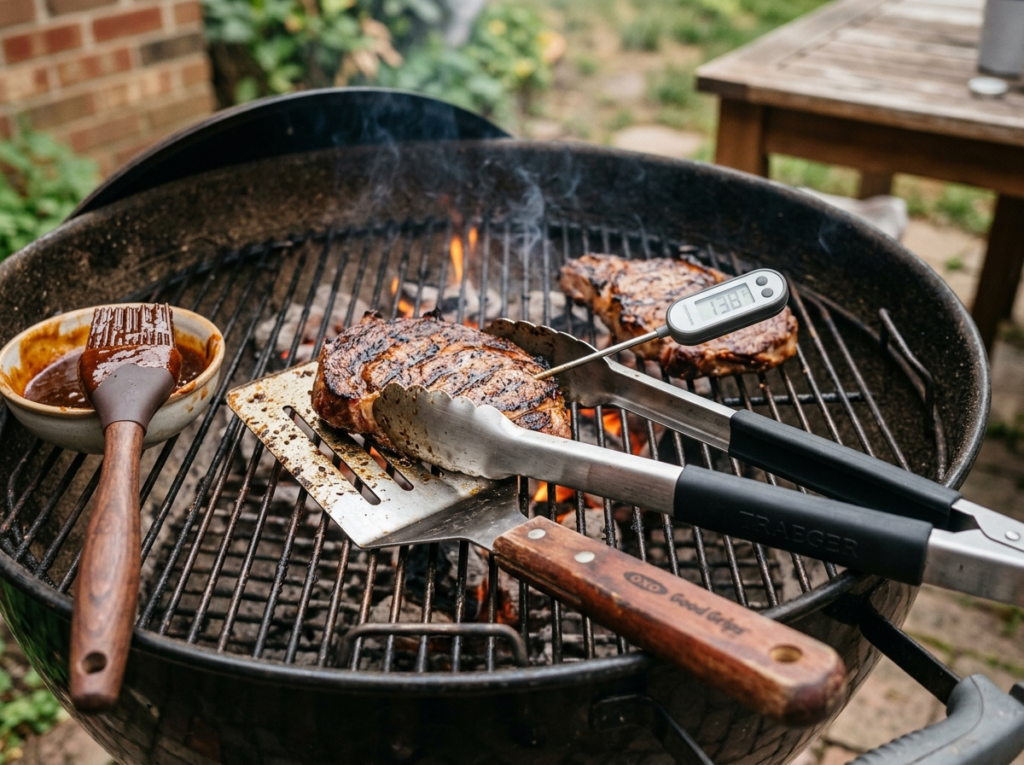
A $2,000 grill won’t save your steak if you’re flipping it with a bent fork from your kitchen drawer. Sounds funny, but you’d be surprised how many people invest heavily in their grill and then grab whatever’s lying around to cook on it. The right grill tools don’t just make cooking easier — they keep you safe, give you better control over your food, and honestly, they make the whole experience a lot more fun.
But here’s the problem. Walk into any store or scroll through Amazon, and you’ll find grill tool sets with 20, 30, even 40 pieces. Most of those pieces? You’ll never touch them. That corn holder you used once in 2019? Still sitting in the drawer. So instead of throwing money at a bloated set, let’s talk about the best grill tools that actually earn their spot next to your grill — the ones you’ll reach for every single cook.
Why Your Grill Tools Matter More Than You Think
Think of it this way. A chef in a restaurant doesn’t cook with dull knives and flimsy pans. The tools are an extension of their skill. Grilling works the same way. Your tongs, your spatula, the thermometer you use — these things directly affect how your food turns out.
Cheap tongs that don’t grip properly? You’ll drop that chicken thigh straight into the flames. A spatula that’s too short? You’re burning your knuckles every time you flip a burger. A thermometer that reads 10 degrees off? You’re either serving dry meat or something that’s dangerously undercooked.
Good grill tools give you precision and confidence. You flip when you want to flip. You grab what you want to grab. You know the exact internal temperature of your brisket without guessing. And you do all of this without worrying about melting handles or wobbly construction.
The difference between a frustrating cook and a smooth one often comes down to what’s in your hand, not what’s on your grate.
The Essential Grill Tools Every Griller Needs
Let’s break this down into what you truly need versus what’s nice to have. If you’re building your grilling toolkit from scratch — or replacing worn-out gear — start here.
Long-Handled Tongs
If you could only have one grill tool for the rest of your life, make it a solid pair of long-handled tongs. They’re your primary point of contact with the food. You’ll use them to flip steaks, move vegetables, rearrange charcoal, and pull things off the grate.
Look for tongs that are at least 16 inches long. Anything shorter and you’re reaching too close to the heat. The locking mechanism matters too — spring-loaded tongs that lock closed are much easier to store and won’t pop open in a drawer. Stainless steel is the go-to material because it handles high heat, cleans up easily, and doesn’t rust if you take basic care of it.
One thing people overlook is the grip. Scalloped tips grip food much better than flat tips. You want enough grip to hold a slippery chicken breast but not so aggressive that you’re tearing into the meat and losing juices.
Pro Tip: Keep two pairs of tongs — one for raw meat and one for cooked food. It’s a simple food safety habit that prevents cross-contamination, and it saves you from washing the same pair mid-cook.
A Sturdy Spatula (Turner)
Your tongs handle most jobs, but some foods need a spatula. Burgers, fish fillets, delicate vegetables — anything that could fall apart if you try to grab it with tongs.
A good grill spatula has a thin, beveled edge that slides under food without tearing it off the grate. The handle should be long enough to keep your hand away from the heat, and the head should be wide enough to support a full burger patty. Some spatulas come with a built-in bottle opener on the handle, which is a fun bonus but definitely not a deciding factor.
If you do a lot of griddle cooking on something like a Blackstone — and if you’re curious about the griddle vs. grill debate — you’ll want a spatula with a slightly different profile. Griddle spatulas tend to be shorter with a stiffer blade because you’re working on a flat surface at close range.
For grate grilling, though, go with a longer handle and a slightly flexible blade. Flexibility helps you get under the food without forcing it.
An Accurate Instant-Read Thermometer
This isn’t optional. If you’re guessing whether your meat is done, you’re either overcooking it or risking food safety issues. An instant-read thermometer takes the guesswork out entirely.
The best ones give you a reading in 2-3 seconds with accuracy within 1°F. You stick it in, get your number, and pull it out. Done. No waiting, no wondering, no cutting into the meat to “check” and losing all those juices.
Digital instant-read thermometers have come a long way. Models from brands like ThermoWorks, ThermoPro, and ChefsTemp offer fast, reliable readings without breaking the bank. You can find a solid one for $15–$25, and the premium models from ThermoWorks run around $100 but are practically indestructible.
We’ve actually done a full breakdown of the best instant-read thermometers if you want to compare specific models. It covers everything from budget picks to professional-grade options.
Did You Know? The USDA recommends cooking poultry to an internal temperature of 165°F, ground beef to 160°F, and steaks to at least 145°F with a 3-minute rest. Without a thermometer, hitting these targets consistently is nearly impossible.
A Reliable Grill Brush
Your grate needs to be clean before you cook. Dirty grates cause food to stick, create off-flavors from old residue, and can even be a fire hazard if grease builds up over time.
Here’s where things get a little tricky, though. Traditional wire-bristle grill brushes have been the standard for decades, but there’s a real safety concern. Loose bristles can break off, stick to the grate, and end up in your food. Every year, emergency rooms see cases of people swallowing wire bristles — and that’s not something you want to deal with.
Bristle-free alternatives have become popular for good reason. Nylon brushes work great for lower-temperature cleaning. Coil-style brushes use tightly wound stainless steel coils instead of individual bristles, making them much safer. And some people have ditched brushes entirely in favor of balled-up aluminum foil held with tongs, or wooden grill scrapers that form grooves matching your grate over time.
We put together a detailed guide on the best grill brushes that covers both traditional and bristle-free options if safety is a concern for you.
Heat-Resistant Grill Gloves
Your hands are pretty important. Protecting them should be a priority, especially if you’re working with charcoal, moving hot grates, or handling large cuts of meat like pork butts and whole chickens.
Regular oven mitts aren’t great for grilling. They’re bulky, they limit your dexterity, and most of them aren’t rated for the kind of heat a grill or smoker produces. Dedicated grill gloves, on the other hand, are designed for temperatures between 500°F and 900°F depending on the material.
Aramid fiber gloves (the same material used in firefighter gear) offer excellent heat protection and enough flexibility to actually grab things. Silicone-coated gloves give you a better grip on greasy or wet surfaces. Some gloves combine both — an aramid inner liner with a silicone outer layer — which gives you the best of both worlds.
If you’re looking for specific recommendations, our rundown of the best grill gloves breaks down the top options by material, heat rating, and use case.
Warning: No glove is truly “fireproof.” Even the best ones have limits. Don’t grab directly onto burning coals or hold onto extremely hot surfaces for extended periods. They buy you time and protection, but they’re not invincibility gauntlets.
Grill Tools That Level Up Your Game
Once you’ve got the essentials covered, a few upgrades can seriously improve your results. These aren’t mandatory, but once you start using them, you’ll wonder how you ever cooked without them.
Wireless Meat Thermometer
An instant-read thermometer tells you the temperature at one moment. A wireless meat thermometer monitors the temperature continuously while you go about your day.
This is a big deal for low-and-slow cooks. If you’re smoking a pork butt for 12 hours or running a brisket through a long cook — say, trying to nail that perfect brisket internal temp of 210°F — you don’t want to stand next to the smoker the entire time. A wireless thermometer sends real-time temperature data to your phone, so you can watch the game, mow the lawn, or take a nap and still know exactly what’s happening with your meat.
Brands like MEATER, ThermoWorks Signals, and FireBoard have become favorites among serious grillers. Most modern models connect via Bluetooth or Wi-Fi and have apps that let you set alerts for target temperatures.
We’ve reviewed the best wireless meat thermometers in detail, so check that out if you’re ready to make the jump.
Grill Basket
Ever tried grilling diced vegetables or shrimp directly on the grate? Half of it ends up in the fire. A grill basket solves that problem completely. It’s a perforated metal container — almost like a tray with holes — that lets heat and smoke reach the food while keeping small pieces from falling through.
Grill baskets are perfect for mixed vegetables, small seafood like scallops and shrimp, diced potatoes, and even stir-fry style dishes. Some have handles that fold flat for storage. Others are shaped like deep bowls for tossing food around.
The key feature to look for is hole size. Too big and small pieces will fall through. Too small and you won’t get good airflow or char marks. Most quality baskets find a nice middle ground.
Basting Brush (Silicone)
If you’re mopping sauce, spreading butter, or applying marinades, you need a basting brush that can handle the heat. Old-school natural bristle brushes work fine at lower temperatures, but they can melt or shed bristles over direct flame.
Silicone basting brushes handle temperatures up to about 450-500°F, they don’t absorb flavors or odors the way natural bristles do, and they’re dishwasher safe. The bristles are wider and more spaced out than traditional brushes, which means they pick up and distribute sauce more evenly.
Chimney Starter (For Charcoal Grillers)
If you’re using a charcoal grill or kamado and still squirting lighter fluid on your coals, stop. Lighter fluid leaves a chemical taste on food, especially during the first few minutes of cooking. A chimney starter lights your charcoal using nothing but newspaper or a fire starter cube and airflow.
Fill it up, light the bottom, wait about 15–20 minutes, and pour out perfectly lit, ashed-over coals. No chemicals, no off-flavors, no wrestling with a lighter for ten minutes.
If you’re cooking on a kamado-style grill, we’ve got a full guide on different ways to light a kamado grill that covers chimney starters, electric starters, and more.
What to Look for When Buying Grill Tools
Picking between brands and models can get overwhelming fast. Here’s what actually matters when you’re shopping.
Material Quality
Stainless steel is the gold standard for most grill tools. It resists rust, handles high heat, and cleans up easily. But not all stainless steel is equal. Thicker gauge steel feels more solid and lasts longer. If a spatula or pair of tongs feels flimsy in your hand at the store, it’s going to feel even worse when you’re wrestling with a rack of ribs.
Wood handles look great and stay cool to the touch, but they can crack or warp over time if they get wet repeatedly. Rubber or silicone-coated handles offer a good grip and some heat insulation. Plastic handles? Skip them entirely — they can melt at high temperatures and generally feel cheap.
Handle Length
This one’s simple but often ignored. Longer handles keep you farther from the heat. For grilling over direct flame, 16–18 inches is a comfortable length. For smokers where you’re reaching into a deep cooking chamber, you might even want something longer.
The trade-off is control. Very long handles can feel unwieldy for precise work. Most people find 16 inches to be the sweet spot — far enough from the heat, close enough to feel in control.
Build and Durability
Give any tool a good shake before you buy it. Does it rattle? Do the parts feel loose? A wobbly tong hinge or a spatula head that flexes too much is going to frustrate you. Solid rivets, tight joints, and a comfortable weight are signs of something built to last.
Also, check if the tools have a hanging loop or hook. You might not think about it now, but being able to hang your tools from a hook on the grill or a pegboard in the garage makes storage so much easier and keeps everything accessible.
Boxed Sets vs. Individual Tools — Which Is the Better Buy?
You’ve probably seen those big boxed grill tool sets at your local home improvement store, wrapped in a nice carrying case. They usually include 15–25 pieces and cost somewhere between $30 and $80. Tempting, right?
Here’s the thing. Those sets are designed to look impressive on a shelf. They include every possible accessory — corn holders, skewers, a “basting brush” with bristles that fall out after two uses, a fork you’ll never need because your tongs do the same job better. The quality of each individual piece is usually mediocre at best because the manufacturer is spreading the cost across so many items.
You’re almost always better off buying individual tools from trusted brands and building your kit over time. Spend $20 on a great pair of tongs, $15 on a solid spatula, $25 on a reliable thermometer, and you’ve already got a better setup than 90% of those boxed sets — for roughly the same price.
The one exception? If you’re buying a gift for someone who’s just getting into grilling and has literally nothing. A starter set gives them everything at once, even if the quality isn’t top-tier. It gets them cooking, and they can upgrade individual pieces as they figure out what they actually use.
Taking Care of Your Grill Tools
You spent the money. Now make them last.
Clean after every use. It sounds obvious, but grease and food residue left on tools can cause corrosion, even on stainless steel. Hot soapy water and a quick scrub is all it takes. Most stainless steel tools are dishwasher safe, but hand washing with a sponge tends to keep them looking better for longer.
Dry them thoroughly. Water sitting on metal causes rust spots. A quick towel dry after washing goes a long way.
Store them properly. Tossing everything into a drawer where tools bang against each other leads to scratched surfaces and bent edges. Hang them on hooks, store them in a tool roll, or keep them in a dedicated container. If you’ve got a grill with side hooks, use them — that’s exactly what they’re there for.
Oil wooden handles occasionally. If any of your tools have wooden handles, a light coat of mineral oil every few months keeps the wood from drying out and cracking.
What About a Propane Torch for Grilling?
This might sound unusual if you haven’t seen it before, but propane torches have found a real place in the grilling world. They’re fantastic for getting a quick sear on sous vide steaks, lighting charcoal without chemicals, caramelizing sugars on grilled desserts, and even starting your smoker.
You don’t need a massive industrial torch. Small culinary torches work fine for finishing work, but if you want something with more power for lighting charcoal or searing large surfaces, a handheld propane torch with a wider flame spread does the job much faster.
Curious about specific models? Our guide on the best propane torch for grilling compares options based on flame output, fuel efficiency, and ease of use.
Matching Your Tools to Your Cooking Style
Not everyone grills the same way, and your tool priorities should reflect how you actually cook.
If you’re a weekend burger-and-hot-dog griller, you don’t need a massive kit. Good tongs, a sturdy spatula, and an instant-read thermometer will cover 95% of your needs. Maybe add a grill brush and you’re set for the season.
If you’re into low-and-slow smoking, a wireless meat thermometer becomes essential rather than optional. You’ll also want heat-resistant gloves for handling heavy briskets and pork shoulders, and possibly a good set of carving knives for slicing. Speaking of smoking, if you’re still dialing in your technique for big cuts, our guides on the best temperature to smoke pork butt and best temperature to smoke brisket can help you lock in your process.
If you grill a lot of fish and vegetables, invest in a grill basket and a quality fish spatula. Regular spatulas work, but a fish spatula — with its thin, flexible, slotted blade — gets under delicate fillets without destroying them.
If you cook on a griddle regularly, your priority tools shift toward flat-top specific gear: shorter spatulas, squeeze bottles for oil, and a scraper for cleaning the surface.
Your tools should match your food. There’s no point owning a brisket knife if you’ve never smoked a brisket, and there’s no point skipping a grill basket if you grill vegetables every weekend.
FAQ
What are the most important grill tools for a beginner?
Start with three things: a good pair of long-handled tongs, a sturdy metal spatula, and a digital instant-read thermometer. These three tools handle the vast majority of grilling tasks. You can add more as you grow into the hobby, but these will carry you through your first season and beyond without any issues.
Are expensive grill tool sets worth the money?
Not usually. Most premium sets include tools you’ll rarely use, and you end up paying for quantity over quality. You’re better off buying a few high-quality individual tools — like restaurant-grade tongs and a reliable thermometer — than spending the same money on a 25-piece set where every piece is just okay.
How often should I replace my grill tools?
There’s no fixed timeline. Replace tools when they show signs of wear that affect performance — wobbly hinges on tongs, rust that won’t clean off, handles that are cracking or melting, or thermometers that give inconsistent readings. Well-maintained stainless steel tools can easily last 5–10 years or longer.
Are wire grill brushes safe to use?
They work well for cleaning, but loose bristles can detach and stick to the cooking grate. If ingested, those bristles can cause serious internal injuries. Many grillers have switched to bristle-free alternatives like coil brushes, wooden scrapers, or nylon brushes for peace of mind. If you do use a wire brush, inspect it before every use and replace it at the first sign of loose bristles.
Do I need different tools for charcoal and gas grilling?
Your core tools — tongs, spatula, thermometer — work the same regardless of fuel type. Charcoal grillers benefit from adding a chimney starter and possibly long-handled fire management tools for moving coals. Gas grillers generally need fewer accessories since temperature control is built into the burner knobs.
Your Next Move
Here’s the honest truth about grill tools: you don’t need a lot of them, but you do need the right ones. A few well-chosen, well-built tools will outperform a drawer full of cheap gadgets every single time. Start with quality tongs, a solid spatula, and a thermometer you trust. Build from there based on what you actually cook.
And take care of what you buy. Clean your tools, dry them, store them properly. Treat them like the investments they are, and they’ll pay you back with years of better, easier, more enjoyable cooks.
Now stop reading about grilling and go fire something up. Your grill’s been waiting.