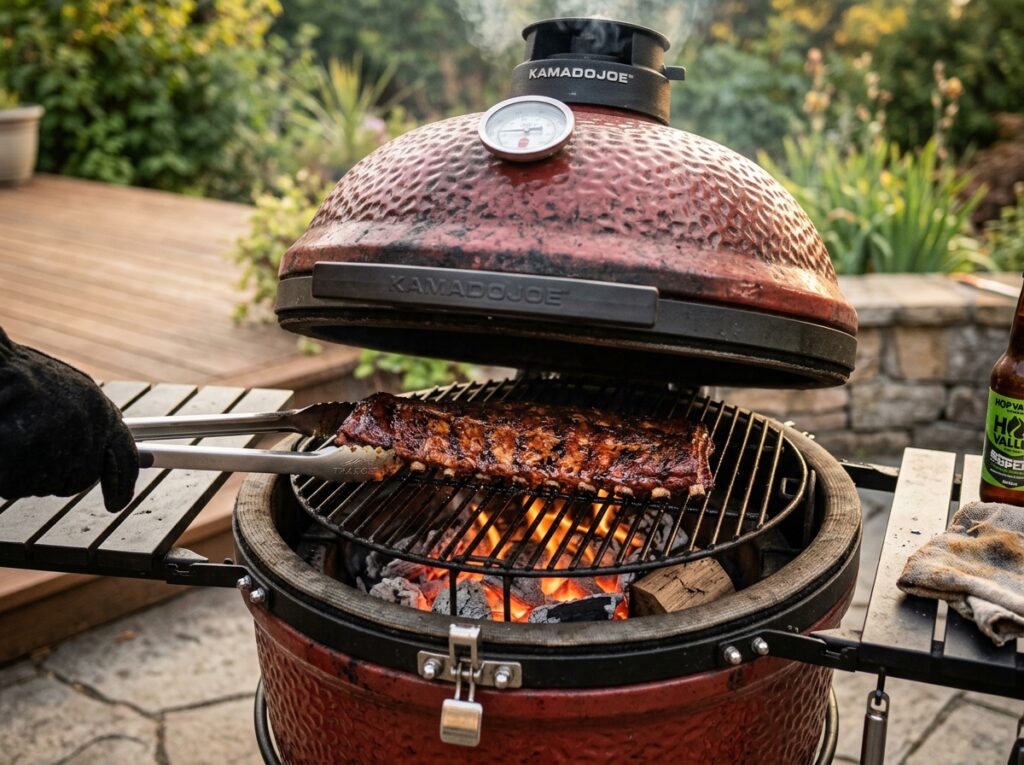
A single grill that can smoke brisket low and slow at 225°F, sear steaks at 700°F+, bake pizza, and hold temperature for 18 hours on one load of charcoal — that’s not a fantasy. That’s a kamado grill doing what it was designed to do. And once you cook on one, every other grill starts to feel like a compromise.
But here’s the problem. There are dozens of kamado grills on the market right now, and the price gap between the cheapest and most expensive is over $5,000. Some are ceramic, some are metal, some are hybrid. Some brands have decades of loyal followers, while others are newer names offering serious value. So which one should you actually spend your money on?
I’ve spent a lot of time breaking this down — comparing build quality, heat retention, versatility, accessories, and real-world cooking performance. Whether you’re on a tight budget or ready to invest in a lifetime cooker, this guide walks you through the best kamado grills you can buy right now and helps you figure out exactly which one fits your needs.
What Makes a Kamado Grill Different?
Before we get into specific models, it’s worth understanding why kamado grills have such a passionate following. A kamado is basically an egg-shaped, insulated cooker. The design traces back thousands of years to clay cooking vessels used in Japan and China. Modern versions use thick ceramic walls (or in some cases, double-walled steel or aluminum) that trap heat incredibly well.
That insulation is the secret weapon. It means a kamado uses far less fuel than a standard charcoal grill. It means temperature stays rock-steady for hours without babysitting. And it means you get a range of cooking temperatures that no other single grill can match.
You can set it up for low-and-slow smoking at 200°F. Push it up to 350°F for roasting. Crank it to 500°F+ for pizza. Or open it all the way for direct-heat searing above 700°F. If you already own a pellet grill or a gas grill, a kamado adds a dimension of charcoal flavor and heat control that those platforms simply can’t replicate.
There’s also something deeply satisfying about the simplicity. No electronics. No hoppers. No gas lines. Just charcoal, fire, and airflow. You control temperature using two vents — one at the bottom, one at the top. That’s it. Once you learn the vents, you control the fire.
How I Evaluated These Kamado Grills
Picking a “best” list isn’t just about reading spec sheets. Here’s what I focused on:
Build quality and insulation — How thick are the walls? How well does it hold temperature in cold weather? Does it feel like it’ll last 10 to 20 years?
Temperature range and stability — Can it genuinely maintain low temps for smoking AND hit extreme heat for searing? How long can it hold steady without adjustments?
Cooking space — How much usable grill surface do you get? Can you set up multi-level cooking?
Ease of use — How intuitive are the vents? How easy is cleanup? Can a beginner figure it out without a manual?
Accessories and expandability — Does the brand offer deflector plates, pizza stones, rotisserie attachments, multi-tier racks?
Value for money — A $2,000 grill needs to earn that price tag. So does a $500 one.
Best Kamado Grills — The Top Picks
Big Green Egg (Large)
You can’t talk about kamado grills without starting here. The Big Green Egg is the name that put kamado cooking on the map in the United States, and the Large model is their most popular size for good reason.
The Large gives you an 18.25-inch cooking diameter — enough room for a whole turkey, a full rack of ribs, or about 20 burgers at once. The ceramic shell is thick, dense, and holds heat like nothing else. I’ve seen Big Green Eggs hold 250°F for 14+ hours on a single load of lump charcoal with barely a vent adjustment. That kind of stability makes overnight brisket cooks almost effortless.
Temperature range? It can go as low as 200°F for gentle smoking and climb past 750°F for pizza or steaks. The calibrated draft door at the bottom and the dual-function metal top vent give you precise airflow control.
What sets it apart: The Big Green Egg has the largest accessory ecosystem of any kamado. Their “EGGspander” system lets you add multiple cooking levels, half-moon stones, cast iron grates, and more. The brand’s dealer network also means support and replacement parts are easy to find years down the road.
The downside: Price. A Large Big Green Egg runs around $1,200–$1,400 for just the grill — no stand, no shelves, no extras. Once you add a nest (stand), side shelves, a plate setter, and a cover, you’re often north of $2,000. You’re paying a premium for the brand name and the support network.
Best for: Experienced grillers who want the gold standard and don’t mind investing in the ecosystem.
Kamado Joe Classic III
If Big Green Egg is the original, Kamado Joe is the brand that pushed the entire category forward with smarter design. The Classic III is their flagship, and it addresses almost every complaint people have ever had about traditional kamado grills.
The standout feature is the SloRoller Hyperbolic Smoke Chamber — a patented insert that sits between the fire and the cooking grate. It distributes heat and smoke more evenly than a standard deflector plate, which means less temperature variation across the grill surface. In real-world tests, this thing reduces hot spots significantly.
You also get the Divide & Conquer flexible cooking system. It’s a tiered rack that splits into half-moon sections, so you can sear on one side and smoke on the other at different levels. It’s incredibly practical for multi-zone cooking.
The Classic III has an 18-inch cooking surface, spring-loaded hinge (so the heavy ceramic lid opens with one finger), a built-in ash tool, and a powder-coated galvanized steel cart with locking wheels. It comes ready to cook out of the box — no buying a separate stand.
What sets it apart: Innovation. The air lift hinge, the SloRoller, the Divide & Conquer system, the included ash tool — Kamado Joe clearly studied what frustrated kamado owners and solved those problems. The 3-tier system is genuinely useful and something competitors haven’t matched yet.
The downside: The Classic III sits around $2,000–$2,200. That’s a significant investment, though you’re getting a cart and more accessories included than a comparable Big Green Egg setup. Some users report that the SloRoller can be tricky to clean after very messy cooks.
Best for: Anyone who wants a premium kamado with modern design improvements and is willing to pay for the best out-of-box experience.
Char-Griller Akorn
Now let’s talk about the other end of the spectrum. The Char-Griller Akorn is a kamado-style grill that costs around $300–$400. Yes, really.
Here’s the catch — it’s not ceramic. The Akorn uses a triple-walled insulated steel construction. It doesn’t retain heat quite as well as thick ceramic, and it won’t last as many decades. But honestly? For the price, the performance is shocking.
The Akorn has a 20-inch diameter cooking surface (actually larger than a Large Big Green Egg), adjustable top and bottom vents, and it can hold low-and-slow smoking temps surprisingly well. Most users report it handles temperatures from about 200°F to 700°F without issue. It heats up faster than ceramic kamados, though it can also lose heat faster in cold or windy conditions.
If you pair it with a quality instant-read thermometer, you’ll cook outstanding food on this grill. Smoked pork shoulders, grilled chicken, burgers, even pizza — the Akorn handles it all.
What sets it apart: The price-to-performance ratio is genuinely hard to beat. For someone who’s curious about kamado cooking but doesn’t want to commit $1,500+, this is the answer.
The downside: The steel body is susceptible to rust over time, especially if the powder coating gets scratched. It doesn’t have the same rock-solid temperature holding that thick ceramic provides, particularly in cold weather. And the resale value is basically zero compared to ceramic kamados.
Pro Tip: If you buy an Akorn, keep it covered when not in use. A good grill cover adds years to its life. The steel construction is its biggest strength (lightweight, affordable) and its biggest weakness (durability).
Best for: Budget buyers, beginners, and anyone who wants to test kamado cooking without a major financial commitment.
Primo All-In-One Oval XL
Every other kamado on this list is round. The Primo Oval is — you guessed it — oval. That shape isn’t just for looks; it fundamentally changes how you cook.
The oval design gives you a clear two-zone setup. You can build your fire on one side and have an indirect zone on the other side without needing deflector plates or accessories. That makes it incredibly easy to smoke on one side and sear on the other simultaneously. Try doing that on a round kamado without extra hardware.
The Oval XL delivers a massive 400 square inches of primary cooking space. That’s more than a Large Big Green Egg and a Classic Kamado Joe. If you regularly cook for large groups — big family gatherings, tailgates, parties — this extra space is a genuine advantage.
Primo makes their grills in the USA using high-quality ceramic. The build feels solid, the glaze is durable, and the brand has been around since the mid-1990s. The “All-In-One” version comes with a built-in cart and side shelves, so you’re not piecing together a setup.
What sets it apart: The oval shape and the two-zone cooking capability make it the most versatile kamado for people who want to do multiple things at once. You can literally smoke ribs on one half and grill corn on the other.
The downside: The oval shape means it’s wider, so it takes up more patio space. It’s also heavier than most round kamados. Price sits around $1,800–$2,200 for the All-In-One package, which is competitive with Kamado Joe but without the same level of included accessories.
Best for: Cooks who frequently feed crowds and want maximum versatility in a single cooker. Also great if you love the idea of two-zone cooking without the hassle of extra inserts.
Louisiana Grills K24 Ceramic Kamado
Here’s a name you might not expect on a kamado list. Louisiana Grills — the same company known for their pellet grills — makes a ceramic kamado that punches well above its weight class.
The K24 has a 24-inch cooking diameter. That’s huge. You get 680 square inches of total cooking area across primary and secondary grates. The ceramic body is thick and well-glazed, and it comes with a solid cart, side shelves, a deflector plate, a cooking grate, and a cover — all included.
Temperature control is good. Not Kamado Joe good, but more than adequate for smoking, roasting, grilling, and baking. The top vent is a cast aluminum daisy wheel design that works well for fine-tuning airflow.
The kicker? The K24 typically sells for $800–$1,000. For a ceramic kamado of this size with a full cart setup, that’s a standout deal.
What sets it apart: Size and value. You get a legitimate 24-inch ceramic kamado with accessories and a cart for roughly half the price of a Kamado Joe Classic III. If cooking surface is a priority and budget matters, this is a smart choice.
The downside: The fit and finish aren’t quite as refined as Big Green Egg or Kamado Joe. Some users note the gasket material could be better (consider upgrading to a Nomex felt gasket down the road). The brand’s kamado-specific accessory ecosystem is also smaller.
Best for: Value-conscious buyers who want a real ceramic kamado with serious cooking space and don’t need the prestige of a bigger brand name.
Vision Grills Classic B-Series
Vision Grills tends to fly under the radar, but they make a solid ceramic kamado at a mid-range price. The Classic B-Series usually falls around $700–$900 and gives you a well-built, no-frills kamado with an 18-inch cooking grate.
What’s interesting about Vision is their proprietary dual-vent system. The adjustable bottom vent has a slider mechanism that’s easy to dial in, and the top vent uses a cast iron cap with precision adjustment. Temperature control is steady and reliable.
The ceramic is good quality, the stainless steel cooking grate is a nice touch over standard porcelain-coated grates, and the overall build quality earns its price. It’s a “quiet performer” — it doesn’t have the marketing hype of a Big Green Egg or the innovation story of a Kamado Joe, but it cooks beautifully.
Best for: Mid-budget buyers who want ceramic quality without the $1,500+ price tag of the big two brands.
Key Features to Look For
If you’re comparing kamado grills beyond this list, here are the things that actually matter.
Wall thickness and material — Thicker ceramic walls mean better heat retention and fuel efficiency. Double-walled steel works too, but it won’t match ceramic’s long-term temperature stability.
Hinge quality — A heavy ceramic lid needs a good hinge. Spring-assisted or counterbalanced hinges make a real difference. You should be able to open the lid smoothly without straining. A few brands still sell kamados with basic hinges, and your arms will notice.
Gasket material — The gasket seals the lid to the base. High-quality felt gaskets (like Nomex) last longer and provide a better seal than cheaper adhesive-backed fiberglass. A poor gasket means air leaks, which means temperature control problems.
Air vents — Precision matters. You want vents that let you make small adjustments. A cast aluminum or cast iron daisy wheel top vent is standard on good kamados. Avoid grills where the vents feel flimsy or imprecise.
Included accessories — Some brands give you a deflector plate, cooking grates, a cart, and a cover right out of the box. Others sell you the grill alone and charge extra for everything else. Factor this into the total cost.
Ceramic vs. Metal Kamado Grills — Which Is Better?
This debate comes up constantly, so let’s clear it up.
Ceramic kamados excel at heat retention. They hold temperature for hours, use less fuel, and handle weather extremes better over long cooks. They’re also incredibly durable — there are Big Green Eggs from the 1990s still cooking today. The trade-off? They’re heavy (a Large Big Green Egg weighs about 140 lbs) and they can crack if you drop them or expose them to sudden temperature shocks.
Metal kamados (like the Char-Griller Akorn or some Broil King models) are lighter, more portable, and cheaper. They heat up fast and cool down fast. But they don’t hold heat as long, they use more fuel on extended cooks, and they’re prone to rust over time.
If you’re planning on keeping your kamado on a patio for 10+ years and doing regular low-and-slow smoking, go ceramic. If you need something lighter, more affordable, or want to take it tailgating, metal works fine.
Sizing Your Kamado Grill Right
One of the biggest regrets kamado buyers have? Going too small.
Here’s a rough sizing guide:
An 18-inch kamado (the most common “large” size) fits about 4–6 steaks, one full rack of ribs (with a rib rack), or a 20-lb turkey. It’s perfect for families of 2–4 or couples who occasionally entertain.
A 24-inch kamado handles significantly more food. You can smoke two full pork shoulders, multiple racks of ribs, or cook for a party of 15+ without feeling cramped. If you regularly host gatherings or like to batch-cook, the extra space is worth it.
Smaller kamados (13-inch to 15-inch) exist, and they’re great as portable options or secondary grills. But as a primary cooker, most people find them limiting.
Did you know? Multi-level cooking racks effectively double your usable space. Before you size up to a bigger (and pricier) kamado, check if your preferred model offers tiered grate systems. The Kamado Joe Divide & Conquer system, for example, can turn an 18-inch grill into a surprisingly spacious cooking setup.
Getting the Most Out of Your Kamado
Owning a kamado and getting the best results from it are two different things. A few things that’ll make your experience better from day one.
Use lump charcoal, not briquettes. Lump charcoal burns cleaner, produces less ash, and lights more easily. Briquettes contain binders and fillers that create more ash, and excess ash can block your bottom vent and choke airflow. Stick with quality lump hardwood charcoal.
Learn the vents before you cook anything important. Spend your first cook just playing with temperatures. Light the charcoal, close the lid, and practice dialing in 250°F, then 350°F, then 450°F. Understand how small vent adjustments change the temperature. It’s a skill, and it takes a few sessions to get comfortable.
Don’t lift the lid constantly. Every time you open a kamado, you lose heat and disrupt airflow. The temperature can spike when you close it again because oxygen floods in. Open with purpose, do what you need to do, and close it.
Know how to light it properly. This sounds basic, but the way you light a kamado affects your entire cook. A chimney starter works, but many kamado users prefer fire starters or an electric starter placed directly in the charcoal. If you need a walkthrough, there’s a detailed guide on how to light a kamado grill that covers different methods.
Invest in a good thermometer. The dome thermometer that comes with most kamados reads the temperature at the top of the dome — not at the cooking grate. That reading can be 25–50°F off from what your food actually experiences. A reliable wireless meat thermometer takes the guesswork out of long cooks.
Kamado Grill vs. Other Grill Types — Quick Comparison
People often ask how a kamado stacks up against other popular grill types. Here’s the honest breakdown.
Kamado vs. pellet grill — Pellet grills are easier to use (set it and forget it), but kamados produce better sear and char. Kamados use charcoal, which gives food a deeper smoky flavor. Pellet grills need electricity and have more moving parts that can fail. If convenience is your top priority, check out the best pellet smokers. If flavor and versatility matter more, a kamado wins.
Kamado vs. offset smoker — Offset smokers are the traditional choice for BBQ purists. They produce incredible smoke flavor, but they demand attention. You’re feeding logs, managing a fire, and babysitting temperature for hours. A kamado gives you a similar quality of smoke with far less effort. If you’re comparing seriously, look at our best offset smoker guide too.
Kamado vs. gas grill — Gas grills heat up fast and offer convenience, but they can’t smoke, and they don’t produce charcoal flavor. A kamado is slower to set up, but it does everything a gas grill does plus a whole lot more.
Kamado vs. kettle grill — Kettle grills (like the Weber Kettle) are affordable and surprisingly capable. They can smoke and grill. But they lack the insulation and temperature stability of a kamado. For the comparison, a kamado is essentially a kettle grill’s more capable, more expensive sibling.
FAQ
How long does a kamado grill last?
A high-quality ceramic kamado can last 20 years or more with proper care. Brands like Big Green Egg and Kamado Joe have units still in daily use after 15+ years. Metal kamados typically have a shorter lifespan — usually 5–10 years depending on how well you protect them from moisture. The main things that can shorten a kamado’s life are cracks from physical drops, gasket deterioration (replaceable), and neglecting to clean ash buildup.
Can you use a kamado grill in the rain or cold weather?
Yes — and this is one of their strengths. The thick insulated walls mean a ceramic kamado can maintain stable temperatures even in sub-freezing weather. Rain doesn’t affect performance since the fire is fully enclosed. You’ll use a bit more charcoal in very cold conditions, but the grill will still hold temperature well. Just make sure you have a good cover for when it’s not in use.
Is a kamado grill good for beginners?
Absolutely. There’s a small learning curve with vent control, but once you understand the basics (bottom vent controls fire intensity, top vent fine-tunes it), a kamado is actually one of the most forgiving grills to cook on. The insulated design makes temperature swings less dramatic than a standard charcoal grill. Your first few cooks should be simple — burgers, chicken thighs, a pork shoulder — to build confidence with the airflow system.
What’s the best fuel for a kamado grill?
Natural lump hardwood charcoal is the recommended fuel. It burns hotter, cleaner, and produces less ash than briquettes. Avoid lighter fluid — it leaves a chemical taste. Use natural fire starters or an electric starter instead. Some brands like FOGO, Jealous Devil, and Royal Oak make lump charcoal that kamado owners consistently recommend.
Can you bake bread or pizza in a kamado grill?
You can, and the results are outstanding. With a deflector plate and a pizza stone, a kamado becomes a wood-fired oven reaching 600°F+. Pizza cooks in 2–3 minutes at those temperatures and develops a beautifully charred, blistered crust you can’t get from a kitchen oven. Bread, focaccia, and even desserts work well too. If dedicated pizza baking interests you, you might also want to explore the best pizza ovens to see how they compare.
So, Which Kamado Grill Should You Buy?
Here’s how I’d break it down.
If money isn’t a major factor and you want the most innovative, ready-to-cook package, the Kamado Joe Classic III is the one to beat. The SloRoller, the multi-level cooking system, and the spring-loaded hinge make it the most thoughtfully designed kamado on the market right now.
If brand heritage, resale value, and the biggest accessory ecosystem matter to you, the Big Green Egg Large is still the gold standard. You’ll pay more for the full setup, but it’s a cooker that holds its value and has decades of community knowledge behind it.
If you need maximum cooking space and love two-zone grilling, the Primo Oval XL gives you something no round kamado can.
If you want a real ceramic kamado without spending $1,500+, the Louisiana Grills K24 offers remarkable value with its 24-inch cooking surface and included accessories.
And if you just want to try kamado cooking without a big investment, grab the Char-Griller Akorn. It won’t last forever, but it’ll teach you everything you need to know about charcoal cooking in an insulated cooker — and the food will taste fantastic while it lasts.
Whichever kamado you pick, pair it with solid grill tools and quality lump charcoal, and you’re set for years of incredible cooking. The best time to start? Right now.