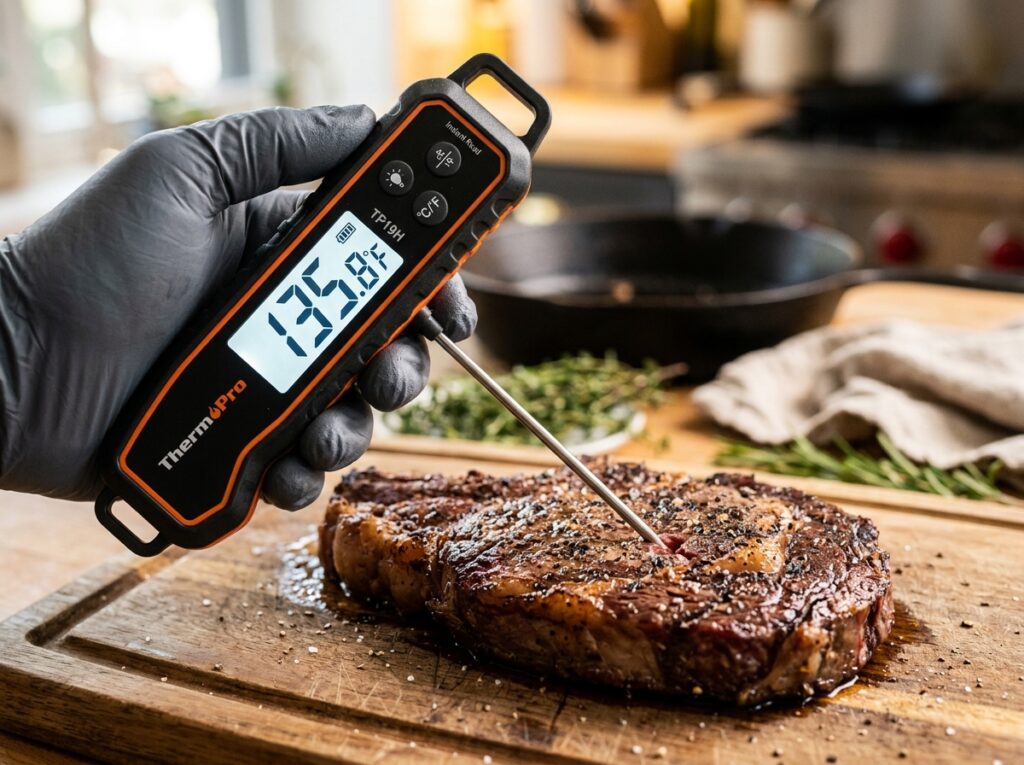
A two-degree difference between a perfectly juicy chicken breast and a dry, overcooked disaster — that’s it. Just two degrees. And yet, most people still cut into their meat, let all the juices run out, and “eyeball it.” An instant read thermometer takes the guesswork out of cooking, and the right one pays for itself the very first time you nail a perfect steak or avoid serving undercooked poultry to your family.
But here’s the problem. There are hundreds of options out there, ranging from $10 gas station specials to $100+ pro-grade tools. Some read temperatures in under a second; others make you stand there for 15 awkward seconds wondering if your reading is even accurate. So which one actually deserves your money?
I’ve spent weeks comparing features, reading user feedback, and testing thermometers across different cooking scenarios — grilling thick steaks, checking brisket in the smoker, frying chicken, and even making bread. This guide breaks down the best instant read thermometers you can buy right now, explains what actually matters (and what doesn’t), and helps you pick the perfect one for your cooking style and budget.
Why Every Cook Needs an Instant Read Thermometer
Let’s be honest for a second. Even experienced grillers and home cooks misjudge doneness. Your steak might look beautifully seared on the outside but still be raw in the center. Your Thanksgiving turkey could feel firm to the touch but sit at 145°F instead of the safe 165°F.
An instant read thermometer eliminates all of that uncertainty. You insert the probe, get a reading within a few seconds, and know exactly where your food stands. No poking, no cutting, no guessing.
And it’s not just about safety. It’s about quality. If you’re smoking a pork butt low and slow for 10 hours, you want to pull it at exactly 203°F for that melt-in-your-mouth texture. Go to 180°F and it’s tough. Push past 210°F and it starts to dry out. That precision matters, and your eyes can’t give it to you.
If you’ve ever followed a recipe for smoked brisket or pork butt, you know that hitting the right internal temperature is the single most important variable. A great thermometer is the tool that makes that possible.
Pro Tip: An instant read thermometer isn’t just for meat. Use it to check oil temperature for frying, water temperature for bread dough, or even the internal temp of casseroles and baked goods.
What Makes a Great Instant Read Thermometer?
Not all thermometers are created equal, and the differences between a good one and a mediocre one are more noticeable than you’d think. Here’s what actually separates the best from the rest.
Speed
The name says “instant read,” but the speed varies wildly. Top-tier thermometers like the ThermoWorks Thermapen give you an accurate reading in about one second. Budget options might take 5–10 seconds, which doesn’t sound like much until you’re holding your hand over a 500°F grill waiting for the number to stabilize.
Anything under 3 seconds is excellent. Under 5 seconds is perfectly acceptable. If a thermometer takes longer than that, you’re going to get frustrated — and you might pull the probe out before it gives you a true reading.
Accuracy
Most decent thermometers are accurate within ±1°F to ±2°F, and for home cooking, that’s more than precise enough. Where cheap thermometers fail isn’t in their initial accuracy — it’s in their consistency. A $15 thermometer might read correctly 8 out of 10 times, but that 9th and 10th reading could be off by 5 or 6 degrees. When you’re checking chicken thighs for 165°F, a reading of 159°F that’s actually 165°F means you’ll overcook them. And a reading of 165°F that’s actually 159°F is a food safety problem.
The best thermometers stay consistent across thousands of readings and across a wide temperature range.
Probe Design
This is something most people don’t think about, but it matters more than you’d expect. A thinner probe tip creates a smaller hole in the meat, which means less juice loss. It also lets you get accurate readings from thinner cuts like chicken breasts, pork chops, or fish fillets without the probe poking through to the other side.
The probe length matters too. For deep pot cooking, candy making, or checking the center of a large brisket, you want at least 4–5 inches of probe.
Build Quality and Waterproofing
Your thermometer is going to live around heat, grease, steam, and the occasional splash of marinade. Cheap plastic housings crack. Buttons that aren’t sealed stop working after a few months. The best instant read thermometers carry an IP rating (IP65 or IP67) meaning they can handle splashes or even brief submersion. This also means you can rinse them under running water to clean them — which is a huge plus from a food safety standpoint.
Backlit Display
Sounds like a luxury feature, right? It’s not. If you’ve ever tried to read a thermometer screen while standing next to a smoker at 6 AM or grilling on your patio after sunset, you know a backlit display isn’t optional — it’s essential. The best models auto-rotate the display too, so you can read the temperature no matter how you’re holding the probe.
The Best Instant Read Thermometers for 2025
After comparing features, real-world performance, price, and long-term durability, here are the thermometers that earned a spot on this list.
ThermoWorks Thermapen ONE
If you ask any professional chef, pitmaster, or serious home cook what thermometer they use, the answer is almost always some version of the Thermapen. The Thermapen ONE is the latest model, and it’s the gold standard for a reason.
It reads in about one second. It’s accurate to ±0.5°F. The display auto-rotates and auto-dims. It’s waterproof (IP67). The probe tip is thin and precise. The battery lasts about 2,000 hours. And it feels genuinely solid in your hand — like a tool built to last years, not months.
The downside? It costs around $105. That’s a lot for a thermometer. But if you grill regularly, smoke meats, or just care about cooking your food properly, the Thermapen ONE is a one-time purchase that outlasts everything else. Think of it this way — if it helps you avoid ruining even one expensive brisket, it’s already paid for itself.
Best for: Serious home cooks, pitmasters, anyone who wants the absolute best performance.
ThermoWorks Thermapen TWO
Released in late 2024, the Thermapen TWO builds on everything the ONE did right and adds a few upgrades. The display is slightly larger and easier to read. The startup time is a bit faster. And there’s a motion-sensing sleep and wake feature that saves battery life without you ever pressing a button.
Performance-wise, it matches the ONE — same ±0.5°F accuracy, same sub-second readings, same IP67 waterproofing. The price sits around $110–$115, so you’re paying a small premium for the incremental improvements.
Is it worth upgrading from the ONE? Probably not. But if you’re buying fresh, the TWO is the one to get.
Best for: Anyone who wants the newest version of the best thermometer on the market.
ThermoWorks ThermoPop 2
Here’s where ThermoWorks wins on the budget side too. The ThermoPop 2 costs around $35 and delivers accuracy within ±2°F with readings in 3–4 seconds. It has an auto-rotating backlit display, a decent probe, and a water-resistant (not fully waterproof) housing.
It doesn’t feel as premium as the Thermapen, and the response time is noticeably slower. But for a home cook who grills a few times a month and wants reliable readings without spending $100+, the ThermoPop 2 is an excellent choice. It’s been a longtime favorite recommendation among BBQ communities, and the second version fixed the only real complaints people had about the original — the screen and the speed.
Best for: Budget-conscious cooks who still want solid accuracy and usability.
MEATER 2 Plus
The MEATER 2 Plus takes a completely different approach. It’s a wireless, truly probe-based thermometer that connects to your phone via Bluetooth and can also work with Wi-Fi through its charging block. You insert the probe into your meat, set your target temperature in the app, and walk away. It’ll ping you when your food is done.
This works especially well for longer cooks — smoking ribs, slow-roasting a pork shoulder, or even oven-roasting a whole chicken. You don’t have to keep opening the lid or oven door, which helps maintain consistent temperature.
The accuracy is within ±1.8°F, and the probe can handle internal temperatures up to 212°F and ambient temperatures up to 527°F. The app also estimates cook time and guides you through rest periods, which is incredibly helpful if you’re timing a whole meal.
The catch? It’s not technically an “instant read” in the traditional sense. You insert it and leave it. If you need quick spot-checks on multiple items, a Thermapen-style thermometer is faster and more practical. But for set-it-and-forget-it monitoring, the MEATER 2 Plus is hard to beat.
If you’re already using a wireless meat thermometer for longer smokes, the MEATER 2 Plus can double as both your leave-in monitor and your quick-check tool — just know it’s better at the former.
Best for: Smokers, low-and-slow enthusiasts, and people who want phone-based temperature monitoring.
ChefsTemp Finaltouch X10
The Finaltouch X10 hit the market as a direct competitor to the Thermapen, and it does a solid job. It reads in 2–3 seconds, is accurate to ±1°F, and features a large, bright, auto-rotating display. It’s waterproof, has a magnet on the back for sticking to your fridge or smoker, and costs about $50–$60.
For roughly half the price of a Thermapen ONE, you get about 80–85% of the performance. The probe is slightly thicker, the response time is a touch slower, and the build quality doesn’t feel quite as bulletproof. But these are small differences that most home cooks won’t notice in everyday use.
Best for: People who want near-Thermapen performance at a lower price point.
Lavatools Javelin Pro Duo
Another strong mid-range option, the Javelin Pro Duo reads in about 2–3 seconds with ±1°F accuracy. It has a stabilization alert that beeps when the temperature reading has settled, which is a nice touch. The display is large, backlit, and auto-rotating. And it comes in at around $50.
Where it stands out is its dual-display design that shows both current and target temperatures. You can set it so a color indicator tells you whether your meat is rare, medium, or well done. It’s a smart feature for grillers who are cooking multiple steaks to different levels of doneness.
The build quality is good, though not on ThermoWorks’ level. The probe fold mechanism feels slightly looser over time compared to the Thermapen’s satisfying snap. Still, for the money, it’s one of the best values on the market.
Best for: Grillers who cook for groups and need to manage multiple doneness levels.
Instant Read vs. Leave-In Thermometers: What’s the Difference?
This is a question that comes up constantly, and the answer is simple: they serve different purposes, and ideally, you want both.
An instant read thermometer is a handheld tool. You open the lid, stick the probe into your meat, get a reading in a few seconds, pull it out, and close the lid. It gives you a snapshot of the internal temperature at that moment. It’s perfect for spot-checking steaks, burgers, chicken, and quick cooks.
A leave-in thermometer stays inserted in the meat throughout the entire cook. It connects to a base unit or your phone and continuously monitors the temperature without you having to open the grill or oven. This is what you want for long smokes — think a 12-hour brisket or a 6-hour pork butt where every time you open the lid, you lose heat and add cook time.
Here’s a real-world example. When you’re following a 3-2-1 ribs method, a leave-in thermometer helps you track the progress over those six hours without constant lid-lifting. But when you’re checking the doneness of individual steaks on a hot gas grill, an instant read thermometer is the right tool.
Many experienced cooks keep a leave-in thermometer running during the cook and then verify with an instant read thermometer before pulling the meat off. It’s a belt-and-suspenders approach, and it works.
How to Use an Instant Read Thermometer Correctly
Owning a great thermometer doesn’t help much if you’re using it wrong. And honestly, a lot of people do — even experienced cooks make some of these mistakes.
Find the Thermal Center
The thermal center is the coldest part of the meat, and that’s where you want your reading. For a steak or a chicken breast, that’s the thickest part, roughly in the middle. For a whole chicken or turkey, it’s the innermost part of the thigh, away from bone.
Bone conducts heat differently than muscle, so if your probe is touching bone, your reading will be inaccurate — usually higher than the actual meat temperature. Always aim for the center of the thickest muscle.
Don’t Poke Through
If you push the probe all the way through a thin piece of meat, you’re reading the air temperature on the other side or the grill grate temperature — not the food’s internal temp. Insert the probe to about the center of the thickest part and let it stabilize.
Take Multiple Readings
One reading isn’t always enough. Meat doesn’t cook uniformly, especially on a grill where you might have hot spots. Check 2–3 spots to get a complete picture. If one part of your chicken breast is at 160°F and another is at 170°F, you know the cooking isn’t even — and you can adjust.
Let the Reading Stabilize
This is where patience matters. Even with a fast thermometer, don’t just glance at the first number that pops up. Wait for the reading to hold steady for a full second or two. That stabilized number is your accurate temperature.
Did you know? The USDA recommends using a food thermometer as the only reliable way to determine if food has reached a safe internal temperature. Visual cues like color and firmness aren’t reliable indicators of doneness — especially with ground meat, which can turn brown before it’s safe or stay pink even when fully cooked.
What Temperature Should You Actually Be Hitting?
Having a thermometer is step one. Knowing your target temperatures is step two. Here’s a practical reference for the most common foods you’ll be checking.
Poultry (chicken, turkey, duck): 165°F — this is non-negotiable for food safety. Dark meat tastes better at 175–180°F because the connective tissue needs that extra heat to break down, but 165°F is the minimum safe temp across the board.
Ground meat (beef, pork, lamb): 160°F — because grinding meat exposes more surface area to bacteria, the safe temp is higher than whole cuts.
Beef steaks and roasts: 130°F for medium-rare, 140°F for medium, 150°F for medium-well. Keep in mind that your steak will continue to rise 3–5°F after you pull it off the grill (this is called carryover cooking), so pull it a few degrees early.
Pork chops and tenderloin: 145°F with a 3-minute rest. The USDA updated this guideline back in 2011, dropping it from the old 160°F recommendation. A lot of people still overcook pork because of the outdated number.
Fish: 145°F for most species, though many chefs prefer pulling salmon around 125–130°F for a more tender, silky texture.
This knowledge becomes especially important when you’re working on something like smoked pork butt, where the difference between 195°F and 205°F internal temperature can mean the difference between a pork butt that pulls apart effortlessly and one that’s still a bit stubborn.
How to Care for Your Instant Read Thermometer
A well-maintained thermometer lasts for years. A neglected one starts giving you unreliable readings within months. Here’s how to keep yours performing.
Clean after every use. Wipe the probe with a damp cloth or a food-safe sanitizing wipe. If your model is waterproof, you can rinse it under running water — just don’t submerge non-waterproof models. This is a food safety basic, especially when you’re moving between raw and cooked proteins.
Calibrate regularly. Most quality thermometers come calibrated from the factory, but over time, they can drift. The easiest calibration test is the ice water method: fill a glass with crushed ice, add cold water, stir, and insert the probe. It should read 32°F (0°C). If it’s off by more than 2°F, check your model’s manual for recalibration instructions — many have a reset button or screw.
Store properly. Don’t toss your thermometer loose in a drawer with metal utensils. The probe tip can get damaged, and a bent or dulled tip affects both accuracy and how easily you can insert it into food. Use the protective sleeve or case that came with it.
Replace the battery before it dies. A low battery can cause slow or inaccurate readings before the screen actually shows a low-battery warning. If your thermometer seems sluggish, swap the battery first before assuming something is wrong with the unit.
Instant Read Thermometer for Grilling: Special Considerations
If grilling is your primary use case, there are a few extra things worth thinking about.
Grilling happens over intense direct heat, often at grate temperatures exceeding 500°F. Your thermometer needs to handle that ambient heat without being damaged. Most quality models are rated for ambient temperatures well above what your grill puts out, but very cheap thermometers with plastic probes or housings can warp or give erratic readings near high heat.
Speed matters more on a grill than almost anywhere else. Every second you have the grill lid open, heat escapes — and with a charcoal kettle grill or kamado grill, recovering that lost heat takes time. A 1-second thermometer lets you check and close the lid in under 5 seconds. A 10-second thermometer means you’re standing there with the lid open, losing heat, extending your cook time, and potentially drying out the food.
If you’re wearing grill gloves, make sure your thermometer is easy to operate with thicker hands. Some models have tiny buttons that are nearly impossible to press while wearing heat-resistant gloves. The Thermapen’s folding probe design is great here — opening the probe turns the unit on, and you don’t have to fumble with buttons.
Also worth mentioning: a thermometer is just one piece of a solid grilling setup. Pairing it with quality grill tools and a good grill brush gives you everything you need for consistently great results.
How Much Should You Spend?
Let’s talk money, because there’s a wide range here and you might be wondering if the expensive options are worth it.
Under $20: You’ll find basic digital thermometers that technically work. They read temperatures, but slowly (8–15 seconds), and accuracy can vary from unit to unit. For very occasional use — maybe checking a turkey twice a year — they’ll do. But you’ll likely replace them within a year or two due to failing electronics or probe issues. If you’re exploring this range, check out our budget instant read thermometer recommendations.
$25–$50: This is the sweet spot for most home cooks. Thermometers in this range — like the ThermoPop 2 — offer good accuracy (±1–2°F), reasonable speed (3–5 seconds), backlit displays, and water resistance. They’re reliable enough for weekly grilling and daily cooking.
$50–$75: The mid-range delivers noticeable improvements in speed, build quality, and features. Models like the ChefsTemp Finaltouch X10 and Lavatools Javelin Pro Duo live here, and they provide near-professional performance.
$100+: This is Thermapen territory. You’re paying for sub-second speed, ±0.5°F accuracy, full waterproofing, exceptional build quality, and a tool that’ll last 5–10+ years with daily use. If cooking is a serious part of your life — whether it’s smoking every weekend, running a food truck, or just wanting the best — the investment is genuinely worth it.
FAQ
What’s the most accurate instant read thermometer?
The ThermoWorks Thermapen ONE and Thermapen TWO are both accurate to ±0.5°F, which is the tightest accuracy you’ll find in a consumer-grade instant read thermometer. For reference, most kitchen thermometers are accurate to ±1–2°F, which is still perfectly fine for home cooking. The Thermapen’s edge shows up most when you need precision across extreme temperature ranges — like checking candy at 300°F or verifying sous vide water at 130°F.
Can I leave an instant read thermometer in the oven or grill?
No, and this is a common mistake. Instant read thermometers are designed for quick spot-checks. You insert the probe, get your reading, and remove it. The electronics in the handle aren’t built to withstand prolonged exposure to oven or grill temperatures. If you need continuous monitoring, you want a leave-in probe thermometer — many wireless models can handle ambient temperatures up to 500°F+ and transmit data to your phone or a base unit outside the grill.
How often should I calibrate my instant read thermometer?
A quick calibration check every couple of months is a good practice, especially if you use your thermometer frequently. The ice water test (should read 32°F) and boiling water test (should read 212°F at sea level, adjusted for altitude) take about 30 seconds each and give you peace of mind that your readings are trustworthy. If your thermometer consistently reads off by more than 3°F and can’t be recalibrated, it’s time for a replacement.
Is an instant read thermometer safe for all types of cooking?
Yes — instant read thermometers work for grilling, smoking, baking, frying, roasting, sous vide, and candy making. The key is matching the thermometer’s temperature range to your application. Most quality models handle -58°F to 572°F, which covers every cooking method you’d use at home. Just make sure you’re using food-grade probes and cleaning them properly between uses, especially when switching between raw and cooked foods.
Do more expensive thermometers really make a difference?
Honestly, yes — but with diminishing returns. The jump from a $10 thermometer to a $35 one is massive in terms of speed, accuracy, and reliability. The jump from $35 to $100 is noticeable but less dramatic. You’re paying for faster response, tighter accuracy, better waterproofing, and a probe that stays consistent over years of hard use. If you grill or cook regularly, spending more upfront saves you from buying replacements and — more importantly — from ruining expensive cuts of meat.
Your Next Step
Picking the right instant read thermometer comes down to how you cook and how much precision matters to you. If you grill every weekend and smoke briskets on the regular, the Thermapen TWO is worth every penny. If you’re a casual cook looking for a reliable everyday tool, the ThermoPop 2 or Javelin Pro Duo will serve you well for years.
The real point is this — once you start using a good instant read thermometer, you’ll wonder how you ever cooked without one. No more cutting into steaks to check. No more dry chicken. No more “I think it’s done.” Just confidence, every single time you cook.
Grab one, learn your target temperatures, and start cooking with certainty. Your food — and the people you feed — will notice the difference.