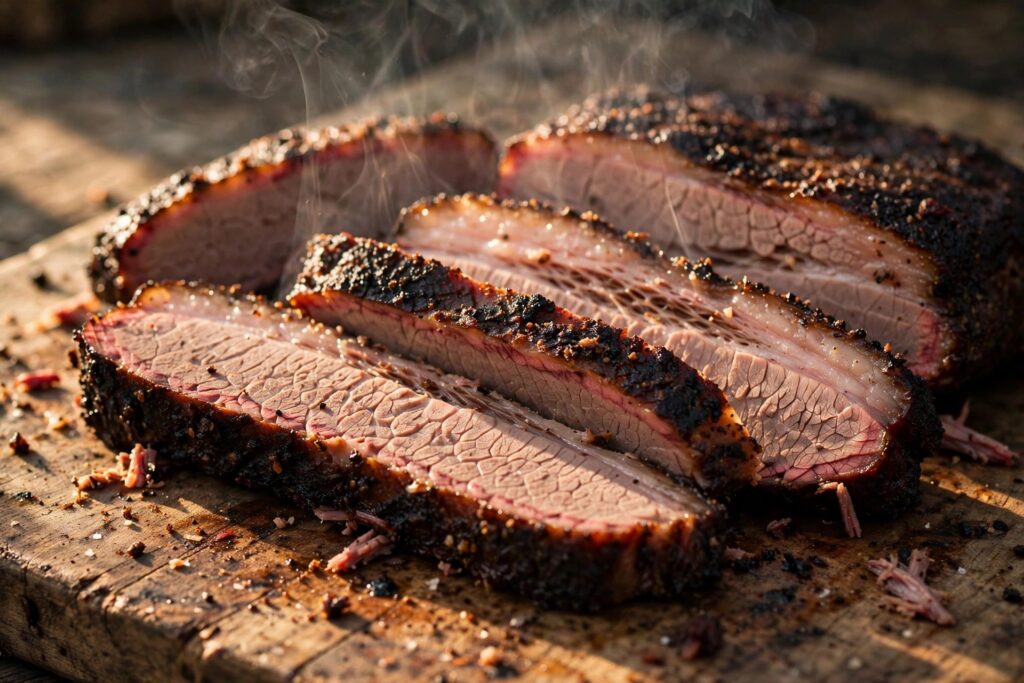
To slice brisket against the grain, rest the brisket 2 to 4 hours, separate the point from the flat, find the direction the muscle fibers run in each piece, and cut straight across those lines — the flat in 1/4 to 1/2-inch slices, the point in 1/2 to 3/4-inch slices. That’s the whole secret. Everything below is how to nail it.
You just spent 12 to 14 hours trimming, seasoning, and tending a fire. The brisket probed like butter at 203°F. And now the last ten minutes — the slicing — get to decide whether all that work eats tender or chews like a rubber band. Learning how to slice brisket properly isn’t optional. It’s the final step of the cook.
What “Against the Grain” Actually Means
Brisket is built from long bundles of muscle fibers. Picture a box of uncooked spaghetti lined up side by side — that’s the grain. If your knife runs parallel to those fibers, each slice keeps the fibers long, and your teeth have to do the work of tearing them apart. Chewy, stringy, disappointing.
Cut perpendicular to the fibers and you shorten every one of them into little segments. Your teeth barely have to work. The same brisket, the same cook, two completely different eating experiences — decided by a 90-degree turn of the knife.
Finding the grain is easier than it sounds. Look closely at a cut face of the meat and you’ll see fine parallel lines running through it. Run your fingertip across the surface: one direction feels smooth, the other catches. The catching direction is across the grain. That’s where your blade goes.
Flat vs. Point: Two Muscles, Two Grain Directions
Here’s the part that trips up most first-timers. A whole packer brisket isn’t one muscle — it’s two overlapping muscles, and the grain runs in different directions in each one. Slice the entire brisket in a single direction and you’ll get one half right and the other half wrong.
The flat is the lean, rectangular muscle. Its grain typically runs lengthwise, in one clean, predictable direction. The point is the thick, fatty, lumpy muscle stacked on top of one end of the flat. Its grain usually runs at a steep angle to the flat’s — often close to 90 degrees off.
| Flat | Point | |
|---|---|---|
| Location | Thin, lean, rectangular half | Thick, fatty, lumpy half stacked on one end |
| Grain direction | Usually runs lengthwise, consistent | Usually runs at a steep angle to the flat’s |
| Slice thickness | 1/4 to 1/2 inch | 1/2 to 3/4 inch |
| Why | Leaner meat eats better thinner | Extra fat keeps thicker slices tender and juicy |
Because of that grain change, you slice the two muscles separately. The simplest approach: make one cut near the middle where the flat meets the point, slice the flat first, then rotate the point so you’re cutting across its grain and slice it second.
Here’s a pitmaster trick most guides skip. Before you ever season the raw brisket, trim a small corner off the flat — cutting across the grain. After hours of smoking, the bark hides every trace of the grain direction. That little clipped corner becomes your permanent marker, showing you exactly which way to cut. One snip now saves you guessing later.
https://woodpeckersbbq.com/wp-content/uploads/2026/09/brisket-point-flat-grain.jpg
Before You Slice: Rest and Tools
Don’t touch the knife until the brisket has rested. Pulling it off the smoker at 200–205°F and slicing right away sends juices flooding across the board instead of staying in the meat. Wrap the brisket, hold it in a dry cooler with towels or a low oven, and give it at least 2 hours — 3 to 4 is better when your schedule allows. You want the internal temp to drift down to around 150°F before the first cut.
While it rests, get your tools in order:
- A long slicing knife. A 12-inch (or longer) brisket slicer is ideal. A scalloped or lightly serrated edge glides through bark without tearing it. A short chef’s knife forces short sawing strokes that shred the meat.
- A big cutting board. A full packer can be 18 inches long. Give it room, or half of it will hang off the edge.
- Heat-resistant gloves. The brisket may still be warm, and gloves keep your grip steady on a slippery hunk of meat.
- A serving platter. Have it ready so slices spend minimal time exposed to air.
- A sharp edge. This matters more than the knife’s brand. A dull blade crushes and tears; a sharp one slides.
How to Slice Brisket Step by Step
Set the rested brisket on the board. Most right-handed slicers put the flat to the left and the point to the right, but the orientation matters less than keeping the meat stable. Work with long, smooth strokes and let the blade do the cutting — don’t press down and squeeze juices out.
- Find the seam. Run your hand over the brisket and feel where the thick point muscle bulges up from the thinner flat. There’s a layer of fat between them. That’s your dividing line.
- Make the first cut. Slice down through that seam, separating the point from the flat. You don’t need to follow the fat seam perfectly — a clean cross-cut near the middle works fine.
- Slice the flat. Start at the cut face and slice across the grain in 1/4-inch slices — about the width of a No. 2 pencil. Keep them as uniform as you can so every guest gets the same bite.
- Check your work. Pick up a slice and hold it over your finger. It should bend without snapping, and pull apart with gentle resistance. If it stretches and fights you, recheck the grain — you may be cutting with it.
- Rotate the point. Turn the point 45 to 90 degrees so you’re cutting across its grain, not the flat’s. The grain will look like it’s running a different direction — that’s the point. Trust it.
- Slice the point thicker. Cut 1/2 to 3/4-inch slices. The point’s marbling keeps thick slices rich and tender instead of heavy. Serve and eat immediately.
https://woodpeckersbbq.com/wp-content/uploads/2026/09/slicing-brisket-knife.jpg
One more thing about the point: don’t saw the whole thing off the flat before you start slicing. Some people remove the point entirely, then slice the flat end to end — but that exposes a big patch of flat with no bark on it, and the bark is where the smoke, salt, and pepper all live. Everybody at the table deserves bark on their slice. Hey Grill Hey’s slicing guide makes the same case, and it’s worth taking to heart. Separate the muscles just enough to change cutting direction, nothing more.
How Thick Should Brisket Slices Be?
Thickness isn’t a style choice — it’s a texture tool. The lean flat dries out and turns chewy if it’s cut thick, so 1/4 to 1/2 inch is the sweet spot. The fatty point can handle 1/2 to 3/4 inch because the intramuscular fat keeps each bite juicy.
Let the brisket talk to you as you slice. If a slice falls apart before you can lift it, the next one goes a little thicker. If a slice feels tough in your mouth, verify the grain direction and go thinner. An overcooked brisket wants thicker slices to hold together; an undercooked one wants thinner slices to chew easier.
Consistency matters as much as the number. Uniform slices look better on the platter, reheat more evenly, and give everyone the same balance of bark, smoke, and tenderness.
Common Slicing Mistakes (and How to Fix Them)
- Slicing before the rest is done. The number-one moisture killer. Juices haven’t settled, so they run out onto the board. Wait the full 2 hours minimum.
- Cutting both muscles in one direction. The grain changes between point and flat. Rotate the point before you slice it — every time.
- A dull or short knife. Tearing instead of slicing wrecks the bark and mangles the slices. Sharpen the blade and use long strokes.
- Pressing down hard. Your guide hand steadies the meat; it doesn’t squeeze it. Heavy pressure pushes juices straight out.
- Slicing the whole brisket at once. Cut surfaces dry out fast. Slice what you’ll serve now, keep the rest whole and covered, and slice more to order.
- Cutting every slice the same thickness. Flat thin, point thick. Treat the two muscles like the two different cuts they are. For a second opinion on the whole process, Lane’s BBQ slicing walkthrough covers the same steps with catering-scale experience behind them.
Slice, Serve, and Store
Arrange the slices in their original order on the platter, flat on one side and point on the other. It looks sharp, and it lets guests choose — lean or fatty, the way real BBQ joints ask “which do you want?” Keep the platter covered if people aren’t eating immediately; sliced brisket starts drying the moment it meets air.
For leftovers, refrigerate sliced brisket promptly in an airtight container with any saved juices or a splash of beef broth. Reheat it gently, covered, with a little liquid so the slices steam back to life instead of turning to shoe leather. And if you’ve got a big chunk of point left unsliced, consider cubing it into burnt ends — the best second act in BBQ.
https://woodpeckersbbq.com/wp-content/uploads/2026/09/brisket-slices-platter.jpg
Wondering how the two muscles differ beyond slicing? Our brisket point vs. flat guide breaks down fat content, cook behavior, and which end to order at a BBQ joint. And if you’re still working on the cook itself, the best temperature to smoke brisket and how long to rest brisket cover the steps that come before the knife ever touches the board.
FAQs About Slicing Brisket
How long should brisket rest before slicing?
At least 2 hours, wrapped, held in a cooler or low oven. Three to 4 hours gives even better results. Slice when the internal temp has settled to around 150°F — hot enough to serve, cool enough to hold its juices.
Which direction is against the grain on a brisket?
There’s no single answer — the flat’s grain usually runs lengthwise and the point’s runs at an angle to it. Look for the fine parallel lines in the meat on each piece and cut perpendicular to them. When in doubt, cut a test slice and check how it chews.
How thick should brisket slices be?
Cut the lean flat 1/4 to 1/2 inch thick and the fatty point 1/2 to 3/4 inch thick. Adjust from there: thicker if slices are falling apart, thinner if they chew tough.
Can I slice brisket ahead of time?
You can, but the brisket will be juicier if you don’t. Slice only what you’ll serve, keep the remainder whole and wrapped, and slice more as needed.
Why is my brisket chewy even though I cooked it perfectly?
Almost always the grain. Slicing with the grain leaves long muscle fibers that fight your teeth. Recheck the grain direction on each piece. If the grain is right and it’s still tough, the brisket may have been undercooked and never fully rendered — go thinner and serve with sauce.
Your next step is simple: rest it, find the grain, and trust the knife. A sharp blade, a patient rest, and cuts across the fiber will do more for your brisket than any gadget in the BBQ aisle. For the full picture on the cook that comes first, see sliced vs. chopped brisket to decide how you want to serve the whole packer.
[…] cooler. Once it’s rested and reading ~150°F, the payoff step is the cut itself: here’s how to slice brisket against the grain, and if you’re feeding a crowd, our guide to keeping BBQ warm for a party picks up where the […]
[…] in the flat runs one way; the grain in the point runs another, nearly perpendicular. Slice both against the grain or all that careful cooking goes to waste — long muscle fibers chew like rope no matter how […]
[…] mustard or oil layer fixes the slipperiest surface in barbecue. If you’re working through the right way to slice brisket later, you’ll want that bark intact to show for […]