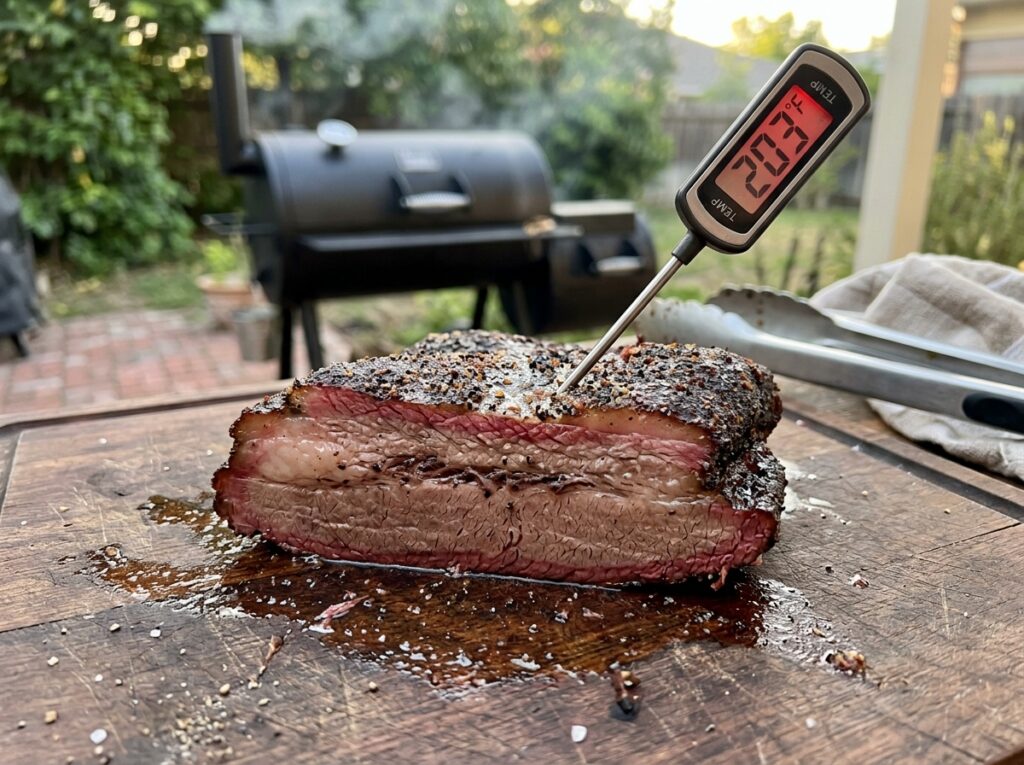
For most backyard cooks, the best temperature to smoke brisket is 250°F.
That number works so well because it balances three things you care about: tenderness, bark, and time. At 250°F, the fat renders well, the collagen has time to soften, and the cook usually finishes sooner than it would at 225°F. You still get that low-and-slow barbecue feel, just without dragging the cook out longer than it needs to.
Can you smoke brisket at 225°F? Yes. Can you smoke it at 275°F? Also yes. But if you want one setting that works on most smokers and gives you a strong shot at juicy slices, 250°F is the safest recommendation.
Quick fact: A brisket cooked at a steady 250°F often turns out better than one cooked at a shaky 225°F. Steady heat beats a “perfect” number with constant swings.
A lot of cooks think lower always means better. That sounds nice, but brisket doesn’t care about barbecue folklore. It cares about consistent heat and enough time for the tough muscle to break down.
If you’re smoking a full packer brisket, 250°F is usually the easiest place to start. If you’re cooking only the flat, which is leaner, you may want to stay between 225°F and 250°F and watch it closely.
Is brisket better at 225, 250, or 275?
You’ll see all three numbers online, and each one can work. The better question is this: what kind of cook do you want today?
225°F: classic low and slow
Smoking brisket at 225°F is the old-school choice. It gives you a long, gentle cook and plenty of time for smoke to build flavor.
That sounds great, and sometimes it is. A full day by the smoker, a steady fire, and a big packer brisket can turn into something special at 225°F.
Still, there’s a trade-off. The cook takes longer, the stall can feel endless, and the flat has more time to lose moisture if the brisket is trimmed too aggressively or the pit runs dry. If your smoker struggles in cold or windy weather, 225°F can stretch into a very long day.
So who is 225°F good for? Cooks with time, patience, and a stable pit. Kamado users often like it because those cookers hold heat so well.
250°F: the sweet spot for most home cooks
This is the zone where brisket feels manageable.
At 250°F, you’re still cooking low and slow, but you’re helping the brisket move through the stall a bit faster. The fat usually renders better, the bark still develops nicely, and the whole cook is easier to plan.
That matters more than people admit. Brisket isn’t stressful because it’s hard to season. It’s stressful because timing can get weird. Starting at 250°F gives you a little breathing room.
If you use a pellet smoker, 250°F is often even more helpful. Many pellet grills hold this temp very well, and the extra heat can help with bark formation. If you’re still comparing equipment, our guide to the best pellet smokers is worth a look.
275°F: faster, but still legit
A lot of people act like 275°F is too hot for brisket. It isn’t.
Plenty of great pitmasters cook brisket hotter than internet comment sections would like to admit. Aaron Franklin, for example, has talked openly about brisket cooks in the 250°F to 275°F range. The idea that brisket must stay locked at 225°F all day just isn’t true.
At 275°F, your brisket will finish faster. That can be a huge help if you’re cooking for lunch, trying to beat bad weather, or just don’t want an overnight session.
The risk? You need to pay closer attention. Bark can darken faster, the outside can tighten up sooner, and a lean flat has less margin for error. Wrapping at the right moment and giving the brisket a proper rest matters even more here.
Does smoker type change the answer?
A little, yes.
On a pellet smoker, 250°F is often the best place to start because temperature control is easy and the cooker tends to run clean. On an offset smoker, 250°F to 275°F can work beautifully if you keep a clean fire and don’t smother the wood. If you want stronger wood-fire flavor and don’t mind tending the pit, these best offset smokers are a good place to compare options.
Kamado cookers are steady and efficient, so 225°F to 250°F feels natural on them. Drum smokers usually do well in that same range.
The big idea stays the same: steady heat matters more than choosing the one “perfect” number.
Why temperature changes the final result
Brisket is not a forgiving cut like chicken thighs. It comes from the chest of the cow, which means the muscle worked hard. Hard-working muscle means more collagen, more connective tissue, and more time needed to get tender.
Brisket needs time to soften
If brisket were just about reaching a safe internal temperature, you could pull it much earlier. Food safety and barbecue tenderness are not the same thing.
USDA guidance for whole-muscle beef is much lower than barbecue finishing temps. Brisket keeps cooking well past that because you’re not just making it safe to eat. You’re trying to make it tender enough to slice cleanly without chewing forever.
That tenderness comes from heat plus time. The collagen slowly breaks down and turns silky. The fat softens and renders. Push too fast without control, and the flat can dry out before the inside feels right. Go too low for too long, and the cook can drag while the meat loses moisture.
The stall is normal
Most briskets hit a point where the internal temperature rises, then seems to stop. That often happens somewhere around 150°F to 170°F.
People panic here. They think the smoker stopped working or the thermometer broke.
It’s usually just the stall.
Did you know? The stall happens because moisture evaporates from the meat and cools the surface, kind of like sweat cooling your skin on a hot day.
That’s one reason the best temperature to smoke brisket isn’t just about “low.” A slightly higher pit temp, like 250°F, can help your brisket move through the stall with less drama.
Bark likes steady heat
Good bark is that dark, flavorful crust on the outside of the brisket. You want it deep and firm, not burnt and bitter, and not soft like pot roast.
Steady heat helps the surface dry, smoke stick, and seasoning set. Wild temperature swings make all of that harder. So does opening the lid every 20 minutes.
Your brisket doesn’t need constant checking. It needs a steady environment. Think of it like baking bread. If you keep opening the oven, you don’t help it. You just slow things down.
Clean smoke matters too. Thin blue smoke is your friend. Thick white smoke can make the bark taste harsh, no matter what temp you picked.
How to smoke brisket at the right temperature
Knowing the best temperature to smoke brisket helps, but your result still depends on how you manage the cook.
Start with the right cut
A packer brisket is the whole brisket, with both the point and flat attached. That’s usually the most forgiving cut for smoking because the point has more fat and helps protect the flat during a long cook.
If you’re deciding between cuts, read our guide on brisket flat vs packer. It clears up why full packers are usually easier for beginners.
The two muscles also behave differently in the smoker. The point can handle more heat and usually stays juicy longer. The flat is leaner and more likely to dry out if you overshoot. Our breakdown of brisket point vs flat explains that in more detail.
Preheat fully and trust the grate temp
Don’t throw your brisket onto a pit that’s still settling in. Let the smoker preheat and stabilize.
One thing many cooks miss: the lid thermometer doesn’t always tell the full story. On some smokers, the dome gauge can read 15°F to 30°F different from the temperature near the grate where the brisket actually sits.
That’s why a good probe setup helps so much. A reliable wireless meat thermometer lets you track both meat temp and pit temp without lifting the lid all day.
Put the probe in the thickest part of the flat
If you only remember one probe tip, remember this one.
Place your meat probe in the thickest part of the flat, not the point and not the fat seam between the two muscles. The flat is the leaner part, and it’s the first place to get dry. That makes it the best place to judge doneness.
If the flat is tender, the rest is usually in good shape.
Wrap when the bark is ready
Most briskets get wrapped somewhere in the stall, often around 165°F to 175°F internal. But don’t treat that number like a rule carved in stone.
Wrap when the bark looks set. You want a dark mahogany color, not wet-looking rub that still smears when you touch it.
Butcher paper is a popular choice because it protects the meat while letting the bark breathe a bit. Foil speeds things up more, but it softens bark faster too.
If your brisket looks pale at 165°F, wait. If it looks great at 170°F, wrap it. The bark decides more than the thermometer here.
Build extra time into your cook
This is where a lot of brisket days go sideways.
People ask, “How many hours per pound?” It’s not a useless question, but it’s not dependable either. Thickness, grade, trimming, weather, and your smoker all matter.
As a rough backyard example, a 12- to 14-pound packer brisket at 250°F might take around 10 to 14 hours to cook, then another 2 to 4 hours to rest or hot-hold. Some finish sooner. Some take longer.
That’s why smart brisket cooks finish early on purpose. You can hold a done brisket. You can’t force an underdone brisket to be ready for dinner in ten minutes.
Pro tip: Plan the meal around the rest, not around the exact finish time.
Rest longer than you think
A rushed brisket often eats worse than a slightly overcooked one that got a great rest.
Once the brisket is done, let it vent briefly if needed, then hold it wrapped in a warm cooler or low oven. A holding temp around 150°F to 170°F works well if your oven can truly stay there.
A rest of at least 1 hour helps. A 2- to 4-hour hold is often even better. The juices settle, the bark relaxes just enough, and the slices come out cleaner.
Just keep food safety in mind. Don’t let cooked brisket sit in the 40°F to 140°F danger zone for extended periods.
What internal temp should brisket reach?
This is the other big question right after smoker temp.
Most briskets finish around 195°F to 205°F
That’s the normal window. A lot of briskets finish somewhere near 198°F to 203°F, especially in the flat.
Still, that’s only a guide. One brisket may feel perfect at 197°F. Another may still feel tight at 203°F.
That’s why people get confused. They hit the “right” number and the brisket still doesn’t slice the way they hoped.
Probe tender beats a magic number
Your brisket is done when the probe slides into the flat with very little resistance. Think soft butter, not rubber.
A number can point you in the right direction. Tenderness makes the final call.
If your brisket hits 203°F and still feels tight in the flat, give it more time. If it feels tender at 198°F, don’t keep cooking just because someone online said brisket must hit 205°F.
That single habit can save a lot of cooks: use temperature as a map, not as the finish line.
Can brisket go to 210°F?
Sometimes parts of a brisket creep higher than 205°F, especially if the point is fatty or the pit has hot spots. That doesn’t mean disaster every time.
Still, don’t aim for 210°F on purpose.
If your flat is pushing past 205°F, check tenderness carefully. A lean flat that stays on too long can turn crumbly and dry. If you’re already in that situation, our article on brisket internal temp 210 can help you figure out whether you actually overcooked it or just need a better rest.
The best temperature to smoke brisket still needs a good finish
Here’s the part many articles miss: a perfect pit temp can’t rescue a brisket that gets pulled too early or sliced too soon.
You can smoke all day at 250°F, nail the bark, wrap at the right time, and still serve tough brisket if the flat never got tender. You can also take a brisket a touch hotter than planned and still get great slices if you rest it well.
That’s why pit temp and internal temp need to work together.
Common temperature mistakes that ruin brisket
You don’t need fancy tricks to mess up brisket. A few small habits do most of the damage.
Chasing every tiny swing
Your smoker moves from 247°F to 258°F and you panic. Don’t.
A brisket doesn’t care about every 5-degree wiggle. It cares about the overall environment. Constantly opening vents, lifting the lid, or adjusting controls can make the cook less stable, not more.
Aim for a steady range, not a perfect frozen number.
Treating 225°F like a law
One common misconception is that “real” brisket must be smoked at 225°F. That’s just not true.
Great brisket gets cooked at 225°F, 250°F, and 275°F every single day. If 250°F gives you a better schedule, stronger bark, and less stress, use it.
Wrapping too early
Wrap too soon, and you trap steam before the bark has set. The outside can turn soft and muddy.
Wait until the bark looks right. That may be 165°F. It may be 175°F. Color and texture matter.
Cooking by time alone
Time per pound is a rough estimate, not a promise.
A thick 12-pound brisket and a flatter 12-pound brisket won’t always cook the same. Weather matters. Marbling matters. Your smoker matters.
If dinner depends on a brisket being ready at an exact minute, start earlier.
Skipping the hold
A brisket straight off the smoker can look good and still slice badly. The juices haven’t settled yet, and the meat may still feel tight.
Resting is not a bonus step. It’s part of the cook.
Warning: If you slice brisket right away because guests are hungry, you may lose more moisture on the board than you saved in time.
4. FAQ Section
Frequently Asked Questions
Is 225 or 250 better for brisket?
For most home cooks, 250°F is better. It shortens the cook, helps the brisket move through the stall, and still gives you strong bark. 225°F can work well too, but it usually takes longer and leaves less room for timing mistakes.
Can you smoke brisket at 275 degrees?
Yes, you can. 275°F is a solid brisket temperature if your fire is clean and you watch the bark closely. It’s especially useful when you need a faster cook. Lean flats need more attention at this temp because they can dry out sooner than a full packer.
What temp should I wrap brisket?
Most people wrap brisket somewhere around 165°F to 175°F internal, but the better rule is to wrap when the bark looks set. If the rub still looks wet or wipes off easily, wait a bit longer.
What internal temperature is brisket done?
Most briskets finish between 195°F and 205°F. Still, the real test is tenderness. The thickest part of the flat should feel soft when you slide in a probe. If it still feels tight, keep cooking even if the number looks “done.”
How long should brisket rest after smoking?
Rest brisket for at least 1 hour, and if you can, hold it for 2 to 4 hours wrapped in a warm cooler or low oven. A longer rest often gives you juicier slices and a more even texture.
Does the best temperature to smoke brisket change on a pellet grill?
Not much. On a pellet grill, 250°F is still the best starting point for most cooks. Pellet smokers usually hold that temperature well, which makes brisket easier to manage. If you want a stronger bark or a more predictable finish time, 250°F often beats 225°F.
5. Conclusion
If you want one simple answer, go with 250°F. That’s the best temperature to smoke brisket for most backyard cooks because it gives you the best mix of bark, tenderness, and sane cook timing.
From there, keep your pit steady, watch the bark before you wrap, cook until the flat feels tender, and give the brisket a real rest. If you do that, you’re already ahead of a lot of brisket cooks. Next time you fire up the smoker, set it at 250°F and let patience do the hard work.