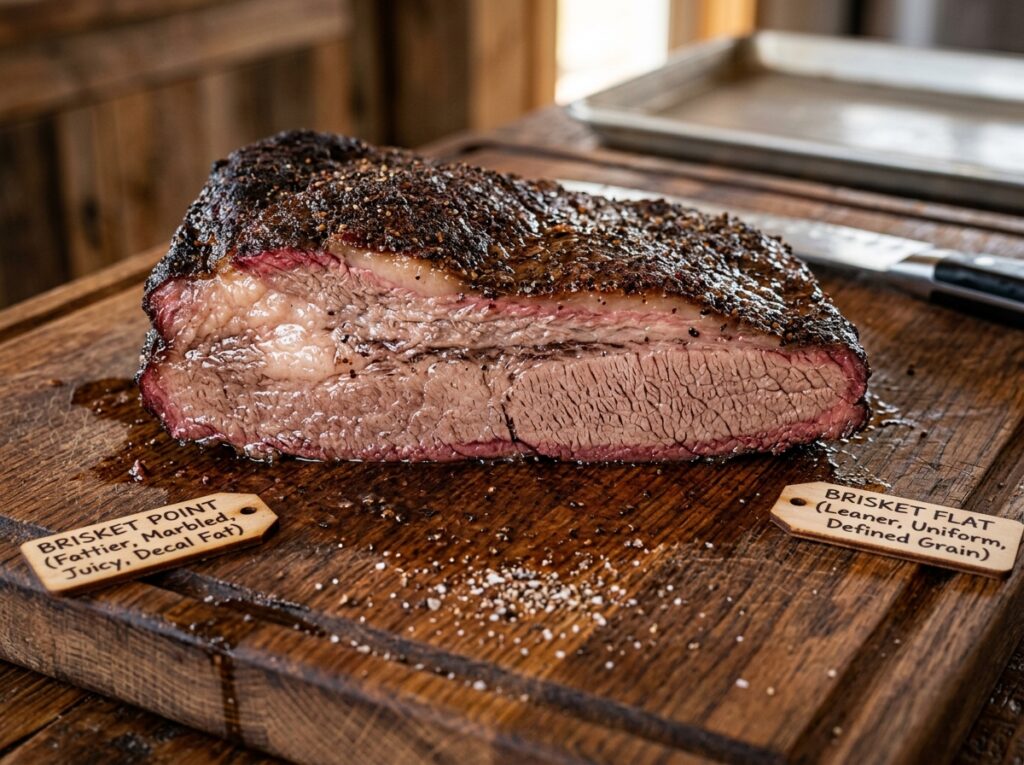
A whole brisket looks like one big roast, but on the smoker it acts like two very different cuts of beef. One side stays lean and slices neatly. The other turns rich, juicy, and almost unfairly beefy. If you’re comparing brisket point vs flat, you’re probably trying to answer a simple question: Which one will give you the result you actually want?
That’s the part most articles skip. They’ll say the point is fattier and the flat is leaner, then leave you standing at the meat case with the same confusion. So let’s make this easy. By the end, you’ll know what each cut is, how they cook, which one is better for your goal, and how to avoid the classic mistake of drying out a good brisket.
What Is the Difference Between Brisket Point and Flat?
Brisket comes from the lower chest of the cow, a hard-working area that carries a lot of weight. That’s why brisket starts out tough. It has plenty of connective tissue, and it only turns tender after a long, slow cook.
A full brisket, often called a packer brisket, has two muscles joined together by a seam of fat: the flat and the point.
Quick fact: If you want a clear breakdown of a whole brisket compared with a trimmed flat, this guide on brisket flat vs packer is a useful next read.
The brisket flat
The flat is the longer, thinner, more rectangular part. It’s usually the section you picture when you think of classic brisket slices laid across a cutting board.
It has less intramuscular fat than the point, so it cooks up leaner. That lean shape makes it easier to slice evenly for sandwiches, platters, or holiday dinners.
That’s also why the flat can be a little unforgiving. Leave it on too long, or cook it with weak moisture control, and it can dry out fast.
If you’ve ever had brisket that looked great but chewed like pot roast, there’s a good chance the flat took the hit.
The brisket point
The point sits on top of one end of the flat. It’s thicker, lumpier, and much more marbled. You’ll notice more internal fat, more connective tissue, and a looser grain.
That extra fat is the reason the point tastes so rich. As it renders, it bastes the meat from the inside. The result is softer texture, deeper beef flavor, and a lot more forgiveness on the smoker.
This is also the section most people use for burnt ends, especially Kansas City-style burnt ends.
One small butcher term that confuses people
Some people call the point the deckle. But that’s not fully accurate. The true deckle is the fat and tissue area between muscles, not the whole point itself.
You don’t need to remember that to cook a good brisket. Still, it helps when you’re talking to a butcher or reading labels online.
Brisket Point vs Flat at a Glance
If you only want the short answer, here it is: the flat is leaner and better for clean slices, while the point is fattier and better for juicy, rich bites.
Here’s the side-by-side view that actually helps:
| Feature | Brisket Flat | Brisket Point |
|---|---|---|
| Shape | Long and even | Thick and uneven |
| Fat content | Leaner | Fattier, more marbling |
| Texture | Firmer, sliceable | Softer, richer |
| Flavor | Beefy but cleaner | Deeper, more intense |
| Best use | Sliced brisket, sandwiches, pastrami | Burnt ends, chopped beef, rich servings |
| Risk during cooking | Can dry out | Can feel greasy if under-rendered |
Which is more tender?
Most of the time, the point feels more tender because the fat and collagen break down into a softer bite.
That doesn’t mean the flat can’t be tender. It absolutely can. Good Texas barbecue joints prove that every day. But the flat needs tighter control. You have to nail the cook, the rest, and the slicing.
Think of it like chicken breast vs chicken thigh. Both can be great. One is just easier to keep juicy.
Which has more flavor?
If we’re talking pure richness, the point wins. More fat means more flavor, more moisture, and more of that melt-in-your-mouth feel people chase in smoked beef.
The flat still tastes great. It just gives you a cleaner, leaner brisket flavor. Some people prefer that, especially if they don’t want every bite to feel heavy.
Which one looks better on a platter?
For neat slices? The flat.
Its shape gives you those long, even pieces you see in photos from Central Texas barbecue spots. That matters if you’re serving guests or want brisket that looks polished on the board.
The point is less tidy. You can slice it, but it often makes more sense as thick slices, chopped beef, or cubes for burnt ends.
Did you know? Traditional burnt ends came from the fattier point end. Kansas City pitmasters used those trimmed pieces as snack bites long before burnt ends became a menu star.
Which One Should You Buy?
This is where the decision gets real. Not every cook needs a full packer brisket, and not every dinner calls for the same result.
Buy the flat if you want lean slices
The flat is the better choice if your goal is neat, consistent slices for a dinner plate, sandwiches, or meal prep.
It also makes sense if you’re cooking for fewer people. A flat-only cut is often smaller and easier to fit in a standard smoker or even a large oven after the smoke phase.
You may also prefer the flat if you’re making pastrami or corned beef, since the uniform shape cures and slices nicely.
Still, the flat asks more from you. A low-grade flat with very little marbling can be tough to nail. If you’re shopping, try to find one with decent bend and visible marbling, not just a thick fat cap on the outside.
Buy the point if flavor matters most
If you care more about juicy, rich bites than pretty slices, the point is hard to beat.
It’s a great pick for chopped brisket sandwiches, tacos, sliders, or burnt ends. Even if your trimming or timing isn’t perfect, the extra fat gives you some breathing room.
That makes the point a nice choice for backyard cooks who want a high reward cook without stressing over every detail.
One catch: point-only cuts aren’t as common in regular grocery stores. You’ll often see flat-only pieces more than point-only pieces.
Buy a whole packer if you want the full brisket experience
A packer brisket gives you both muscles together, which means you get the best of both worlds: slices from the flat and richer meat from the point.
It’s usually the best value per pound too, especially at warehouse stores like Costco or Sam’s Club. Many brisket fans start out thinking a flat-only cut is simpler, then realize a whole packer often gives better eating quality for the money.
You’ll need more smoker space and more time, of course. But if you’re cooking for a crowd, or you want leftovers worth bragging about, a packer is usually the smartest buy.
So which cut is best for beginners?
A lot of people assume the flat is easier because it’s smaller. That sounds right, but it’s not always true.
A smaller flat cooks faster, sure. But it also gives you less room for error. One hour too long, or a bad slice across the grain, and the result feels dry.
The point is more forgiving. If you can find one by itself, it’s often easier to cook well.
If you’re open to a larger project, a well-marbled whole brisket is often the best learning tool because you can study both muscles in one cook.
How Point and Flat Cook on the Smoker
Here’s where brisket point vs flat really matters. They don’t cook exactly the same, and treating them like one uniform roast causes a lot of disappointment.
Why the flat dries out faster
The flat is thinner and leaner. That means heat moves through it faster, and it has less internal fat to protect it.
During a long smoke, the flat can lose moisture before the collagen fully softens. That’s why people end up with brisket that hits a “done” temperature but still tastes dry.
This is also why many cooks place the flat in the cooler part of the smoker, or aim the point toward the hotter area. The point can take more heat without falling apart.
Why the point can handle more cooking
The point has more fat and connective tissue, so it can stay on longer and still improve.
That extra time helps the fat render. If you pull the point too early, it can feel squishy in a bad way—soft fat, not finished brisket. Done right, it turns buttery and rich.
This is why many pitmasters separate the point after the main cook, cube it, sauce it lightly, and return it to the smoker for burnt ends.
What temperature should you smoke them at?
Most backyard brisket cooks happen between 225°F and 275°F. Both cuts can work anywhere in that range.
If you want more time for smoke and a gentle cook, 225°F to 250°F works well.
If you want a shorter cook and stronger bark development, 265°F to 275°F can still produce great brisket.
If you want a fuller breakdown, this article on the best temp to smoke brisket lays out the trade-offs well.
Should point and flat finish at the same internal temperature?
Not always, and that’s a big one.
You’ll often hear that brisket is done at 203°F. That number is useful as a ballpark, not a rule. Some briskets feel ready at 198°F. Some need a bit more time.
The better test is probe tenderness. When a thermometer probe or skewer slides in with little resistance, especially in the thickest part of the flat, you’re close.
If you’re unsure about the whole “is brisket done at 210°F?” debate, this piece on brisket internal temp 210 helps sort out the confusion.
Where should you check doneness?
Check more than one spot.
The flat matters most because it’s easier to overcook. Probe the thickest part of the flat, not the thin edge. Then check the point too.
A good thermometer makes this easier. If yours is slow or inconsistent, you’ll feel like you’re guessing. A solid instant-read thermometer saves a lot of frustration with brisket.
Wrapping and resting matter more for the flat
The flat benefits most from smart wrapping and a proper rest.
Many cooks wrap brisket during the stall, often around the mid-160s to low-170s, using butcher paper or foil. Paper helps protect bark while still reducing moisture loss. Foil traps more moisture but can soften bark.
Once it’s done, don’t rush the slicing. Resting lets juices settle and carryover heat finish the job gently. A short rest can work, but a longer warm hold often makes brisket better.
A common mistake people make
They cook the point and flat as if they should feel exactly the same at the same moment.
That rarely happens.
The point might feel ready while the flat still needs time. Or the flat may be perfect while the point can keep going. If you only follow one number for the whole brisket, you can miss the window.
Warning: Don’t chase a temperature and ignore feel. Brisket doesn’t care what number you wanted. It only cares whether the collagen has broken down.
Your smoker also changes the result
A steady cooker makes the flat much easier to manage. Pellet grills, insulated smokers, and well-run kamados reduce the temperature swings that punish lean meat.
If you’re still picking a cooker for long beef cooks, it’s worth comparing a few of the best pellet smokers before you buy.
Can You Separate the Point and Flat?
Yes, and in some cases it’s the smartest move.
Separating before the cook
You can separate the muscles before smoking if you want more control. This works well if you only want burnt ends from the point, or if you want to season and cook each muscle a little differently.
It also shortens the cook compared with a full packer, since the heat can reach more surface area.
The trade-off is that you lose some protection that comes from cooking the whole brisket together. A connected packer holds moisture better and gives you a more traditional result.
Separating during or after the cook
This is the sweet spot for a lot of backyard cooks.
Smoke the whole brisket until the flat is close to done. Then separate the point, finish the flat for slicing, and return the point to the smoker for burnt ends.
That way, you don’t overcook the flat while waiting on the point to fully render.
Competition teams and serious home cooks use this move all the time because it gives each muscle the finish it wants.
When does separating make the most sense?
It makes sense when:
- the flat is done but the point still feels tight
- you want burnt ends without turning the flat mushy
- you’re cooking for mixed preferences and need both lean slices and rich bites
That said, if it’s your first brisket, cooking the whole packer intact teaches you a lot about how the two muscles behave.
FAQ Section
FAQs About Brisket Point vs Flat
Is brisket point better than flat?
Not across the board. The point is better for richness, juiciness, and burnt ends. The flat is better for clean slices and leaner servings. “Better” depends on what you want to eat and how you plan to serve it.
Which is more tender, brisket point or flat?
The point usually feels more tender because it has more fat and collagen. The flat can still be very tender, but it takes more careful cooking and slicing.
Which one is best for burnt ends?
The point is the classic choice for burnt ends. Its marbling and loose texture handle extra time on the smoker much better than the flat.
Does brisket flat cook faster than point?
Yes, in many cases it does. The flat is thinner and leaner, so it often reaches tenderness sooner. That doesn’t mean it should come off the smoker early every time. You still need to check feel, not just the clock.
Can I buy only the flat or only the point?
You can usually find flat-only cuts more easily at grocery stores. Point-only cuts exist, but they’re less common and may require a butcher shop or specialty meat market.
What’s the best brisket cut for sandwiches?
If you want tidy slices on a sandwich, go with the flat. If you want juicy chopped beef sandwiches, the point often tastes better.
Is a whole packer brisket worth it?
For many cooks, yes. A whole packer gives you both muscles, often at a better price per pound than a trimmed flat. It also gives you more flexibility: slices from the flat and rich meat from the point.
5. Conclusion
The Simple Way to Decide
If you want one easy rule, use this: choose the flat for lean slices, choose the point for rich flavor, and choose a whole packer if you want the full brisket experience.
That’s really what brisket point vs flat comes down to. Not which cut wins on paper. Not which one a pitmaster on Reddit swears by. Just what fits your plate, your smoker, and your comfort level.
If this is your first brisket, don’t overcomplicate it. Buy the cut that matches how you want to serve it, cook until it feels tender, then rest it longer than you think you should. That one move alone fixes a lot of brisket problems.
And once your brisket is ready, a few of these best BBQ side dishes can make the whole meal feel complete.