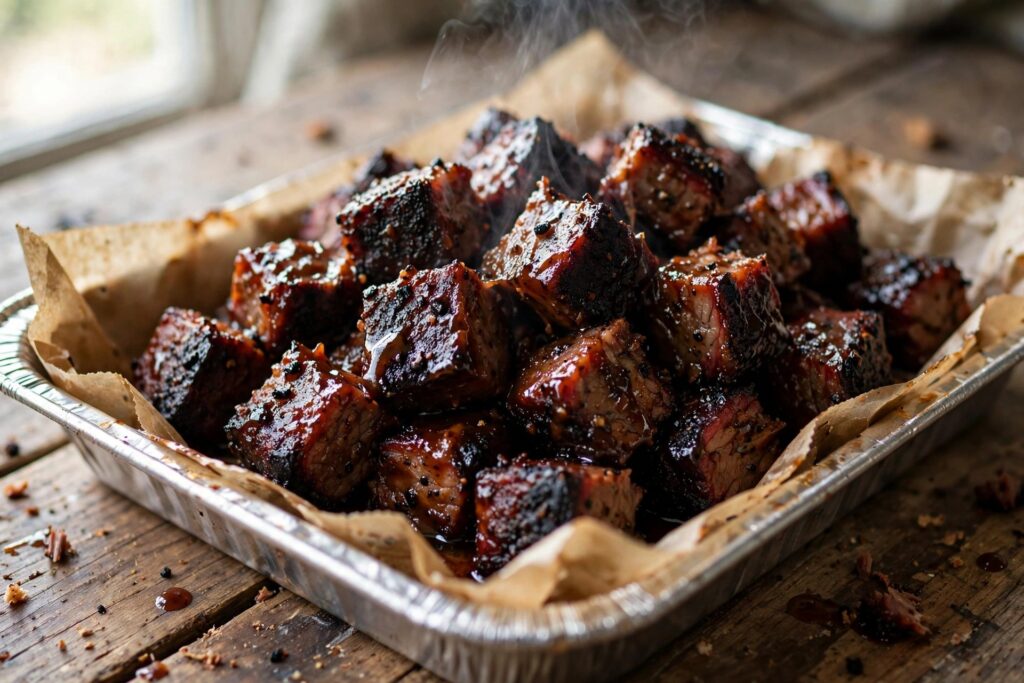
Burnt ends are cubes of smoked brisket point — usually cut 1 to 1½ inches — that get tossed in barbecue sauce, brown sugar, honey, and butter, then finished in the smoker until the sauce caramelizes into a sticky glaze. Born in Kansas City as a Friday special, they’ve become the most prized bite in all of BBQ.
Despite the name, nothing here is actually burnt. The near-black crust comes from hours of smoke building bark on the meat, plus the sugar in the sauce darkening as it caramelizes. Inside, the cubes are soft, beefy, and almost impossibly juicy — the fat rendered down into something closer to meat candy than any brisket you’ve sliced before. If you’ve ever heard a pitmaster call them “the best part of the brisket,” this is why.
Where Burnt Ends Came From
Burnt ends started in Kansas City, at Arthur Bryant’s restaurant. During the week, briskets were sliced for sandwiches and platters, and the crispy, well-cooked ends — the pieces too craggy to slice neatly — piled up in the kitchen. On Fridays, the staff sauced those ends, piled them on white bread, and sold them as a special.
They sold out. Every time. Word spread, and food writer Calvin Trillin wrote about Bryant’s “burnt edges” in a 1972 New Yorker piece, sending pilgrims to Kansas City just to taste them. Within a decade, joints across the city — Joe’s Kansas City (then Oklahoma Joe’s), Jack Stack, and others — were making burnt ends on purpose rather than waiting for leftovers. Hey Grill Hey traces the same Friday-special origin in her burnt ends guide, noting that the technique has stayed remarkably faithful to the original.
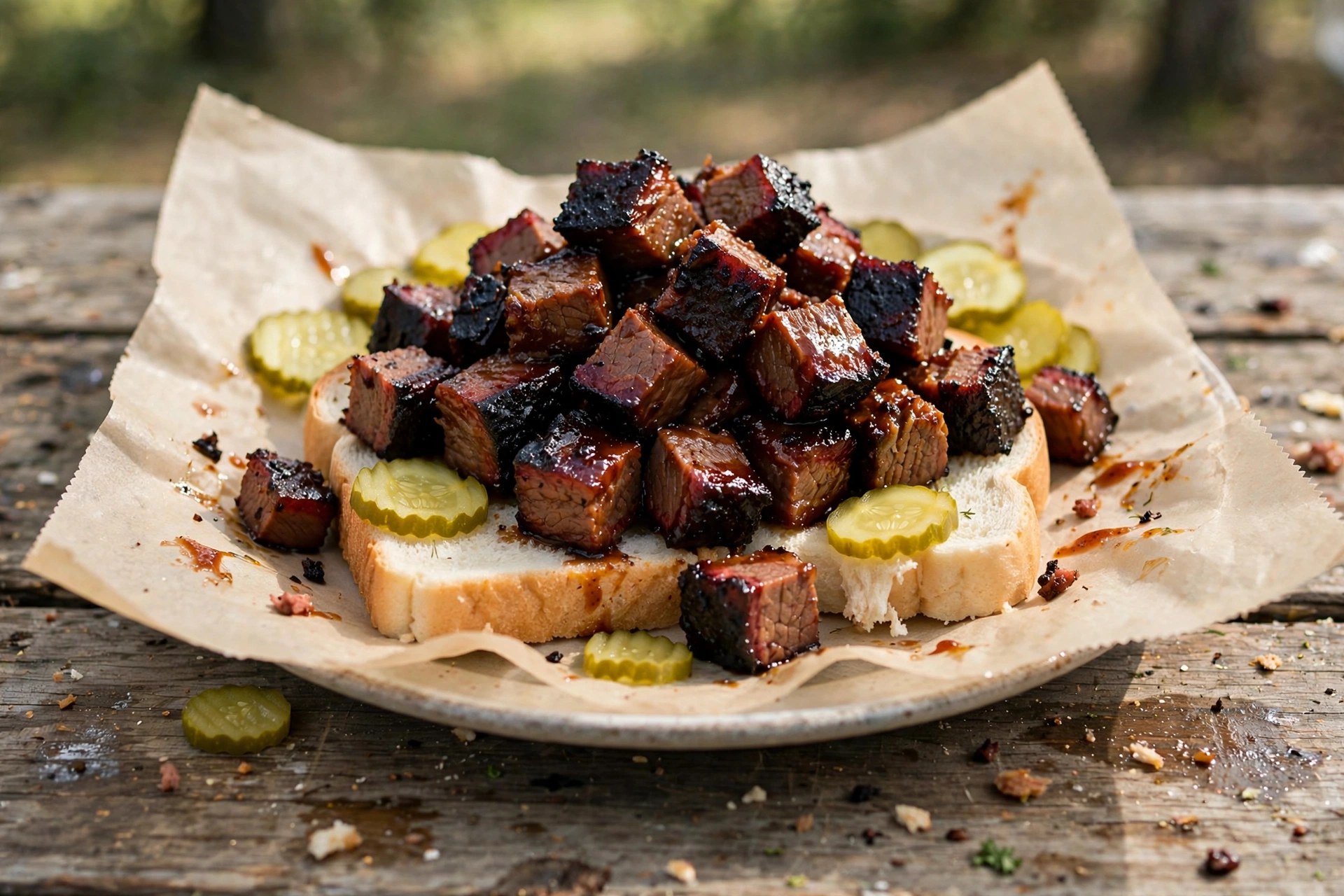
That origin explains the traditional serving style you’ll still see at KC joints: burnt ends on a slice of plain white bread with pickles. The bread soaks up the drippings. Nothing fancy. Nothing needed.
Why Burnt Ends Come From the Brisket Point
A whole packer brisket is two muscles stacked together: the flat and the point (also called the deckle). The flat is lean, rectangular, and built for slicing. The point is thick, triangular, and shot through with intramuscular fat — exactly the structure that turns soft and spoonable after a long smoke.
That fat is the whole reason burnt ends exist. Cubes cut from the flat would dry out during the second cook; cubes from the point render down and baste themselves from the inside. The connective tissue breaks down into gelatin somewhere around 195–203°F internal, which is why burnt ends finish at a higher temperature than sliced brisket ever would.
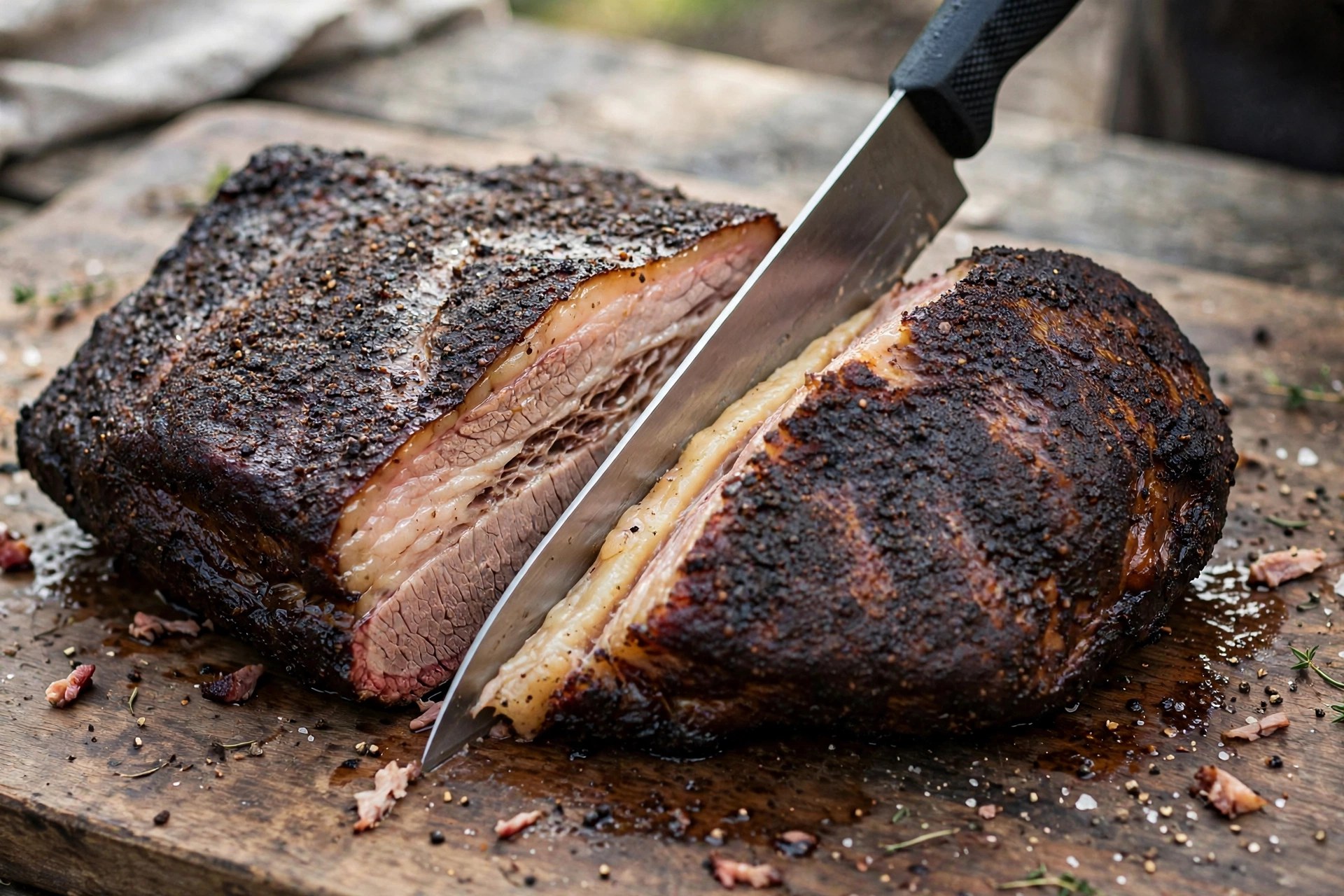
Know which muscle you’re working with before you start — our point vs flat breakdown shows exactly where the seam runs and how to find it with a knife.
How to Make Burnt Ends: The Traditional Method
Every ranking recipe agrees on the broad strokes, and the broad strokes are what matter. Here’s the method KC pitmasters have used for decades, adapted for a backyard smoker:
- Smoke the brisket. Season a whole packer (or just the point — more on that below) with salt, pepper, and garlic — a simple SPG seasoning is traditional. Smoke at 225–250°F until the internal temperature hits 165°F, usually 6–8 hours.
- Separate the point from the flat. At 165°F, slide a long knife along the thick vein of fat between the two muscles. Wrap the flat in butcher paper or foil and return it to the smoker to finish to 195–203°F for slicing.
- Cube the point. Cut the point into 1 to 1½-inch cubes, keeping them as uniform as you can so they cook evenly. Trim any giant pockets of hard fat as you go.
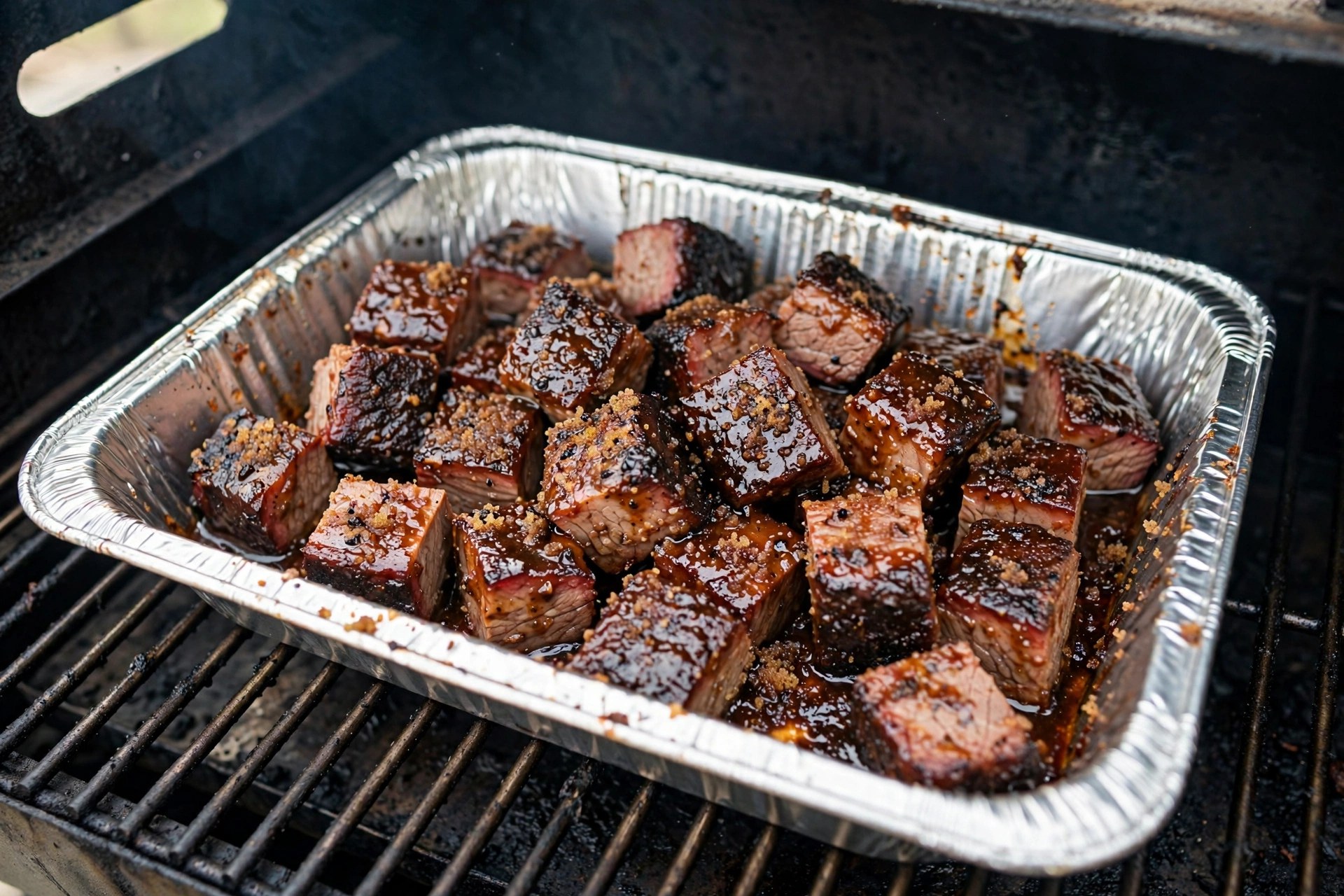
- Sauce and season. Toss the cubes in a foil pan with Kansas City–style barbecue sauce, brown sugar, a drizzle of honey, and a few pats of butter. Re-season lightly with your rub.
- Finish in the smoker, uncovered. Return the pan to the smoker at 225–250°F for 1–2 hours, uncovered. The sauce reduces, thickens, and starts to caramelize.
- Cover and cook to probe-tender. Cover the pan with foil and keep cooking another 1–2 hours. Pull the cubes when they probe like soft butter and hit 200–210°F internal — temperature tells you when, but the probe feel is the real test.
- Rest briefly and serve. Let the pan sit 15–20 minutes off the heat so the glaze sets. Serve on white bread with pickles, the KC way.
Total time: roughly 10–12 hours, of which the burnt ends portion is only the last 2–4. That’s why the traditional method makes so much sense — you’re already smoking a brisket. The burnt ends are a bonus course, not a separate project.
Point-Only vs Whole Packer: Which Method Is Better?
The Kansas City restaurants that pioneered burnt ends actually use a slightly different approach: they smoke the point by itself, not the whole packer. KC pitmasters favor this method because every surface of the point gets smoke and bark — more bark per cube in the end.
| Whole Packer Method | Point-Only Method (KC style) | |
|---|---|---|
| What you smoke | Full packer brisket (12–16 lbs) | Brisket point only (6–8 lbs) |
| Bark coverage | Good — but the point’s underside is shielded by the flat | Excellent — every side sees smoke |
| Bonus yield | You get sliced flat for dinner plus burnt ends | Burnt ends only — plan another main |
| Total cook time | 12–14 hours including the flat’s finish | 10–12 hours, done when the cubes are |
| Best for | Feed a crowd; two dishes from one brisket | Maximum bark and the most intense cubes |
If your butcher will sell you just the point — many will if you call ahead — the point-only route is simpler and gives you the best possible burnt ends. If you’re already cooking a packer for a party, the whole-packer method costs you almost nothing extra and hands you two dishes from one cook.
Timing, Temperature, and Sauce Ratios
Burnt ends are forgiving, but they still run on numbers. Here are the targets that matter, plus the sauce formula behind the classic sweet-sticky finish.
| Phase | Smoker temp | Internal temp | Time |
|---|---|---|---|
| Initial smoke | 225–250°F | 165°F (then separate point/flat) | 6–8 hours |
| Wrapped (point-only method) | 225–250°F | 195°F | ~3 hours |
| Sauced, uncovered | 225–250°F | — | 1–2 hours |
| Covered, to finish | 225–250°F | 200–210°F, probes like butter | 1–2 hours |
For the sauce mix, per 6–8 pound point (about a full foil pan of cubes):
- 1 cup Kansas City–style barbecue sauce (thick, sweet, tomato-based)
- ½ cup dark brown sugar
- ¼ cup honey
- 4 tablespoons unsalted butter, cut into pats
- 2–3 tablespoons of your brisket rub, to re-season the cubes
Coat, don’t drown. Vindulge’s burnt ends guide makes the same point: every cube needs an even coating, because bare spots cook unevenly and you’ll end up with chewy bites next to perfect ones. Start with one cup of sauce and add more only if the pan looks dry. You can always add; you can’t take away.
Variations: Pork Belly, Poor Man’s, and Beyond
Once brisket burnt ends went mainstream, pitmasters started applying the cube-sauce-caramelize formula to other meats. Each version works, but none is quite the original:
| Variation | Cut used | Typical cook time | What to expect |
|---|---|---|---|
| Traditional burnt ends | Brisket point | 10–12 hours | Beefy, smoky, with real bark — the benchmark |
| Pork belly burnt ends | Skinless pork belly, cubed | 3–4 hours | Richer, fattier, faster; smoke at 250°F to ~195°F internal |
| Poor man’s burnt ends | Chuck roast | 7–9 hours | Close to the real thing at half the price; cube at 165°F, finish the same way |
| Hot dog burnt ends | Hot dogs, scored and quartered | 2–3 hours | A fun backyard novelty, not a substitute |
Poor man’s burnt ends deserve special mention. Chuck roast has the same hard-working-muscle structure as brisket, with enough fat and collagen to survive the double cook. Take it to 165°F, cube it, sauce it, and finish it exactly like brisket burnt ends. At current beef prices, a 3–4 pound chuck roast is often half the cost of a packer — and nobody at the table will complain.
Mistakes, Serving, Storing, and Reheating
The errors that wreck burnt ends are all avoidable:
- Using the flat. It’s too lean. It will dry out and fall apart instead of turning tender.
- Uneven cubes. Small pieces turn to mush while big ones stay chewy. Aim for uniform 1 to 1½-inch cubes.
- Cooking by the clock. Every brisket is different. Pull by probe tenderness (200–210°F internal), not by the timer.
- Too much sauce. The cubes should be coated, not swimming. Excess sauce never reduces properly and turns the finish soupy.
- Skipping the uncovered phase. The sauce needs direct smoker heat to reduce and caramelize. Covering too early steams the cubes instead.
For serving, keep it simple: white bread, pickle chips, and maybe a little extra warm sauce on the side. Burnt ends are rich — the acid in the pickles cuts through the fat and keeps you going back for another cube.
Leftovers keep 3–4 days in an airtight container in the fridge, or 2–3 months in the freezer. Reheat covered at 300°F until they hit 165°F internal — the foil keeps the glaze from drying out. Our full guide to reheating brisket covers the details if you’re dealing with a big batch.
Burnt Ends FAQs
Are burnt ends actually burnt?
No. The dark color comes from the smoky bark built during the long cook, plus the sugar in the barbecue sauce caramelizing during the final phase. Properly made burnt ends are tender and juicy, never bitter or scorched.
What part of the brisket is used for burnt ends?
The point (deckle) — the fatty, well-marbled muscle that sits on top of the flat. Its fat and collagen break down during the double cook, keeping the cubes moist. The lean flat is better for slicing, not cubing.
Can I make burnt ends from a chuck roast?
Yes — that’s the famous “poor man’s burnt ends.” Smoke a 3–4 pound chuck roast to 165°F internal, cube it, sauce it, and finish it the same way. The result is remarkably close to brisket burnt ends at a fraction of the cost.
How long do burnt ends take from start to finish?
About 10–12 hours: 6–8 hours of initial smoking to 165°F internal, then 2–4 hours of cubing, saucing, and finishing to 200–210°F. Judge doneness by probe feel — the thermometer should slide in like soft butter — not by the clock.
What’s the difference between burnt ends and brisket bites?
The terms overlap, but “burnt ends” traditionally means cubes from the brisket point that go through the full smoke-cube-sauce-smoke process. “Brisket bites” is a looser term that can mean any cubed, sauced brisket — sometimes made from the flat, sometimes just sauced without the second smoke.
Your next step: smoke a brisket this weekend and plan the split before you start. Decide whether you’re cooking the whole packer (slices for dinner, burnt ends for the finale) or just the point (maximum bark, all cubes). Either way, call your butcher ahead — a pre-separated point saves you the trickiest cut of the whole cook.
Leave a Reply