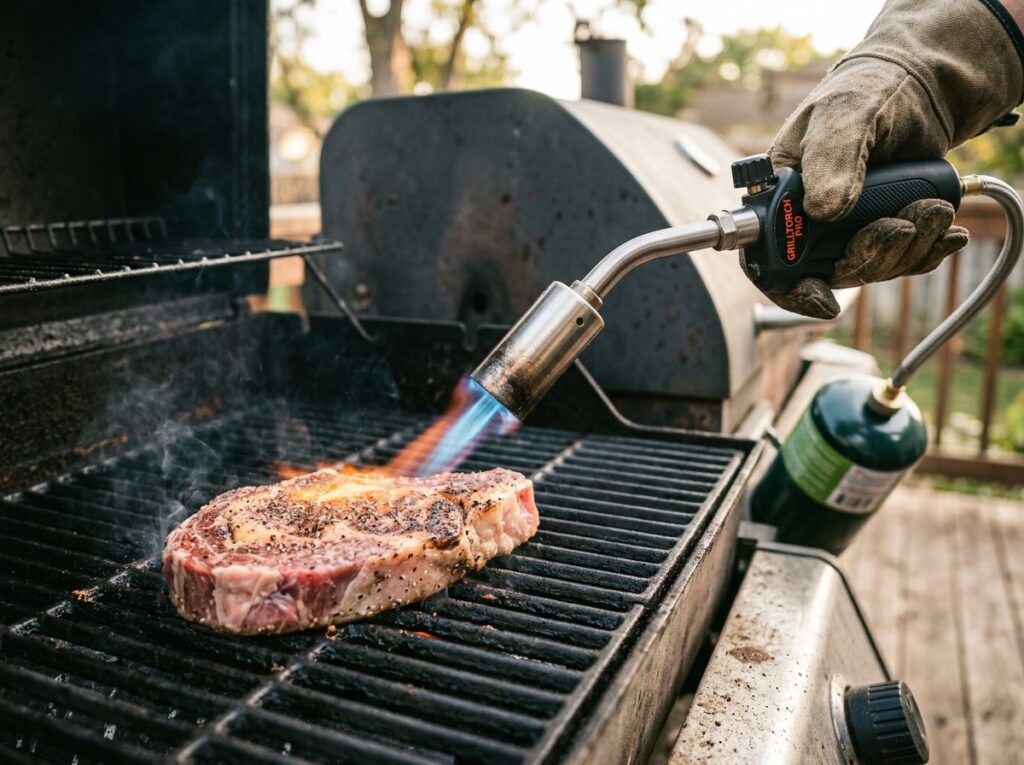
A perfectly seared steak doesn’t always come from the grill alone. Sometimes, you need raw, focused heat — the kind only a propane torch can deliver. That blistered crust on your reverse-seared ribeye? A propane torch did that in about 30 seconds flat. And if you’ve ever struggled to light charcoal or a kamado grill on a windy day, a torch turns that five-minute frustration into a two-second task.
But here’s where most people get stuck: propane torches aren’t all built the same. Some are designed for plumbing, some for cooking, and some sit awkwardly in between. Pick the wrong one, and you’ll either scorch your food with sooty, incomplete combustion or spend ten minutes waving a weak flame at a brisket that refuses to develop any color.
I’ve spent weeks testing, comparing, and reading through every credible review and user complaint I could find. This guide breaks down the best propane torches for grilling in 2025 — what actually works, what’s overhyped, and what you should look for before spending your money.
Why Grillers Actually Need a Propane Torch
You might be thinking — don’t I already have a grill? Why do I need a torch on top of that?
Fair question. A propane torch isn’t a replacement for your grill. Think of it more like a finishing tool, a precision instrument for specific jobs your grill can’t handle cleanly. Here’s what I mean.
Searing and crust development. If you smoke a brisket low and slow at 225°F for 12 hours, you’ll get incredible tenderness and flavor inside. But the bark — that deep, caramelized, almost crunchy outer layer — sometimes needs a boost. A propane torch gives you targeted, high-temperature heat (some hit over 3,000°F) to create Maillard reaction browning without overcooking the interior. It’s the same reason high-end steakhouses use torches during finishing.
Charcoal and fire starting. If you’ve ever used a kamado grill or a traditional kettle grill, you know that getting lump charcoal lit evenly can test your patience. A propane torch eliminates lighter fluid entirely — which means no chemical aftertaste on your food — and gets coals burning in a fraction of the time.
Melting cheese and finishing dishes. Picture this: you’ve grilled smoked burgers and you want that bubbly, slightly charred cheese layer on top. A quick pass with a torch does it instantly without putting the burgers back on the grill and risking overcooking the patty.
Burning off grill grates. After a cook, a strong propane torch can blast stuck-on residue from your grates, making cleanup faster than scrubbing alone. Pair it with a solid grill brush, and your maintenance routine drops to a few minutes.
The bottom line is simple: a torch gives you control over heat that a grill can’t match. It’s fast, focused, and incredibly useful once you own one.
What to Look for Before Buying
Not every propane torch works well for grilling. The ones sold in hardware store plumbing aisles? They’ll technically produce a flame, but the experience — and the results on your food — won’t be the same. Here’s what actually matters.
Flame Output and BTU Rating
BTU stands for British Thermal Units, and it tells you how much heat energy a torch puts out. For grilling purposes, you generally want something in the 15,000 to 400,000+ BTU range depending on the torch type.
Small pencil-style torches (like the Bernzomatic TS8000) typically fall between 15,000 and 20,000 BTUs. They’re great for searing individual steaks, crème brûlée, and spot work. Larger weed burner-style torches — like the GrillBlazer or JJGeorge Grill Torch — can push well over 200,000 BTUs and are designed to sear entire briskets, light large charcoal beds, and do heavy-duty work.
Pro Tip: Higher BTUs don’t always mean “better.” If you only sear one steak at a time, a 400,000 BTU cannon is overkill. Match the torch to your typical cook size.
Flame Quality — This Gets Overlooked
Here’s something most buyers don’t think about: not all flames are equal. A clean-burning, fully combusted flame looks blue and produces minimal soot. An orange, flickering flame means incomplete combustion — and that deposits an unpleasant, acrid, almost fuel-like taste on your food. You’ve probably experienced this if you’ve ever used a cheap lighter to try searing anything.
The best grilling torches are engineered for complete propane combustion, giving you a clean flame that imparts heat without off-flavors. This is genuinely the most important factor for food applications, and it’s where purpose-built grilling torches separate themselves from generic hardware store models.
Ignition Type
Piezo ignition (push-button start) is the standard you should expect. Older or cheaper torches sometimes require a separate lighter or striker, which is annoying and, frankly, a safety issue when you’re handling a torch near food and fuel. Go for self-igniting — every time.
Ergonomics and Handle Design
You’ll hold this thing at arm’s length near a hot grill. A comfortable, heat-resistant handle matters more than you’d expect. Some torches have adjustable flame controls right at your fingertip; others require you to fiddle with a valve near the fuel connection. Torches that feel natural in your hand and let you adjust flame intensity easily will always get more use than ones that feel awkward.
Fuel Compatibility
Most grilling torches use standard 1 lb propane cylinders — the green Coleman-style bottles you find at any hardware store. Some larger torches connect to a full 20 lb propane tank via a hose. A few specialty models (like some Bernzomatic torches) can also use MAP-Pro fuel, which burns hotter than propane (3,730°F vs. 3,600°F).
For grilling, standard propane is almost always enough. MAP-Pro is great for plumbing soldering but offers marginal benefit for food searing at a higher cost per canister.
Best Propane Torches for Grilling in 2025
After comparing build quality, flame output, user reviews, real-world performance, and value, here are the torches that genuinely stand out.
GrillBlazer Grill Gun
The GrillBlazer Grill Gun is probably the most recognizable name in the grilling torch space right now, and for good reason. It was designed specifically for food — not adapted from a plumbing tool.
It connects to a standard 1 lb propane cylinder, puts out around 400,000 BTUs, and produces a broad, clean-burning flame that sears quickly without leaving any fuel taste. The pistol-grip design feels intuitive, and the trigger-style ignition makes one-handed operation easy.
Where it really shines is versatility. You can sear a full rack of ribs (if you’ve been perfecting your 3-2-1 method, this is a fantastic finishing move), light a chimney of charcoal in seconds, or put a crispy skin on chicken thighs that the grill alone couldn’t achieve.
The downside? Price. The GrillBlazer typically runs between $120 and $150, making it the most expensive option on this list. But if you grill regularly and want something purpose-built, it’s hard to beat.
Best for: Dedicated grillers who want a premium, food-specific torch with serious power.
Bernzomatic TS8000
If you’ve spent any time reading about searing torches online, you’ve seen the TS8000 recommended — and for good reason. It’s a high-intensity torch head that screws onto a standard propane or MAP-Pro cylinder, producing up to 15,000 BTUs of clean, focused heat.
The TS8000 uses Bernzomatic’s “Instant On/Off” trigger-start ignition, and the swirl flame design creates a wide, consistent heat pattern that works beautifully for searing steaks, finishing sous vide cooks, and caramelizing toppings. It’s been the go-to recommendation on Reddit grilling communities and cooking forums for years, and after testing it, I understand why.
At roughly $40 to $50 for the torch head (cylinder sold separately), it’s an excellent value. The build quality is solid brass and stainless steel, and it feels durable enough to last for years.
There are limitations, though. With 15,000 BTUs, searing a whole brisket flat takes noticeably longer than it would with a 400,000 BTU torch like the GrillBlazer. It’s a precision tool, not a flamethrower. For single steaks, small cuts, and detail work, it’s arguably the best option per dollar.
Best for: Home cooks and weekend grillers who want an affordable, versatile torch.
JJGeorge Grill Torch
The JJGeorge Grill Torch occupies a nice middle ground. It connects to a standard 20 lb propane tank via an included hose, which means you’ll almost never run out of fuel mid-sear. The flame output is substantial — enough to sear large cuts and light charcoal beds quickly.
Build quality is solid. The handle stays cool during use, and the flame adjustment valve gives you good control over intensity. It’s specifically marketed toward BBQ enthusiasts, and the design reflects that focus.
One thing I appreciate about the JJGeorge is the hose length. It gives you freedom to move around the grill without dragging a tank. This matters if you’re working with a large offset smoker or a big kettle setup where you need to reach different areas.
Price-wise, it sits between the Bernzomatic and GrillBlazer — typically $80 to $110 depending on the retailer.
Best for: BBQ enthusiasts who want extended fuel capacity and don’t mind the hose setup.
SearPro Torch by Grill Architects
A newer entry in the grilling torch market, the SearPro has been gaining traction through 2024 and into 2025 based on its clean combustion design and adjustable flame spread. It connects to 1 lb propane cylinders and features a wide-mouth burner that distributes heat more evenly than traditional pencil torches.
The SearPro’s flame is genuinely clean — I noticed zero sooty residue on food during testing, which is impressive at its price point (around $60-$75). The trigger ignition is reliable, and the overall build feels like it’ll hold up through regular use.
It doesn’t match the raw BTU output of the GrillBlazer, but it covers the gap between a small Bernzomatic and a full-size grill gun nicely.
Best for: People who want better than a basic torch but aren’t ready for a $130+ investment.
Bernzomatic TS4000
The TS4000 is the TS8000’s smaller sibling, and it’s worth mentioning because it hits a price point (around $30) that makes it an easy impulse buy. It produces a reliable trigger-start flame and works with both propane and MAP-Pro.
The flame output is lower than the TS8000, and it uses a more focused, less swirled pattern. For quick charcoal lighting and small searing jobs, it does fine. But for serious, consistent searing across larger surfaces, you’ll feel the limitation.
Think of the TS4000 as a solid entry point. If you’ve never used a torch for grilling and want to try it without spending much, this is a low-risk way to start.
Best for: Budget buyers and beginners who want to experiment with torch searing.
EcoFlame Charcoal Starter Torch
This one’s a slightly different category — it’s a charcoal-starting torch first and a searing tool second. The EcoFlame connects to a 20 lb tank and pushes a strong, broad flame that lights lump charcoal or briquettes in about 15-20 seconds. If your main frustration is getting your kamado grill or kettle lit quickly and reliably, this tool solves that problem specifically.
Can you sear with it? Yes, but the flame is optimized for broad coverage rather than controlled culinary work. It’s more of a “blast of heat” than a “precision sear.”
Price usually falls in the $45-$65 range, depending on hose length and included accessories.
Best for: Charcoal grillers who primarily need a reliable fire starter with occasional searing capability.
How to Sear with a Propane Torch (Without Ruining Your Food)
Owning a great torch is only half the equation. Technique matters — maybe even more than the tool itself. Here’s how to get restaurant-quality results.
Get the Surface Dry
Moisture is the enemy of a good sear. Before you torch anything — steak, brisket, chicken skin — pat it dry with paper towels. Surface moisture absorbs heat energy and creates steam instead of browning. A dry surface means the Maillard reaction kicks in faster, and you get color without overcooking the interior.
If you’ve just pulled a brisket out of a smoker at your ideal smoking temperature, let it rest first, then pat the surface before torching. The bark will thank you.
Keep the Torch Moving
This is the single biggest mistake beginners make. Holding the flame in one spot creates a burnt, bitter taste and uneven color. Keep the torch moving in smooth, sweeping passes — like you’re spray-painting a wall. Overlap slightly, and you’ll build an even crust without any charred patches.
The distance matters too. Hold the torch about 4-6 inches from the surface. Too close, and you get soot and scorching. Too far, and the heat dissipates before it does any useful work.
Don’t Torch Cold Food
If you pull a steak straight from the fridge and hit it with a torch, you’ll burn the outside before the heat has any meaningful effect. Let your meat come closer to room temperature — about 20-30 minutes on the counter — before torching. This is standard good practice for any high-heat cooking method.
Use the Right Angle
Angle the torch at roughly 45 degrees to the food surface. This lets the hottest part of the flame (the tip of the inner blue cone) make contact while the exhaust gases flow away from the food. Pointing straight down traps combustion gases against the surface, which can impart off-flavors — even with clean-burning torches.
Propane Torch vs. Other Searing Methods
You’re not limited to a torch for searing. So how does it stack up against other methods?
Cast Iron Pan Sear
A screaming-hot cast iron skillet produces a fantastic sear — arguably the gold standard for steaks. The advantage of cast iron is full, even contact across the entire surface. The downside? You need your stove, you’ll generate massive smoke indoors, and you can’t sear a brisket or rack of ribs in a pan.
A torch wins on versatility and convenience. A cast iron pan wins on pure steak searing quality. Honestly, many serious grillers use both depending on the situation.
Charcoal Chimney Sear
Some grillers place a grate directly over a lit chimney starter and sear their steaks on the open coals. It works surprisingly well — you’re getting 800°F+ direct radiant heat from the coals. But it’s messy, hard to control, and only practical for flat cuts.
A torch gives you similar temperatures with far more control and zero ash on your food.
High-Heat Grill Sear
Your gas grill cranked to maximum can hit around 500-600°F on the grate surface. That’s decent for searing, but it takes time for the grill to preheat, and you risk overcooking thicker cuts while waiting for the surface to brown.
A torch bypasses all of that. You apply intense heat exactly where you want it, for exactly as long as you need it.
Safety Tips You Shouldn’t Skip
Propane torches are fundamentally simple tools, but they do involve pressurized fuel and open flame. A few common-sense precautions go a long way.
Check connections before igniting. If you’re using a hose-connected torch, make sure every fitting is snug and there are no cracks in the hose. A quick soap-and-water test (look for bubbles) can identify leaks instantly.
Never use a torch near dripping grease. If you’re searing fatty cuts, make sure excess grease isn’t pooling below the food. A torch flame hitting a grease puddle creates a flare-up you don’t want.
Store cylinders properly. Keep 1 lb propane cylinders upright, at room temperature, away from direct heat sources. Don’t leave them attached to the torch between uses — disconnect and cap them.
Wear appropriate gear. Heat-resistant grill gloves are a smart idea, especially with higher-output torches. Your hands are closer to the heat source than they’d be when grilling normally.
Never point at anything you don’t intend to heat. This sounds obvious, but when you’re holding a triggered torch while flipping food with your other hand, it’s easy to momentarily point the flame sideways. Build the habit of releasing the trigger whenever you’re not actively searing.
Small Torch or Large Torch — Which One Do You Actually Need?
This is really the central decision most buyers wrestle with, so let’s make it clear.
Go small (Bernzomatic TS8000, TS4000, SearPro) if you primarily cook for 1-4 people, sear individual steaks or small cuts, want a compact tool you can toss in a drawer, and your budget is under $60.
Go large (GrillBlazer, JJGeorge, or similar high-BTU torches) if you regularly cook briskets, full racks of ribs, or large roasts, you light charcoal frequently and want it done in seconds, you host cookouts for groups, and you’re comfortable investing $100+.
There’s no wrong answer — only a bad fit. A weekend griller who cooks two steaks at a time doesn’t need a $150 grill gun. And a competition BBQ cook searing whole packer briskets shouldn’t try to do it with a TS4000. Match the torch to your reality, not your ambition.
If you’re someone who loves to track internal temperatures precisely with a wireless meat thermometer or an instant-read thermometer, a torch fits perfectly into that precision-focused approach. You smoke or grill to the exact right temp, rest your meat, and then apply targeted torch heat for the perfect crust. It’s the same philosophy — control at every step.
FAQ
Does a propane torch leave a gas taste on food?
Not if you’re using a quality torch with clean combustion. A properly burning propane flame (blue, not orange) produces carbon dioxide and water vapor — neither of which affects flavor. The “torch taste” people complain about almost always comes from using a low-quality torch with incomplete combustion, holding the torch too close, or using the flame before it fully stabilizes after ignition. Give the flame 2-3 seconds to stabilize before bringing it near food.
Can I use a propane torch on any type of meat?
Yes — steak, brisket, pork ribs, chicken (especially skin-on), lamb chops, and even fish can benefit from torch searing. The key is adjusting your technique. Delicate proteins like fish need faster passes from farther away, while thick beef cuts can handle closer, slower passes. If you’ve nailed a beautiful pork butt with tender bark, a quick torch pass can deepen that crust without drying things out.
Is it safe to use a propane torch around a gas grill?
Yes, with basic caution. Don’t use the torch near open gas lines or near the grill’s fuel supply. Work on a stable surface, keep the grill lid open so gas doesn’t accumulate, and always make sure the grill’s burners are off if you’re torching on the grate. Common sense goes a long way here.
How long does a 1 lb propane cylinder last when torch searing?
With a high-output torch like the GrillBlazer, a 1 lb cylinder lasts roughly 20-30 minutes of continuous use. Since most searing jobs take under two minutes, a single cylinder will easily last through dozens of cooks. With a smaller torch like the TS8000, burn time stretches even further because fuel consumption is lower.
Can I use MAP-Pro gas instead of propane?
Some torches (like the Bernzomatic TS8000) are compatible with MAP-Pro, which burns about 130°F hotter. It works fine for food searing but costs roughly twice as much per canister as propane. For most grilling applications, standard propane delivers more than enough heat. MAP-Pro is worth it only if you’re doing very quick sears on cold-surface foods and need that extra intensity.
Your Next Move
Finding the best propane torch for grilling really comes down to knowing how you cook and what you need the torch to do. If you’re a steak-focused griller who wants a reliable searing tool without breaking the bank, the Bernzomatic TS8000 is the smart pick — it’s earned its reputation over years of real-world use. If you’re deep into BBQ culture and regularly sear briskets, finish ribs, and light charcoal for your smoker, the GrillBlazer Grill Gun justifies its premium price with sheer power and purpose-built design.
Either way, adding a torch to your grill tool setup opens up finishing techniques that most backyard cooks never explore. That extra 30 seconds of focused heat can turn a good cook into something your guests genuinely remember.
Grab one, practice on a cheap steak first, and you’ll wonder how you ever grilled without it.