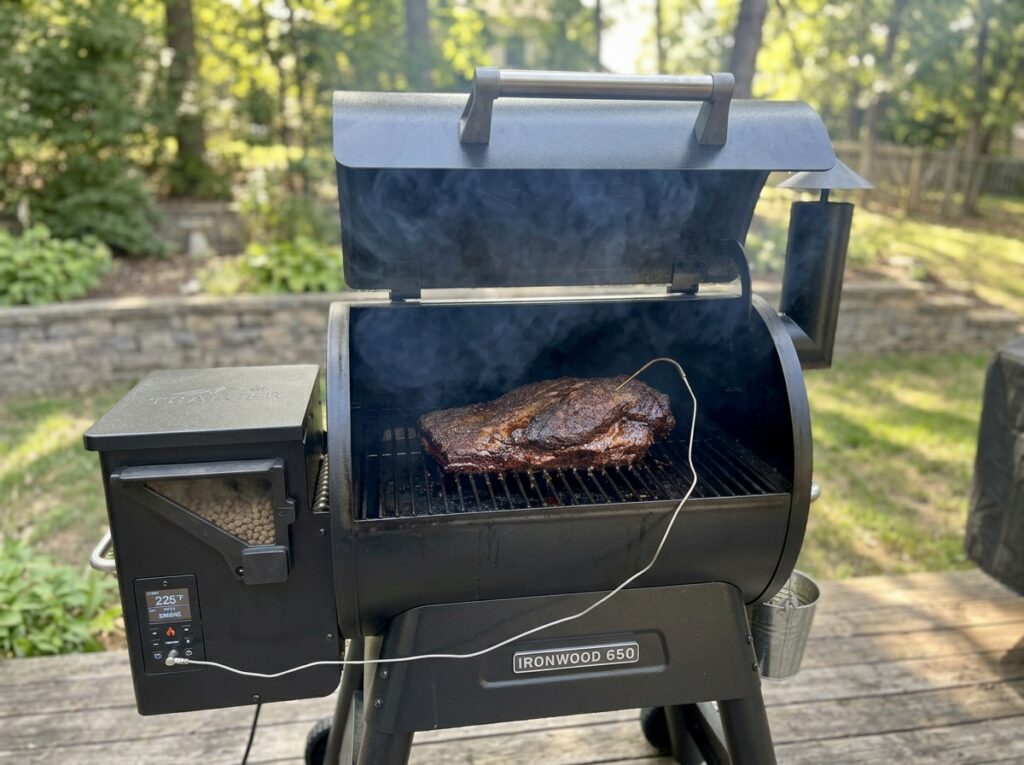
A pellet smoker runs on compressed hardwood pellets, feeds them automatically into a fire pot, and holds your cooking temperature within a few degrees for hours on end. You load the hopper, set your temp, and walk away. That kind of simplicity is exactly why pellet smokers have become the fastest-growing segment in outdoor cooking over the past five years. According to the Hearth, Patio & Barbecue Association’s 2024 report, pellet grill sales grew nearly 10% year-over-year, outpacing charcoal and gas combined.
But here’s the thing — not every pellet smoker deserves a spot on your patio. Some nail temperature control but choke on smoke flavor. Others produce gorgeous bark on a brisket but fall apart after two seasons. Price tags range from $350 to well over $3,000, and a higher number doesn’t always mean a better cook.
I’ve spent weeks comparing build quality, temperature consistency, smoke output, hopper capacity, ease of cleanup, and real user feedback across dozens of models. This guide breaks down the best pellet smokers you can actually buy right now — and, more importantly, helps you figure out which one fits your cooking style, space, and budget. Whether you’re smoking your first rack of ribs or you’ve been chasing the perfect brisket bark for years, there’s a pellet smoker here that makes sense for you.
What Makes a Pellet Smoker Different from Other Smokers?
Before we talk about specific models, let’s get clear on what sets a pellet smoker apart — because if you’re comparing it against an offset smoker or a propane smoker, the differences matter more than you’d think.
A pellet smoker uses an electric-powered auger to move small hardwood pellets from a storage hopper into a fire pot. A hot rod ignites the pellets, a fan controls airflow, and a digital controller reads the internal temperature and adjusts pellet feed speed to hold your target temp. That’s it. You’re basically looking at an outdoor convection oven that also produces wood smoke.
The upside? Temperature stability. Most quality pellet smokers hold within ±5°F of your set point. That’s something even experienced offset smokers struggle to match manually. You can set 225°F, put a pork butt on the grate, go to sleep, and wake up to a perfectly smoked pork butt without babysitting the fire.
The tradeoff? Smoke intensity. Pellet smokers produce a cleaner, lighter smoke compared to stick burners. If you want that heavy, almost aggressive smoke ring and bark you’d get from an all-wood fire, you’ll need to work a bit harder with a pellet — using smoke tubes, choosing stronger pellet blends, or cooking at lower temps during the initial hours.
PID Controllers vs. Standard Controllers
You’ll see this term a lot while shopping, so here’s the plain version. A PID (Proportional-Integral-Derivative) controller is the brain of a pellet smoker. Older, cheaper models use basic “time-based” controllers that simply cycle pellets on and off. They work, but temperature swings can be ±25°F or worse.
PID controllers constantly calculate the difference between your target temp and the actual temp, then make tiny, real-time adjustments. The result is much tighter temperature control — usually ±5°F. In 2025, almost every pellet smoker above the $500 mark uses a PID controller. If you’re looking at a budget model, check this spec first. It makes a noticeable difference in cook quality.
Wi-Fi and App Control — Do You Actually Need It?
Short answer: you don’t need it, but once you use it, you won’t want to cook without it. Wi-Fi connectivity lets you monitor chamber temp, probe temps, and adjust your set temperature from your phone. You can be inside watching a game, running errands, or even at work while your smoker does its thing.
Most brands — Traeger, Weber, Camp Chef, and Recteq — offer their own apps. Traeger’s Wifire app and Recteq’s app are probably the most refined right now. They let you set up custom cook programs, get alerts when your meat hits a target internal temp, and even control the smoker remotely. For long cooks like brisket, that kind of remote monitoring isn’t just convenient — it genuinely helps you time your wraps and rest periods better.
Best Pellet Smokers — Our Top Picks for 2025
I’ve organized these picks by what they do best, not just by price. Every smoker on this list earns its spot for a specific reason.
Traeger Ironwood XL — Best Overall Pellet Smoker
Traeger practically invented the pellet grill category back in 1985, and the Ironwood XL represents their best thinking in 2025. It runs on Traeger’s D2 drivetrain — a variable-speed fan and auger system paired with a PID controller — and holds temperature remarkably well even in cold weather.
You get 885 square inches of cooking space, which translates to roughly six racks of ribs, four whole chickens, or a full packer brisket with room to spare. The Downdraft Exhaust System is worth highlighting here. It pulls smoke downward across the food before venting, which means more even smoke contact and noticeably better flavor than older Traeger designs.
The Wifire app works well. You can set temps, switch between smoke and grill modes, and monitor up to four probe temperatures remotely. Build quality is strong — powder-coated steel, solid lid seal, double-walled insulation on the barrel. It’s not cheap (street price around $1,699–$1,799), but if you want one smoker that handles everything from low-and-slow to 500°F searing, this is hard to beat.
Who it’s for: Serious home cooks who want a do-it-all pellet smoker with reliable tech and don’t mind paying for it.
Recteq RT-700 (Bull) — Best Value for the Money
Recteq doesn’t spend millions on marketing. They spend it on stainless steel and customer service. The RT-700, often called “The Bull,” gives you 702 square inches of cooking space, a stainless steel build that laughs at rust, and a PID controller that holds temps within ±5°F.
What makes the RT-700 stand out at its price point (around $1,199) is the build material. Most competitors at this price use painted or powder-coated carbon steel. Recteq uses 304 stainless steel for the entire body. That’s the same grade used in high-end kitchen appliances. After three or four seasons, while other smokers start showing rust spots and paint chips, the RT-700 still looks like it did on day one.
The Wi-Fi control is solid, the hopper holds 40 pounds of pellets (enough for 20+ hours of smoking), and cleanup is straightforward with a grease management system that actually works. Smoke flavor is good — on par with Traeger and slightly better than Weber’s pellet offering.
Who it’s for: Anyone who wants commercial-grade build quality without paying $2,000+. Particularly great if you live in a humid or coastal climate where rust is a real concern.
Camp Chef Woodwind Wi-Fi 36 — Best for Versatility
Camp Chef has built a reputation for thinking about what cooks actually need, and the Woodwind Wi-Fi 36 shows it. The standout feature? A Slide and Grill system that lets you pull a lever and expose the flame directly to your cooking grate. That means you can go from smoking at 225°F to searing steaks over direct flame — no separate grill needed.
You get 1,236 square inches of total cooking space (with the included upper rack), a PID controller, Wi-Fi/Bluetooth connectivity, and an ash cleanout system that makes post-cook maintenance genuinely easy. Camp Chef also offers a Sidekick attachment — an accessory burner that mounts to the side and can hold a flat-top griddle, a pizza oven, or a searing station. If you want a pellet smoker that replaces multiple pieces of outdoor cooking equipment, this is the one.
At around $999–$1,099, the Woodwind offers more functional cooking versatility than anything else in this price range. The build quality is good (powder-coated steel, not stainless), and temperature consistency is reliable.
Who it’s for: Cooks who want one outdoor station that smokes, grills, sears, and even bakes pizza. Ideal if you have limited patio space and can’t fit a separate gas grill or griddle.
Weber SmokeFire EX6 (2nd Gen) — Best from a Legacy Brand
Weber’s first attempt at a pellet smoker had some well-documented problems — flameouts, grease fires, temperature swings. They went back to the drawing board, and the second-generation SmokeFire EX6 is a genuinely different product.
The redesigned grease management system eliminates the flare-up issue almost entirely. A new baffle plate distributes heat more evenly. The PID controller is tighter. And Weber added their Weber Connect smart technology, which provides step-by-step cook programs, estimated finish times, and food readiness alerts through the app.
You get 1,008 square inches of cooking space, a porcelain-enameled steel build, and a temperature range of 200°F to 600°F. That high-end range is noteworthy — the EX6 can actually sear a steak directly on the grates at 600°F, something many pellet smokers can’t reach.
At roughly $1,299–$1,399, it’s competitive with the Recteq and Camp Chef. If you’re already in the Weber ecosystem and trust the brand, the second-gen SmokeFire is worth a serious look.
Who it’s for: Weber loyalists who want pellet convenience. Also great for anyone who wants genuine high-heat grilling capability from their pellet smoker.
Z Grills 7002C3E — Best Budget Pellet Smoker
Not everyone wants to spend over a grand on a smoker, and that’s completely fine. The Z Grills 7002C3E costs around $499–$549 and delivers surprisingly capable performance for that price.
You get 694 square inches of cooking space, a PID controller (yes, at this price point), and a temperature range of 180°F to 450°F. Build quality is basic — painted carbon steel that you’ll need to keep clean and dry — but the cooking performance punches well above its weight. Temperature holds within ±10°F, which is perfectly acceptable for ribs, pulled pork, chicken, and brisket.
The hopper holds 20 pounds of pellets, and the included meat probe works fine for basic monitoring. You won’t get Wi-Fi at this price, so you’ll be walking outside to check temps. But for someone just getting into pellet smoking — or cooking for a small family — this is an honest, functional smoker that does exactly what it promises.
Who it’s for: Beginners, apartment dwellers with small balconies, or anyone on a tight budget who still wants real wood-fired flavor.
Yoder Smokers YS640S — Best Premium Pick
If money isn’t the primary concern and you want a pellet smoker built like a commercial kitchen appliance, Yoder is the name that serious BBQ competitors drop in conversation. The YS640S is made in Hutchinson, Kansas, from 10-gauge steel. That’s thick. Most residential pellet smokers use 16- or 18-gauge steel. The weight difference is noticeable — this thing weighs over 300 pounds — and so is the heat retention.
The heavy-gauge steel stores and radiates heat incredibly well, which means recovery time after opening the lid is fast, and temperature stability in cold or windy conditions is exceptional. The cooking surface gives you 1,070 square inches across two tiers, and Yoder offers a two-piece diffuser plate that lets you create a direct-heat grilling zone on one side while maintaining indirect smoke on the other.
Yoder uses a basic but reliable PID controller. Wi-Fi is available through their FireBoard integration, which is actually one of the best monitoring systems on the market. Price? Around $2,099–$2,299 for the base model, and it goes up with add-ons.
Who it’s for: Dedicated pitmasters who cook multiple times a week and want a smoker that will outlast them. Also popular with competition BBQ teams.
How to Choose the Right Pellet Smoker for You
With so many solid options on the market, the real question isn’t “which smoker is best?” — it’s “which smoker is best for me?” Here are the factors that actually matter.
Cooking Space — How Much Do You Really Need?
Most people overestimate how much cooking space they need. A 500-square-inch grate handles a full rack of ribs, a pork butt, and a couple of chicken breasts at the same time. That’s enough for a family of four with leftovers.
If you entertain regularly — hosting 10 or more people — then 700+ square inches makes sense. Competition cooks or people who like to batch-cook (smoking multiple briskets at once, for example) should look at 900+ square inches.
Here’s a rough guide: one rack of baby back ribs takes about 1.5 square feet of grate space. A full packer brisket needs roughly 2 square feet. A whole chicken sits in about 1 square foot. Do the math based on what you typically cook and how many people you feed.
Build Quality and Materials
This one matters more than features, apps, or brand names. A pellet smoker lives outdoors. It faces rain, sun, humidity, and temperature swings. The body material determines how long your investment lasts.
304 Stainless Steel (Recteq, some Yoder models): Best corrosion resistance. Lasts a decade or more with minimal maintenance. You’ll pay more upfront.
Powder-Coated Carbon Steel (Traeger, Camp Chef, Weber): Good durability if you keep it covered and clean. Expect some wear after 3–5 years, especially in harsh climates.
Painted Steel (Z Grills, some budget brands): Functional but requires more care. Use a quality cover, don’t leave it uncovered in rain, and touch up paint chips quickly to prevent rust.
Hopper Capacity and Pellet Consumption
A pellet smoker burns roughly 1–3 pounds of pellets per hour, depending on your set temperature and ambient weather conditions. At 225°F on a mild day, you’ll burn about 1–1.5 pounds per hour. At 400°F+ or in cold/windy weather, consumption can jump to 3+ pounds per hour.
Match your hopper size to your cooking style. If you do a lot of overnight cooks (12–16 hour briskets), a 20-pound hopper means you might need to refill at 3 AM. A 40-pound hopper handles the same cook without any refills. For quick smokes — chicken, burgers, ribs using the 3-2-1 method — even a small hopper is more than enough.
Temperature Range
Most pellet smokers run from about 180°F to 450°F. That covers smoking, roasting, and baking beautifully. But if you want to sear steaks or char burgers directly on the grates, you need a smoker that hits 500°F or higher.
The Weber SmokeFire reaches 600°F. The Camp Chef Woodwind’s Slide and Grill feature exposes the flame directly. Traeger’s Ironwood can hit 500°F. Budget models typically max out at 450°F, which is fine for smoking but won’t give you a proper sear.
If searing matters to you, check the max temp spec carefully. Alternatively, keep a separate portable griddle or a cast iron skillet handy for finishing sears after smoking.
Pellet Smoker Tips That Actually Make a Difference
Owning a great pellet smoker is half the equation. Using it well is the other half. Here are some tips I’ve picked up that genuinely improve results.
Season Your Smoker Before the First Cook
Every new pellet smoker needs an initial burn-in. Run it at 350°F–400°F for about an hour with the lid closed and nothing on the grates. This burns off manufacturing oils, cures the interior coating, and primes the fire pot. Some brands include specific instructions — follow them. Skip this step, and your first cook might taste like metal and oil.
Use Quality Pellets — They’re Not All the Same
Pellets vary wildly in quality. Cheap pellets often contain fillers, bark content, and binding agents that produce more ash and less smoke flavor. Stick with brands that use 100% hardwood with no fillers — Lumberjack, Bear Mountain, and Traeger’s own pellets are consistently good.
Wood species matters too. Hickory and mesquite deliver stronger smoke flavor — great for beef, pork, and game. Apple and cherry are milder and slightly sweet — perfect for poultry, fish, and ribs. Oak is a solid all-purpose choice that pairs with everything.
Pro Tip: Store your pellets in airtight containers. Moisture is the enemy. Damp pellets expand, jam the auger, and create excessive ash. A 5-gallon bucket with a gamma seal lid works perfectly.
Don’t Skip the Meat Thermometer
Your pellet smoker’s built-in probe works fine for monitoring chamber temperature. But for meat, invest in a reliable instant-read thermometer or a quality wireless meat thermometer. Internal meat temperature — not time — determines doneness.
Pork butt is done at 195°F–205°F. Brisket finishes between 200°F–210°F (many pitmasters aim for that 210°F sweet spot). Chicken needs 165°F minimum for safety. Relying on time alone leads to inconsistent results because every piece of meat is different.
Clean the Fire Pot Regularly
Ash buildup in the fire pot is the number one cause of temperature problems and flameouts in pellet smokers. After every 2–3 cooks, vacuum out the ash from the fire pot and burn chamber. Some smokers (like Camp Chef’s Woodwind) have ash cleanout systems that make this easy. Others require you to remove the grates and heat diffuser to access the fire pot.
It takes five minutes. Do it consistently, and your smoker will run trouble-free for years.
Pellet Smoker vs. Other Smoker Types — A Quick Comparison
People often ask how pellet smokers stack up against other options. Here’s the honest breakdown.
Pellet vs. Offset: Offset smokers use wood logs or charcoal and produce heavier smoke flavor. They require constant fire management — adjusting vents, adding fuel, managing airflow. A pellet smoker gives you 80% of the flavor with 20% of the effort. If you enjoy the process of tending a fire, get an offset. If you want consistent results without babysitting, get a pellet.
Pellet vs. Charcoal (Kamado/Kettle): A kamado grill or kettle grill offers incredible versatility — smoking, grilling, baking — in a compact package. They hold fuel longer than offsets but still need more attention than pellet smokers. Charcoal also gives a more pronounced smoky flavor. Pellets win on convenience; charcoal wins on flavor depth.
Pellet vs. Propane Smoker: Propane smokers are simple and affordable but offer minimal smoke flavor on their own — you’ll need to add wood chips manually. Pellet smokers produce real wood smoke automatically. Unless your budget is very tight, a pellet smoker is the better investment for actual smoked food.
Pellet vs. Gravity Smoker: Gravity smokers use charcoal in a gravity-fed hopper with a fan-controlled system. They produce heavier smoke than pellets and hold temperature nearly as well. They’re a great middle ground between an offset’s flavor and a pellet’s convenience. If you want max smoke flavor with minimal effort, a gravity smoker is worth considering alongside a pellet.
What About Portable Pellet Smokers?
If you tailgate, camp, or just have a small outdoor space, portable pellet smokers are a legitimate option in 2025. Brands like Traeger (Ranger, Tailgater), Green Mountain Grills (Trek), and Recteq (RT-340) offer compact units with 300–400 square inches of cooking space.
They run on standard 110V power (bring an inverter or generator for camping), hold temps reasonably well, and can smoke a rack of ribs or a small pork butt without any issues. You won’t fit a full packer brisket on one, but for 2–4 people, they’re more than capable.
The Traeger Ranger is probably the most popular portable option right now — lightweight, foldable legs, 184 square inches of grate space, and Traeger’s D2 controller. It’s not a replacement for a full-size smoker, but as a travel companion, it’s solid.
Common Mistakes New Pellet Smoker Owners Make
I see these mistakes on BBQ forums constantly. Avoid them, and your first few cooks will go much smoother.
Opening the lid too often. Every time you lift that lid, you lose 50°F–100°F of heat instantly. The smoker then burns extra pellets trying to recover. This adds time, wastes fuel, and creates temperature swings that affect your food. Check your meat temp, close the lid, and walk away. If you’re looking, you’re not cooking.
Ignoring the startup cycle. Pellet smokers need 10–15 minutes to ignite and stabilize. Don’t put food on the grates the second you hit the power button. Let the smoker go through its ignition cycle, see the smoke appear, watch the temp climb to your set point, and then load your food.
Using the wrong temp for the wrong food. Smoking a brisket at 300°F because you’re impatient won’t give you the same result as 225°F for 12 hours. Low and slow cooking at 225°F–250°F is what breaks down collagen in tough cuts and creates that melt-in-your-mouth texture. Higher temps work great for chicken, turkey, and vegetables — not so much for brisket and pork shoulder.
Neglecting grease management. Pellet smokers produce a lot of drippings during long cooks. If your grease bucket overflows or your drip tray gets clogged, you’re looking at a potential grease fire. Empty the bucket before every cook and line your drip tray with foil for easy cleanup.
FAQ
How long do pellet smokers last?
With proper care — regular cleaning, a quality cover, and dry pellet storage — a mid-range pellet smoker lasts 5–8 years. Premium models from brands like Yoder and Recteq can last 10+ years. The components most likely to need replacement are the hot rod igniter (every 2–4 years), the temperature probe, and the auger motor. These are inexpensive and easy to swap on most models.
Are pellet smokers worth it for beginners?
Absolutely. Pellet smokers are the most beginner-friendly type of smoker available. The automated temperature control removes the steep learning curve of fire management. You can produce genuinely impressive results on your very first cook — especially with forgiving cuts like baby back ribs, pulled pork, or smoked chicken.
Do pellet smokers use a lot of electricity?
A pellet smoker draws the most power during ignition — around 300–500 watts for the first few minutes. Once the fire is established, consumption drops to about 50–80 watts (similar to a light bulb) to run the auger, fan, and controller. You won’t notice it on your electric bill. They do require a standard 110V outlet, though, so placement near a power source matters.
Can you grill on a pellet smoker?
Yes, but with a caveat. Most pellet smokers can reach 400°F–450°F, which is hot enough for grilling burgers, chicken, and vegetables. For a true high-heat sear on steaks (500°F+), you’ll need a model with direct-flame access (like Camp Chef’s Slide and Grill) or one that reaches 600°F (like the Weber SmokeFire). Alternatively, you can smoke your steak at 225°F and then finish with a reverse sear using a cast iron pan or propane torch.
What’s the best wood pellet flavor for smoking?
There’s no single “best” — it depends on what you’re cooking. Hickory is the most popular all-around choice and works beautifully with pork and beef. Apple and cherry are perfect for poultry and ribs. Mesquite is bold and intense — great for beef but can overpower lighter meats if used exclusively. Many pitmasters use competition blends (a mix of hickory, maple, and cherry) as a versatile starting point.
Your Next Move
Choosing a pellet smoker doesn’t need to be complicated. If you’re just starting out and want something reliable without a huge investment, the Z Grills 7002C3E gets you real wood-smoked flavor for under $550. If you want a smoker that’ll handle everything from weeknight chicken to competition brisket, the Recteq RT-700 or Traeger Ironwood XL are both excellent choices that will serve you for years.
The best pellet smoker is the one you’ll actually use — regularly, confidently, and with a cold drink in your hand while it does most of the work. Pick the one that fits your budget, matches your cooking goals, and get some good BBQ side dishes ready. Your backyard is about to smell a whole lot better.