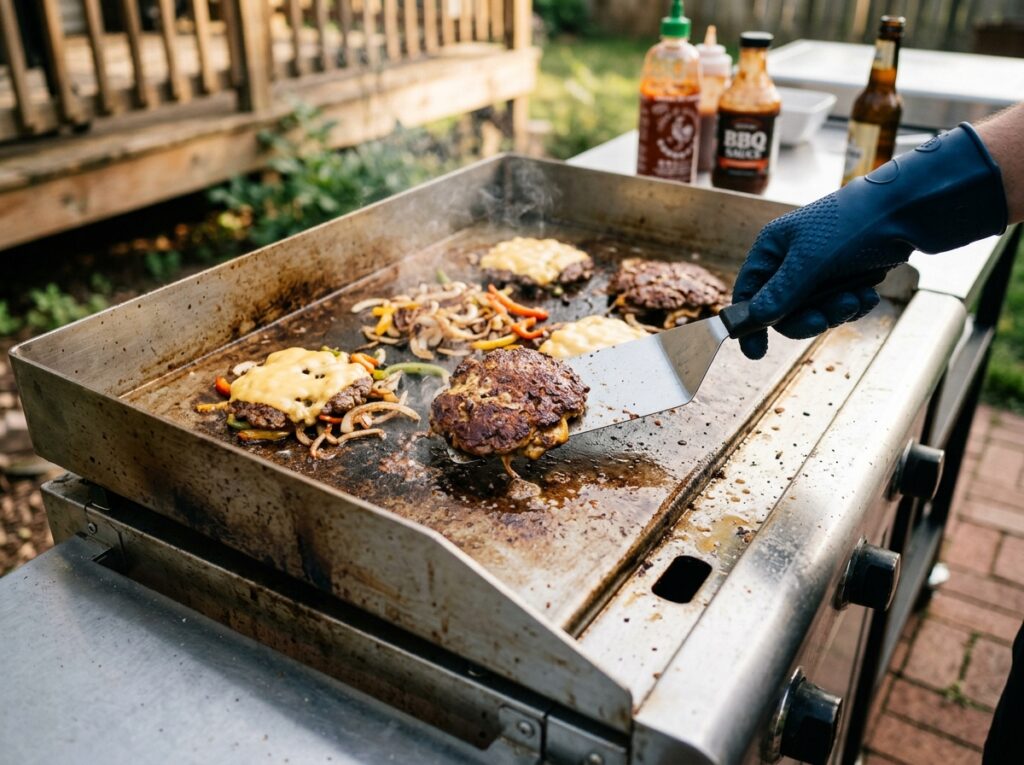
A single flat-top griddle can replace half the appliances cluttering your kitchen counter. Pancakes, smash burgers, stir-fry, bacon for twelve people — all on one cooking surface, all outdoors where the mess stays outside and the flavor goes through the roof. That’s exactly why outdoor griddles have exploded in popularity over the past few years, with Blackstone alone selling over a million units annually.
But here’s the thing. Walk into any home improvement store or scroll through Amazon, and you’ll find dozens of griddles from $80 all the way up to $800. Different sizes, different fuel types, different build quality. Some are genuinely fantastic. Others look great in photos and fall apart after two summers.
So how do you actually pick the right one? That’s what this guide is about. I’m not going to throw twenty product links at you and call it a day. Instead, let’s talk about what makes an outdoor griddle worth your money, which models consistently deliver, and what mistakes people make that leave them frustrated.
Whether you’re feeding a family of four on a Sunday morning or hosting a backyard cookout for twenty, the right griddle changes the game.
Why an Outdoor Griddle and Not Just a Regular Grill?
This is a fair question, and a lot of people wrestle with it before buying. If you already own a gas grill or a charcoal setup, do you really need a griddle too?
The honest answer: it depends on what you cook most often.
A traditional grill gives you flame contact, grill marks, and that unmistakable smoky char. It’s perfect for steaks, burgers with a classic sear, chicken thighs, and anything you want kissed by fire. If you’re curious about how grills and griddles actually stack up head-to-head, there’s a solid comparison between Blackstone griddles and traditional grills that breaks it all down.
A griddle, on the other hand, gives you a completely flat cooking surface. Think of it like a giant cast-iron skillet, but outdoors and way bigger. That flat surface means:
You can cook things that would fall through grill grates. Diced vegetables, eggs, shrimp, fried rice — none of that works on an open grill without extra pans or baskets.
Even heat distribution across a huge area. No hot spots over burners and cold zones between them. A good griddle heats uniformly, so your pancakes on the left cook at the same rate as the ones on the right.
Faster cooking for large groups. A 36-inch griddle gives you roughly 720 square inches of cooking space. That’s enough for 28 burgers at once. Try doing that on a standard grill.
Grease management is built in. Most griddles have a rear grease trap system. The cooking surface is slightly angled so fat runs off naturally. Your food doesn’t sit in its own grease, and cleanup is surprisingly easy.
The tradeoff? You don’t get that smoky, flame-grilled flavor. If smoky flavor is your whole reason for outdoor cooking, a griddle probably isn’t your primary tool. But if you want versatility, speed, and the ability to cook breakfast-to-dinner on one surface — a griddle earns its spot fast.
What to Look for in an Outdoor Griddle
Before I get into specific models, let’s talk about what actually matters. Because brands love to throw around buzzwords and features that sound impressive but don’t really affect your cooking experience.
Cooking Surface Size
This is your single most important decision. Outdoor griddles typically come in four sizes: 17-inch, 22-inch, 28-inch, and 36-inch (measured diagonally or by width, depending on the brand).
17-inch models are great for solo cooking, camping, or tailgating. They’re portable and usually sit on a tabletop. But they’re too small for feeding a family regularly.
22-inch models work for couples or small families. You can cook a reasonable breakfast or lunch for 2–4 people without feeling cramped.
28-inch models hit the sweet spot for most families. Enough room for a full meal — proteins, veggies, and sides — all cooking simultaneously. If you’re buying your first griddle and don’t host huge parties often, 28 inches is probably your answer.
36-inch models are for people who entertain regularly, have large families, or just love having elbow room while cooking. The extra space feels like a luxury until you use it. Then it feels necessary.
Pro Tip: Measure your patio or deck space before falling in love with a 36-inch model. These griddles plus their side shelves can easily span 60+ inches wide. Make sure you have room.
BTU Output (And Why It’s Not Everything)
You’ll see BTU ratings plastered all over griddle specs. A 36-inch Blackstone puts out around 60,000 BTUs. A Camp Chef flat-top might list 48,000 BTUs for the same size.
Does higher BTU mean better? Not necessarily.
BTU measures how much gas the burners consume, not how efficiently that heat reaches your food. A griddle with lower BTUs but better heat retention in its cooktop plate can outperform a higher-BTU model with a thinner plate.
What you actually want is fast heat-up time and consistent temperature across the surface. Those two things matter more than a raw BTU number. Most quality griddles in the 28–36 inch range offer 40,000–60,000 BTUs, and that’s plenty.
Cooktop Material and Thickness
Almost every outdoor griddle uses cold-rolled steel for the cooking surface. It’s the same material used in professional restaurant flat-tops. Cold-rolled steel heats evenly, develops a natural non-stick seasoning over time (like cast iron), and is relatively easy to maintain.
The thickness of that steel plate matters a lot. Thicker plates (around 7-gauge or roughly 3/16 inch) hold heat better and distribute it more evenly. Thinner plates heat up faster but lose temperature quickly when you drop cold food on them. If you’ve ever put frozen hash browns on a griddle and watched the sizzle completely die — that’s a thin cooktop struggling to recover.
Most mid-range and premium griddles use adequately thick steel. Budget models sometimes cut corners here, and you’ll notice it in performance.
Number of Burners and Heat Zones
A griddle with multiple independently controlled burners lets you create different heat zones. That’s a bigger deal than it sounds.
Imagine cooking eggs on low heat on one side while searing steak on high heat on the other side — simultaneously, on the same surface. With a single-burner griddle, you can’t do that. With three or four independent burners, you basically have a multi-zone cooking station.
For 28-inch griddles, look for at least three burners. For 36-inch models, four burners is standard and well worth it.
Wind Guards and Lids
Outdoor cooking means dealing with wind. And wind is the enemy of griddle cooking. A strong breeze can reduce your surface temperature dramatically because there’s no enclosed firebox — the heat rises straight up from an open flat surface.
Wind guards (sometimes called wind screens) wrap around the sides and back of the griddle to block airflow. Some models include them; others sell them as accessories. Either way, if you live in a breezy area or cook on an exposed deck, wind guards aren’t optional. They’re essential.
Lids are a newer addition to the griddle world. Blackstone and Camp Chef both offer hard covers or dome lids now. A lid lets you melt cheese, steam vegetables, or even do light smoking on a griddle. It’s not a must-have, but it adds real versatility.
Grease Management
Every griddle produces grease. How it handles that grease determines how easy cleanup is and how safe your cooking stays.
Rear-draining grease systems are the current standard. The cooktop is angled slightly from front to back, and grease flows into a channel that leads to a removable cup or tray at the rear. This keeps grease away from the burners (which sit underneath the front or middle of the cooking surface) and reduces flare-up risk.
Some older or cheaper models drain to the side or — worse — have no real grease management at all. Avoid those. A clogged or poorly designed grease system is the number one cause of griddle fires.
Best Outdoor Griddles Worth Considering in 2025
Alright, let’s get into the actual models. I’ve narrowed this down to griddles that consistently earn praise from real users, hold up over time, and offer genuine value for their price point.
Blackstone 36-Inch Original Griddle Station
There’s a reason Blackstone dominates this category. They didn’t invent the outdoor griddle, but they made it mainstream, and the 36-inch original model is their bestseller for good reason.
You get four independently controlled burners pushing 60,000 BTUs total across 720 square inches of cold-rolled steel cooking surface. The rear grease management system works cleanly. Two side shelves fold down for storage, and the whole unit sits on a powder-coated steel frame with caster wheels.
What people love most is the heat consistency. After proper preheating (about 10–15 minutes), the surface holds temperature remarkably well across all four zones. You can sear smash burgers on one end and gently cook scrambled eggs on the other without drama.
What’s not perfect? The seasoning on a brand-new Blackstone takes a few sessions to build up properly. Out of the box, food will stick until you develop that non-stick patina. Also, the included igniter buttons are notoriously unreliable across many Blackstone models — keep a long lighter handy.
Price range: $280–$350 depending on retailer and any included accessories.
Best for: Families, entertainers, and anyone who wants the most cooking real estate for the money.
Blackstone 28-Inch Griddle with Hood
If 36 inches feels too big or you have limited patio space, the 28-inch Blackstone with the hard cover hood is a smart pick. You still get a solid 470 square inches of cooking surface with three burners at 37,000 BTUs total.
The hood is the standout feature here. It turns the griddle into a semi-enclosed cooking environment when closed, which means you can melt cheese, warm buns, or even do a rough approximation of steaming. It also keeps the cooking surface cleaner when the griddle is off and covered.
Build quality matches the 36-inch model. Same cold-rolled steel cooktop, same rear grease trap design, same general construction.
What’s not perfect? Three burners on a 28-inch surface means your heat zones are narrower. It’s fine for most cooking scenarios, but if you want to do a true multi-temperature cook with wide zones, the 36-inch gives you more flexibility.
Price range: $230–$300.
Best for: Small families, apartments with modest balcony space, and people who want a hood included out of the box.
Camp Chef Flat Top Grill 600
Camp Chef is a brand that serious outdoor cooks respect deeply, and the Flat Top Grill 600 shows why. It offers 604 square inches of cooking surface with four burners producing 48,000 BTUs.
What sets Camp Chef apart is build quality details that Blackstone sometimes overlooks. The legs feel sturdier. The grease management trough is better engineered — larger, easier to access, and less prone to overflowing during long cooks. The pre-seasoned finish on the cooking surface is also notably better out of the box compared to Blackstone’s bare steel.
Camp Chef also includes a built-in matchless ignition system that actually works consistently. Small thing, but after fighting with failed igniters on other brands, it’s a relief.
What’s not perfect? Camp Chef griddles cost more. You’re paying a 15–25% premium over comparable Blackstone models. Whether that premium is worth it depends on how much you value fit-and-finish versus raw value.
Price range: $350–$450.
Best for: Cooks who want a more polished product and don’t mind paying extra for better construction.
Royal Gourmet Regal GB4001 4-Burner Griddle
If budget is your primary concern, Royal Gourmet consistently offers the most affordable entry point into full-size griddle cooking. The GB4001 gives you a 36-inch surface with four burners at 52,000 BTUs — solid specs for a griddle that often sells under $220.
The cooking surface is thinner than what you get from Blackstone or Camp Chef, and you’ll notice it during temperature recovery. Drop a batch of cold chicken breasts on this griddle and the surface temperature will dip more and take longer to climb back up. For casual weekend cooking, that’s totally fine. For high-volume cooking or restaurant-style speed, it’s a limitation.
The frame and overall build feel a step below the competition. Side shelves are smaller, wheel locks are flimsier, and the powder coating shows wear faster. But — and this matters — the actual cooking performance on food is surprisingly close to models costing twice as much.
What’s not perfect? Longevity is the real question with budget griddles. After 2–3 years of regular use, you’ll likely see more rust and wear than premium models. Proper seasoning and covering the griddle when not in use extends its life significantly.
Price range: $180–$230.
Best for: First-time griddle buyers, occasional cooks, and anyone wanting to try flat-top cooking without a big investment.
Pit Boss Deluxe 4-Burner Griddle
Pit Boss made their name with pellet grills and smokers, and they’ve applied similar thinking to their griddle line. The Deluxe 4-Burner model gives you roughly 757 square inches of cooking surface — that’s notably larger than Blackstone’s 36-inch — with four stainless steel burners at 62,000 BTUs.
The extra cooking space comes from a slightly wider and deeper cooking surface design. It’s not a dramatic difference, but if you regularly cook for crowds, those extra square inches add up. Pit Boss also includes a stainless steel lid as standard equipment on the Deluxe model.
Build quality sits between Blackstone and Camp Chef. Better than budget brands, with some nice touches like a paper towel holder, tool hooks, and a slightly more robust frame. The pre-seasoning on the cooking surface is decent but still benefits from a couple of additional seasoning sessions before heavy use.
What’s not perfect? Pit Boss doesn’t have the same accessory ecosystem as Blackstone. If you want custom-fit covers, press tools, basting domes, and every griddle accessory imaginable, Blackstone’s aftermarket support is unmatched. Pit Boss accessories are available but limited.
Price range: $300–$380.
Best for: People who want more cooking surface than Blackstone offers at a similar price point, and those who already own Pit Boss smokers and want brand consistency.
Portable Pick: Blackstone 17-Inch Tabletop Griddle
Not everyone needs a full-size griddle. If you’re buying specifically for camping, tailgating, RV trips, or just occasional use on a small patio, the Blackstone 17-inch tabletop is the one to get.
It weighs about 30 pounds, runs on small 1-pound propane canisters (or a 20-pound tank with an adapter), and puts out 12,000 BTUs through a single burner. The 268 square inches of cooking surface handles breakfast for 2–3 people or a round of burgers without issue.
For something this portable, it cooks shockingly well. The single burner does create a noticeable hot spot in the center, but once you learn where the heat concentrates, you adjust naturally.
If you’re interested in other portable options for outdoor cooking on the go, the best portable griddle roundup covers some alternatives worth looking at.
Price range: $80–$110.
Best for: Campers, tailgaters, RV owners, and anyone who needs a griddle they can throw in a truck bed.
How to Season a New Outdoor Griddle
You bought your griddle. You assembled it. Now what?
Don’t cook on it yet. Seriously. A brand-new griddle surface is bare steel, and food will stick to it like crazy unless you build a proper seasoning layer first. This process takes about 30–45 minutes, and it’s the single most important thing you’ll do for your griddle’s performance.
Start with a high-heat burn-off. Turn all burners to high and let the griddle run for 15–20 minutes. This burns off any factory oils, coatings, or residue from manufacturing. The surface will discolor and may smoke a bit. That’s normal.
Apply a thin layer of oil. After the burn-off, reduce heat to medium. Using a paper towel held with tongs (the surface is extremely hot), spread a very thin layer of cooking oil across the entire surface. Flaxseed oil, avocado oil, or vegetable shortening all work well. The key word here is thin — you want a barely visible film, not a pool of oil.
Let it smoke and repeat. The oil will start smoking within minutes. That’s polymerization happening — the oil is bonding to the steel surface and creating a natural non-stick coating. Once the smoke stops, apply another thin coat. Repeat this process 3–4 times.
After those initial seasoning layers, your griddle will have a dark, slightly glossy finish. It’ll get better with every cook. After a month of regular use, a well-maintained griddle surface becomes more non-stick than most coated pans.
Quick Fact: Professional flat-top grills in restaurants develop their seasoning over thousands of hours of daily use. That’s why diner eggs and smash burgers taste so good — years of seasoning built into the cooking surface.
Cleaning and Maintenance That Actually Extends Your Griddle’s Life
A lot of griddle owners baby their surfaces with elaborate cleaning routines. Here’s what actually matters.
Clean while the griddle is still warm. After cooking, scrape the surface with a metal griddle scraper to remove food debris. Pour a small amount of water on the warm (not screaming hot) surface. The water will steam and loosen stuck-on bits. Scrape again. Wipe with a cloth or paper towel.
Apply a thin oil layer after every cook. Once the surface is clean and still slightly warm, rub a thin coat of oil across it. This protects the steel from moisture and maintains your seasoning.
Always use a cover. When your griddle isn’t in use, cover it. Rain, morning dew, and humidity are your griddle’s worst enemies. Bare steel plus moisture equals rust, and rust destroys seasoning. A fitted hard cover or a quality vinyl cover makes all the difference.
Don’t use soap on the cooking surface. Soap strips seasoning. If you’ve built up several layers of polymerized oil on your griddle, soap will undo that work. Water, scraping, and a light oil coating are all you need.
⚠️ Warning: If you notice rust spots forming, don’t panic. Scrub the rust off with steel wool or a griddle stone, re-season that area with oil, and investigate why moisture got to the surface. Usually it means the cover wasn’t on or wasn’t sealing properly.
Keeping your griddle tools clean matters too. A solid grill brush designed for flat surfaces helps with maintenance between cooks, and quality grill gloves protect your hands during high-heat cleaning.
Propane vs. Natural Gas: Which Setup Makes More Sense?
Most outdoor griddles ship as propane units, designed to connect to standard 20-pound LP tanks. Some models offer natural gas conversion kits, either included or sold separately.
Propane is more portable and requires no permanent installation. You buy a tank, connect it, and cook. The downside is you’ll run through a 20-pound tank in roughly 8–12 hours of continuous cooking (varies by BTU output). For most home cooks who griddle a few times a week, a single tank lasts several weeks.
Natural gas connects directly to your home’s gas line, giving you an unlimited fuel supply. No tank swaps, no running out of gas mid-cook. The downside is you need a gas line run to wherever your griddle sits, which often means hiring a plumber. And once connected, your griddle isn’t moving — it’s essentially a permanent fixture.
If you’re placing your griddle in a dedicated outdoor kitchen area and you have existing natural gas access nearby, the conversion makes sense. If you want flexibility to move the griddle around your yard or take it to events, stick with propane.
What Can You Actually Cook on an Outdoor Griddle?
More than you think. That’s the real answer. People buy griddles for burgers and breakfast, but the cooking surface handles way more than that.
Breakfast staples are obvious — pancakes, eggs any style, bacon, French toast, hash browns. A griddle is objectively better than a stovetop for breakfast because you can cook everything simultaneously instead of in batches.
Smash burgers are where griddles truly shine. The flat surface gives you maximum crust development. Press a ball of ground beef flat against the hot steel, and the Maillard reaction creates a crispy, caramelized exterior that you simply can’t replicate on grill grates. This is why smash burger restaurants use flat-tops.
Stir-fry and fried rice work beautifully on a griddle at high heat. Toss vegetables, protein, and rice directly on the surface, hit it with soy sauce and sesame oil, and you’ve got restaurant-quality fried rice in minutes.
Philly cheesesteaks, quesadillas, grilled sandwiches, fajitas, hibachi-style meals — the list keeps going. Anything that benefits from a flat, hot surface and direct contact cooking works on a griddle.
What doesn’t work well? Anything that needs indirect heat or long, slow cooking. You’re not smoking a brisket on a griddle. You’re not doing low-and-slow ribs. For those, you need a proper smoker — something like a reliable pellet smoker or an offset smoker designed for that purpose.
And don’t forget the sides. While your protein sizzles on the griddle, you’ll want something alongside it. The best BBQ side dishes guide has plenty of ideas that pair perfectly with griddle-cooked meals.
Common Mistakes New Griddle Owners Make
I see the same errors come up repeatedly in forums, Facebook groups, and Reddit threads. Avoiding these will save you frustration.
Not preheating long enough. A griddle needs 10–15 minutes of preheating on high before you start cooking. Many people get impatient, toss food on after five minutes, and wonder why it sticks or cooks unevenly. Be patient. Let the steel get properly hot.
Using too much oil. More oil doesn’t mean less sticking. Excess oil pools, smokes excessively, and creates a gummy surface instead of a smooth seasoning layer. Thin coats, always.
Cooking everything on high heat. Just because the griddle goes to 500°F+ doesn’t mean everything should cook at that temperature. Eggs on high heat become rubber. Pancakes on high heat burn before the inside cooks. Learn to use your different burner zones and vary the temperature based on what you’re cooking.
Neglecting the grease trap. That little cup or tray at the back fills up faster than you’d expect during a big cook. If it overflows, you’ve got hot grease running down the back of your griddle and potentially onto your deck or patio. Check it during long cooking sessions. Empty it between cooks.
Storing the griddle uncovered. I mentioned this earlier, but it bears repeating. Even one night of rain on an uncovered griddle can create rust spots. Always cover it.
Do You Really Need Expensive Accessories?
Blackstone and other brands sell a ton of accessories — press tools, basting covers, squeeze bottles, spatula sets, carry bags, breakfast kits. It’s easy to spend an additional $150+ on accessories alone.
Here’s what you actually need: two good flat metal spatulas (wide, with a thin edge for scraping), a squirt bottle for water or oil, a metal scraper for cleaning, and a cover for the griddle. That’s your starter kit. Everything else is nice-to-have.
Basting domes (those metal dome covers you place over food) are worth getting. They let you melt cheese, steam cook proteins, and trap heat for faster cooking. You can buy a two-pack for under $15.
Squeeze bottles for oil and water cost a dollar each and make cooking significantly easier than trying to pour from a full-size bottle.
Everything else — griddle-specific tool kits, branded spatula sets, organizer carts — buy it if you want it, but don’t feel like you need it to cook great food. An accurate thermometer matters more than any specialty griddle tool. A quick-read instant read thermometer ensures your proteins hit safe internal temperatures every time.
FAQ
How long does an outdoor griddle last?
With proper care — regular seasoning, cleaning after each use, and covering when not in use — a quality outdoor griddle lasts 5–10 years easily. The cooking surface itself is durable cold-rolled steel that can be re-seasoned and restored even if it gets neglected for a while. The burners and ignition system are typically what fail first, and replacement parts are widely available for major brands like Blackstone, Camp Chef, and Pit Boss.
Can I use an outdoor griddle in winter?
Yes, but expect longer preheating times and slightly lower maximum temperatures. Cold ambient air and wind cool the cooking surface faster. Using wind guards helps significantly. Some people build simple windbreaks around their griddle area for winter cooking. Propane tanks also perform worse in extreme cold — if temperatures drop below 20°F, your tank pressure drops and you may notice weaker burner output. Keeping a spare tank inside your garage (at room temperature) and swapping before cooking helps.
Is a Blackstone griddle worth it over cheaper brands?
For most people, yes. Blackstone hits a sweet spot between price, performance, and accessory availability that cheaper brands can’t match. You’ll pay $50–$100 more than budget options like Royal Gourmet, but you get a thicker cooking surface, better heat distribution, more reliable construction, and access to the largest ecosystem of accessories and replacement parts. If you cook outdoors regularly — say once a week or more — that premium pays for itself in durability alone. For very occasional use, a budget griddle does the job fine.
What’s the best oil for seasoning a griddle?
Flaxseed oil creates the hardest, most durable seasoning layer because of its high concentration of omega-3 fatty acids, which polymerize effectively. It’s also the most expensive option. Avocado oil is a great middle ground — high smoke point, durable seasoning, widely available. Canola oil and vegetable shortening (like Crisco) work perfectly fine and cost very little. Avoid olive oil for seasoning — its low smoke point creates a sticky, uneven coating that flakes off.
Can I convert my propane griddle to natural gas?
Many griddles from Blackstone, Camp Chef, and Pit Boss offer natural gas conversion kits, either included with certain models or sold separately for $30–$60. The conversion involves swapping out the gas orifices in the burners and connecting a natural gas hose. It’s a straightforward process, but if you’re not comfortable working with gas connections, hire a professional. Using the wrong orifice size or having a loose connection isn’t something you want to get wrong.
Your Next Move
Picking the best outdoor griddle really comes down to three things: how many people you regularly cook for, how much space you have, and how much you’re willing to spend. Get those three answers clear in your head, and the right choice almost makes itself.
If you’re feeding a family and hosting friends, a 36-inch Blackstone or Camp Chef gives you the space and performance you need without overspending. If you’re cooking for two or want something for weekend camping trips, a 22-inch or 17-inch model does the job beautifully. And if you’re just testing the waters — a Royal Gourmet or similar budget model lets you experience griddle cooking without committing to a big investment.
One thing I can tell you from personal experience: once you start cooking on a griddle outdoors, you’ll use your indoor stovetop a lot less. There’s something about standing outside on a Saturday morning, watching eggs sizzle on a perfectly seasoned flat-top, knowing you’ve got 700 square inches of cooking space and zero dishes to wash afterward. That’s the feeling that turns occasional griddle users into people who cook outside five nights a week.
Season it well, keep it covered, and cook on it often. That griddle will reward you for years.