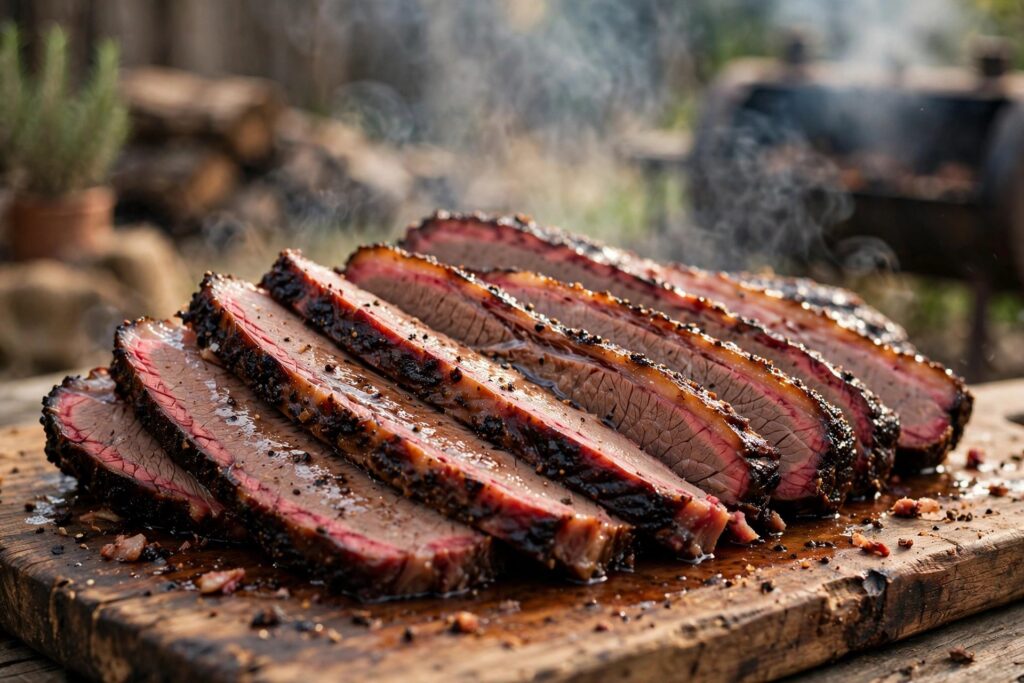
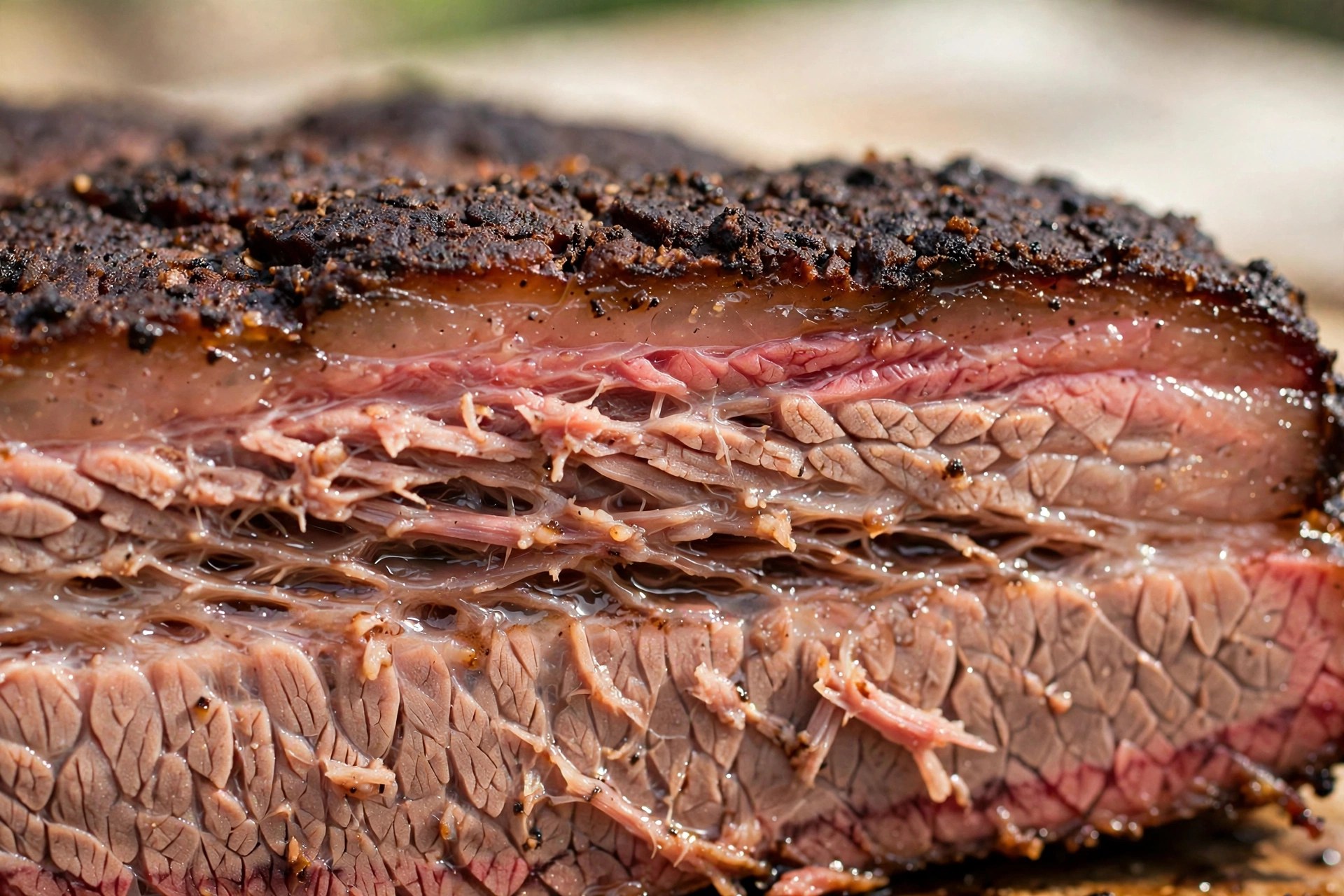
A BBQ smoke ring is the pinkish-red band, usually ⅛ to ½ inch thick, that appears just under the bark of smoked meat. It’s caused by nitric oxide and carbon monoxide from burning wood binding with myoglobin, the meat’s red protein, which locks in a pink color that heat can’t erase. It doesn’t add any flavor — it’s purely visual, a chemical side effect of a good low-and-slow cook.
Slice into a brisket and that rosy halo gets a room talking. People treat it like a badge of honor. Some pitmasters chase it obsessively. Others roll their eyes at it. Both sides are arguing about a chemical reaction that stops mattering roughly two hours into a twelve-hour cook — and neither side is entirely wrong.
Here’s everything about what a smoke ring is, the actual science behind it, why it has zero effect on taste, how to get a great one naturally, and the myths that refuse to die.
What a Smoke Ring Looks Like
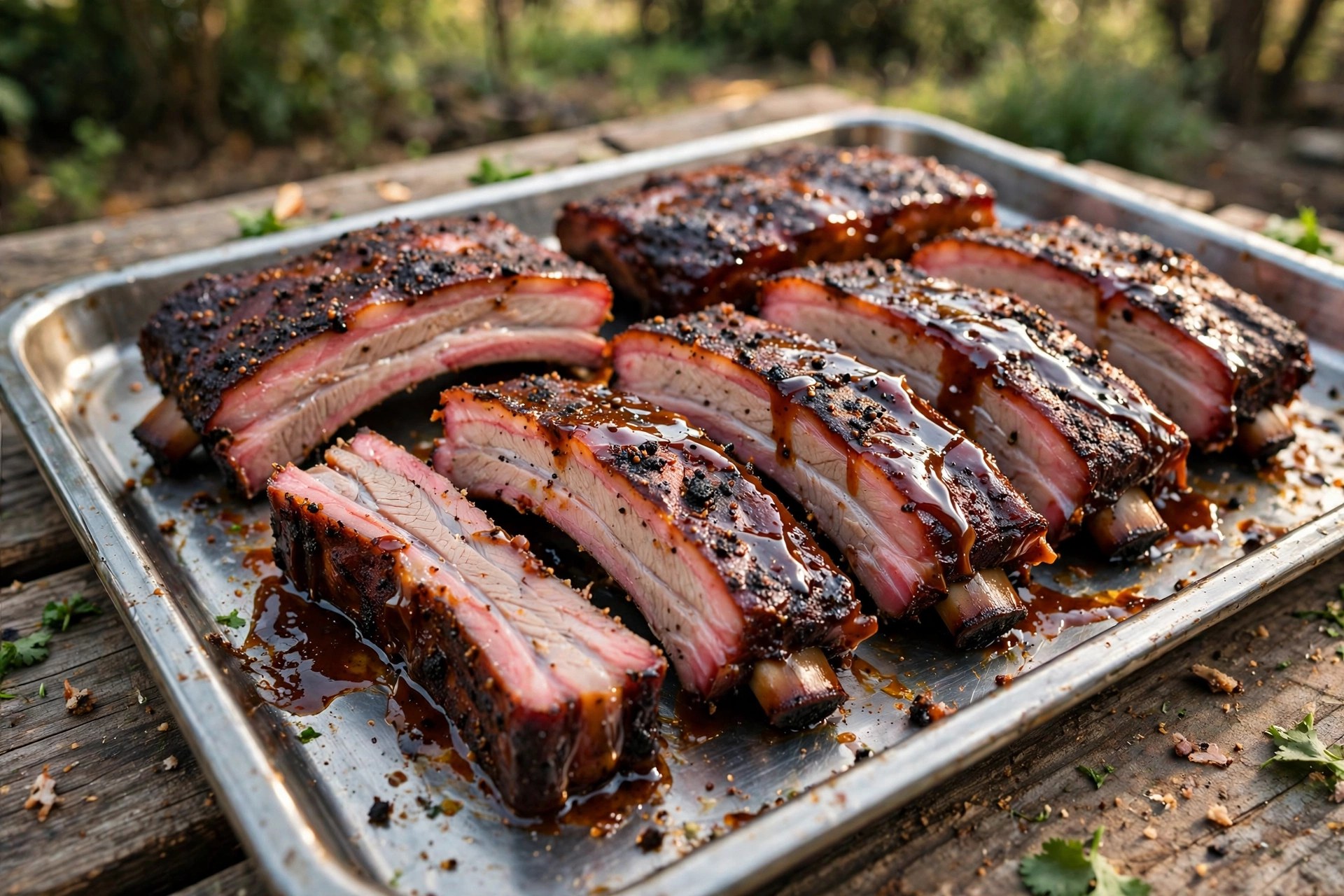
The smoke ring sits right beneath the dark bark, a thin pink band hugging the outer edge of the meat. It’s most dramatic on brisket, where it can run a half inch deep, and thinner on ribs and pork shoulder. On chicken it’s usually faint or invisible.
That’s not a coincidence. Beef carries about four times more myoglobin than pork, and poultry carries far less than either — so the ring’s depth follows the myoglobin. A deep-red beef brisket has far more color to lock in than a pale chicken breast.
One thing the ring never indicates: doneness. Pink under the bark is not pink in the middle. A brisket with a gorgeous ring is still fully cooked at 200°F+ internally; the color stays because the pigment that forms is heat-stable. If you judge doneness by color instead of a thermometer, you’ll either serve unsafe food or badly overcooked food. A reliable thermometer beats your eyes every time.
What Causes a Smoke Ring in BBQ: The Chemistry
Here’s the simple version. Raw meat contains myoglobin, the protein that makes raw beef look red. When you heat meat, myoglobin breaks down and the color turns brown or gray. That’s the normal path.
But when wood or charcoal burns, it releases invisible gases — mainly nitric oxide (NO) and carbon monoxide (CO). Early in the cook, while the meat’s surface is still cool, these gases dissolve into the surface moisture and bind with myoglobin before heat can destroy it. The result is a new pigment — nitric oxide myoglobin (or carboxymyoglobin when CO does the binding) — that is extremely resistant to heat. It stays pink while the rest of the meat browns around it.
Three things limit the ring:
- Penetration depth. The gases can’t push far into dense muscle. They reach the outer layers and stop, which is why the ring lives at ⅛ to ½ inch and never goes deeper.
- Time window. The reaction ends once the meat’s internal temperature climbs past roughly 140°F to 170°F, when myoglobin breaks down and can’t bind anything anymore. Everything after that point is about tenderness and flavor — the ring is finished forming.
- Gas availability. A clean-burning fire with good airflow produces more of these reactive gases than a smoldering, choked fire pumping out thick white smoke. Thin blue smoke builds a better ring than billowing white smoke — which is also why a pellet grill can produce a fine ring with barely visible smoke.
Strictly speaking, “smoke ring” is a misnomer. The visible smoke — the particles that darken your bark and carry smoke flavor — isn’t what paints the ring. As one barbecue science writer put it, it should really be called a “nitrogen dioxide ring.” The ring and the smoky taste arrive on different chemical trains.
Why a Smoke Ring Doesn’t Change the Flavor
This is the part that deflates people. The smoke ring adds nothing to taste or tenderness. Not a little — nothing. The pink pigment has no flavor of its own, and its presence tells you exactly one thing: nitric oxide reached the meat’s surface early in the cook.
Flavor comes from somewhere else entirely: smoke particles settling on the surface, fat rendering, the rub, and hours of patient cooking. You can have a brisket with a spectacular ring that tastes flat, and a brisket with barely any ring that people talk about for weeks.
The competition world learned this the hard way. When pitmasters figured out that curing salts could fake a ring (more on that below), the ring stopped being proof of anything. Today, many professional barbecue competitions explicitly tell judges to ignore the smoke ring when scoring appearance — it’s scored separately from flavor and tenderness. A pretty slice and a delicious slice are different things.
So should you chase it? If it shows up, enjoy the look. But if your meat is tender, juicy, and flavorful, a missing ring is not a failure — it’s just chemistry that didn’t happen to show.
How to Get a Great Smoke Ring Naturally
If you want the ring, everything that helps happens in the first couple of hours. After that window closes, no amount of smoke will add a millimeter. Here’s what actually works, in the order it matters:
- Start with cold meat. Put it on the smoker straight from the fridge. Cold meat stays below the 140°F reaction cutoff longer, buying the gases more time to work. Don’t let it sit on the counter for an hour first.
- Run 225–250°F early. Low, steady pit temps keep the surface cool longer. This is the same low-and-slow range that builds the rest of your barbecue anyway.
- Keep the surface moist. NO and CO have to dissolve into surface moisture to reach the myoglobin. A water pan in the smoker helps, and a light spritz after the bark sets keeps things humid — but don’t wash off your rub.
- Burn clean. Aim for thin blue smoke, not thick white clouds. Good airflow and a hot, oxygen-fed fire produce more of the reactive gases and less of the bitter soot that ruins flavor.
- Use hardwoods. Oak, hickory, and mesquite are the classic choices for strong ring development. Pick your wood to match the meat too — here’s how to choose wood for brisket specifically.
- Don’t wrap early. Foil cuts off smoke exposure and stops ring formation cold. If you use the Texas crutch, wait until the internal temp is past ~150°F — by then the ring has already done all it’s going to do.
- Skip the acid. Vinegar, lemon juice, and other acidic ingredients inhibit ring formation. If your spritz is vinegar-based and you want a ring, spritz later or use water and apple juice instead.
That’s the whole playbook. No soaking wood chips, no magic tricks — just cold meat, low temps, clean fire, and patience through the first hours.
The Nitrate “Cheat” and Why Competitions Banned It
Here’s why the ring lost its credibility as a judging criterion. The pink in a smoke ring is chemically identical to the pink in ham, bacon, and pastrami — cured meats where sodium nitrite preserves myoglobin’s color through cooking. Add a curing agent like Morton Tender Quick or Prague Powder #1 to a rub or brine, and you can manufacture a perfect ring on meat that never saw a wisp of wood smoke.
Even “natural” products do it. Celery seed and celery powder are rich in nitrates, which convert to nitric oxide the same way. That’s why so-called “uncured” bacon still looks pink — the nitrates just arrived from a vegetable instead of a salt.
For backyard cooking, this trick is pointless. It changes the look without changing the flavor, and anyone who knows barbecue can taste that nothing about the smoke improved. In competition, it’s typically prohibited or rendered moot by rules that ignore the ring. Cook the meat well; let the ring be what it is.
Smoke Ring Myths That Won’t Die
Barbecue forums recycle the same claims forever. Let’s clear them up:
| Myth | Reality |
|---|---|
| A deep ring means better BBQ | It means a chemical reaction happened early. Flavor and tenderness are separate matters. |
| More wood = deeper ring | Clean combustion matters more than smoke volume. Thick white smoke can hurt flavor while adding nothing to the ring. |
| No ring means bad BBQ | False. Some of the best briskets ever cooked show only a faint ring. |
| You can fix it later in the cook | Once the meat passes ~140–170°F internal, the window is closed for good. |
| Pellet grills can’t make a ring | They can. The gases form from any clean combustion, even with barely visible smoke. |
| Pink means undercooked | The ring’s pigment is heat-stable. Judge doneness with a thermometer, not color. |
Frequently Asked Questions
Is the pink smoke ring safe to eat?
Yes. The pink color is a stable pigment, not raw meat. A brisket with a smoke ring is fully cooked as long as the internal temperature reached the target — typically 200–205°F for brisket. Color is never a doneness test.
Why does brisket get a better smoke ring than chicken?
Myoglobin content. Beef has roughly four times the myoglobin of pork, and poultry has far less than either. More myoglobin means more pigment available to lock in, so the ring shows up deeper and brighter on beef.
At what temperature does the smoke ring stop forming?
Around 140°F to 170°F internal temperature. Once the meat’s surface heats past that range, myoglobin breaks down and can no longer bind with the gases from the fire. That’s why everything that builds a ring happens in the first hours of the cook.
Can you get a smoke ring on a gas grill or in an oven?
A faint one is possible anywhere combustion gases are present early and the meat stays cool — even some gas grills produce a ring. But curing salts are the only way to get a strong ring without real smoke, and that’s faking it.
Does a smoke ring make the meat taste smokier?
No. Smoky flavor comes from smoke particles depositing on the meat’s surface, not from the gases that create the ring. The two arrive together during a good cook, which is why people confuse them — but they’re separate processes.
The next time you slice a brisket and see that pink halo, admire it for what it is: a little chemistry souvenir from the first hours of your cook. Then forget about it and focus on what actually matters — tender meat, good seasoning, and a clean run through the stall. That’s the part people remember.
[…] brisket tells its own story on the cutting board. The bark should be jet black and peppery, the smoke ring a pink band running about a quarter inch into the meat, and a slice of the flat should drape over a […]