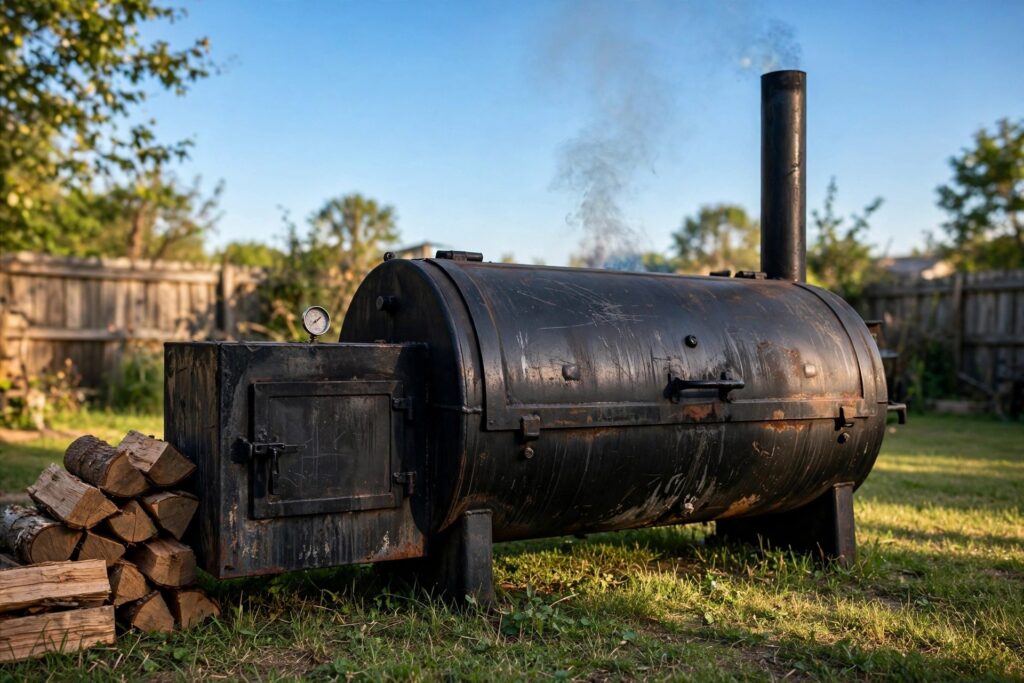
Thin blue smoke is the faint, almost invisible pale-blue exhaust from a clean-burning fire. It means your wood or charcoal is burning hot and efficiently with plenty of oxygen, producing smooth, balanced smoke flavor. Thick white or gray smoke, by contrast, signals smoldering fuel — and that can leave meat tasting bitter or ashy.
Watch a competition pitmaster and you’ll notice they check the chimney as often as the thermometer. Smoke color tells you whether your fire is healthy, whether your food is picking up flavor or trouble, and whether it’s time to put the meat on. Here’s how to read it.
What Is Thin Blue Smoke, Exactly?
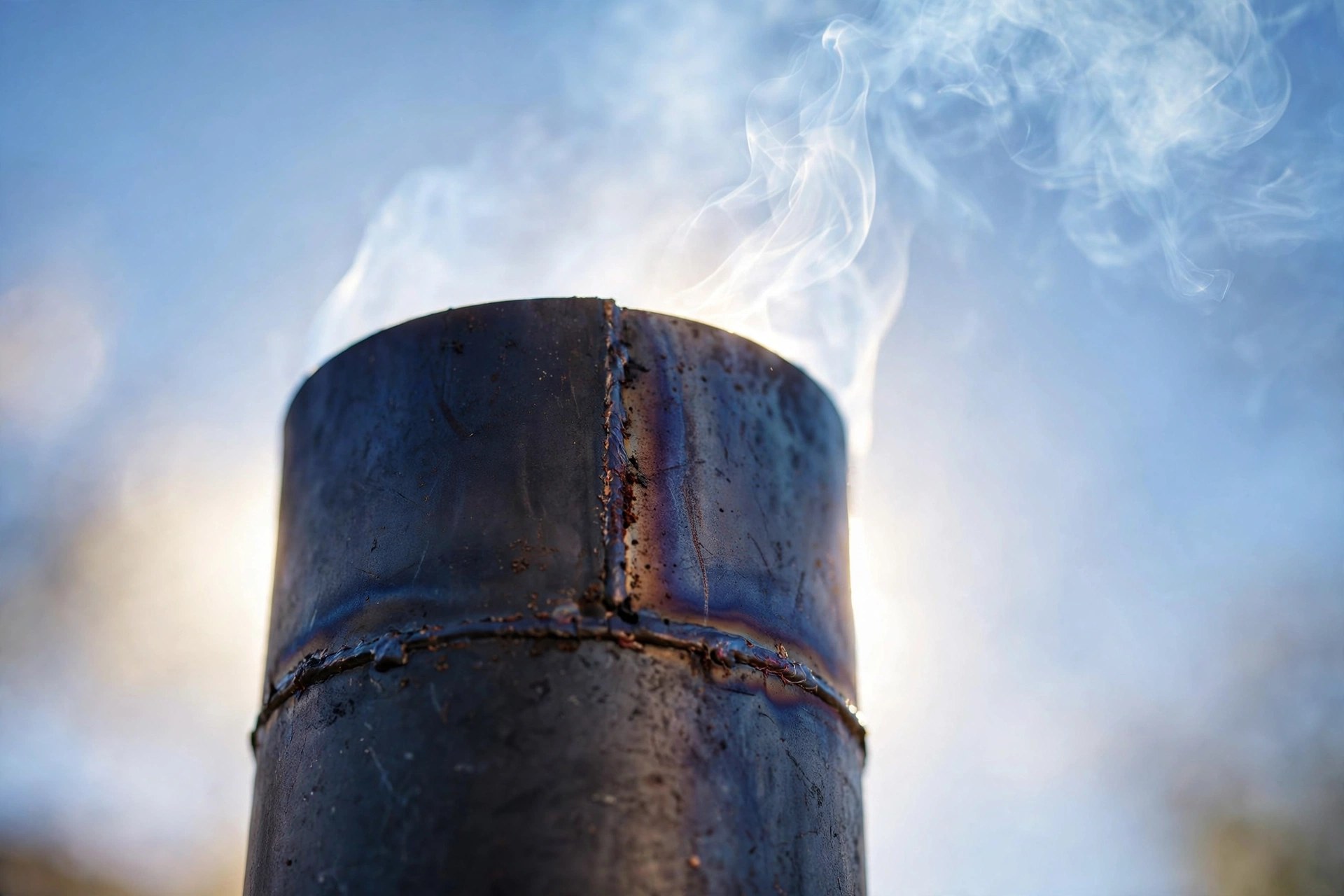
Start with what’s physically happening. When wood burns hot with enough oxygen, combustion is nearly complete: volatile compounds break down into very small particles and gases that rise from the stack as a wispy, almost transparent exhaust. Those tiny sub-micron particles scatter short wavelengths of light more efficiently than long ones — the same physics that makes the sky blue — which is why clean smoke can show a faint blue tint in bright sunlight.
What you actually see, most of the time, is barely anything: a faint shimmer above the stack, a slight haze crossing a sunbeam. If you’re used to smokers pumping out clouds, this feels wrong at first. It’s not. The flavor compounds are still there, riding on clean combustion instead of soot. When hardwood lignin breaks down in a clean fire, it produces syringol (mostly aroma) and guaiacol (mostly taste) — the phenols behind classic sweet-smoky BBQ character. Destination BBQ’s deep dive on blue smoke traces this chemistry to the research: clean combustion delivers these desirable compounds while minimizing the harsh condensates of smoldering wood.
So the working formula is simple: heat + oxygen + dry fuel = thin blue smoke. Cool, oxygen-starved, or damp fuel pushes the fire toward incomplete combustion — bigger particles, heavier condensates, thicker white or gray exhaust, and flavors you don’t want on your brisket.
Why Thin Blue Smoke Matters More Than Your Rub
Here’s an uncomfortable truth for the rub-obsessed: smoke quality affects your finished meat more than any seasoning you can buy. Smoke is a seasoning in vapor form, and like any seasoning, dose and quality both matter. Clean smoke acts like salt used well — it enhances and balances, letting the meat taste like itself. Dirty smoke is the whole shaker dumped at once: acrid, ashy, mouth-coating bitterness.
The mechanism is creosote — the heavy, tarry condensates that form when wood smolders instead of burning. A little is unavoidable and even desirable (it’s part of what builds bark). A lot of it coats your meat in a bitter, tongue-numbing layer no sauce can fix. Meat cooked for hours in thick white smoke doesn’t taste “extra smoky” — it tastes like an ashtray. Dirty smoke is the number one cause behind the damage described in our guides to creosote in BBQ and why smoked meat turns bitter.
Thin blue smoke also does the good work you want from a long cook: it builds bark gradually instead of painting the meat black, develops a defined smoke ring without oversmoking the interior, and layers flavor over hours without accumulating harshness. A 12-hour brisket can only survive that much smoke exposure if the smoke is clean. Experienced pitmasters would rather have a thin stream of clean smoke for the whole cook than a thick cloud for the first two hours.
The myth to kill: more visible smoke does not mean more flavor. It usually means worse flavor. The best BBQ you’ve ever eaten was probably cooked in smoke you could barely see.
Reading Your Smoke: Blue vs White vs Gray
Smoke color is a diagnostic tool. Here’s the quick reference:
| What you see | What it means | Flavor outcome | What to do |
|---|---|---|---|
| Thin blue / nearly invisible | Clean combustion, plenty of oxygen | Clean, balanced smoke flavor | Maintain airflow; feed small, dry fuel |
| White, billowy | Startup steam, damp or smoldering fuel | Acrid, ashy notes if prolonged | Let the plume clear; open vents; use drier fuel |
| Gray, dull haze | Oxygen-starved fire, dying coals | Flat, stale, increasingly bitter | Open exhaust fully; knock ash off coals |
| Dark gray / black | Grease fire or choked combustion | Sooty, acrid | Check for grease buildup; open all vents |
Context matters, though. Thick white smoke at startup is completely normal — steam and heavy aerosols from fuel that hasn’t fully caught, clearing on its own as the fire establishes. The problem is only white smoke that persists 20–30 minutes into the cook. Learn to distinguish the two and you’ll stop panicking at ignition and start noticing real problems.
Lighting changes what you see, too. Smoke that looks thin and gray in shade can show its blue tint in direct sunlight. Don’t chase an exact color — read the whole picture: how thick is the exhaust, how fast is it moving, and what does it smell like.
The smell test: your most reliable tool
If smoke color is the dashboard, smell is the engine diagnostic. Your nose is more sensitive and more honest than your eyes, and every experienced pitmaster uses it constantly.
Walk up to the exhaust stream and take a careful sniff (not a deep lungful). Clean smoke smells pleasant: sweet, woody, faintly like a campfire in the best way. It smells like something you’d want your food to taste like — if the smoke smells good, the food will taste good.
Dirty smoke announces itself: acrid, sharp, eye-stinging, or sour, like a campfire someone threw a wet log on. If the smell makes you pull your head back, that same chemistry is landing on your meat. Trust the recoil. Make it a habit at three moments: when you first light the smoker, right before the meat goes on, and every time you add fuel during a long cook.
How to Get Thin Blue Smoke, Step by Step
Clean smoke isn’t luck — it’s a repeatable process. Here’s the sequence:
1. Start with dry fuel. The single biggest factor. Use seasoned hardwood with 12–20% moisture content — split and dried for 6–12 months. Wet or green wood spends its energy boiling off water instead of burning, and that steam-plus-smolder is the classic source of thick white exhaust. Never soak your wood chunks. The right wood for smoking matters for flavor, but dryness matters more for smoke quality.
2. Light it fully before you cook. Don’t put meat on a smoker that’s still waking up. Light your coals — a chimney starter gets them fully lit and ashed over — and let the cooker come up to temperature with the thick startup plume blowing through. Wait until that plume thins out and the exhaust turns wispy. Same discipline as preheating your smoker properly; the two go hand in hand.
3. Run the exhaust wide open. The stack or top vent stays 100% open, always. The exhaust is not a temperature control — it’s the chimney that pulls fresh air through the fire. Choking it is the fastest way to create dirty smoke.
4. Control heat with the intake only. Adjust at the intake vents, in small moves. Open a crack to raise temps, close slightly to lower them, and wait 5–10 minutes between adjustments for the fire to respond. Big vent swings starve the fire, then flood it — both produce dirty smoke.
5. Feed a small, hot fire. Add one small, dry piece of wood at a time, while there’s still visible flame — the new piece should catch fire, not smolder. A small hot fire with frequent modest additions burns far cleaner than a big load smoldering away. For offsets, that’s one small split every 20–45 minutes; for a Weber Smokey Mountain, about one chunk per hour.
6. Keep ash and grease under control. Ash smothers coals and chokes airflow — knock it off the coals during long cooks. Grease is worse: drippings hitting hot metal produce thick, acrid grease smoke no vent adjustment fixes. Keep grates scraped and drip pans emptied.
Fire and Vent Control by Cooker Type
The principles are universal, but the knobs differ by cooker:
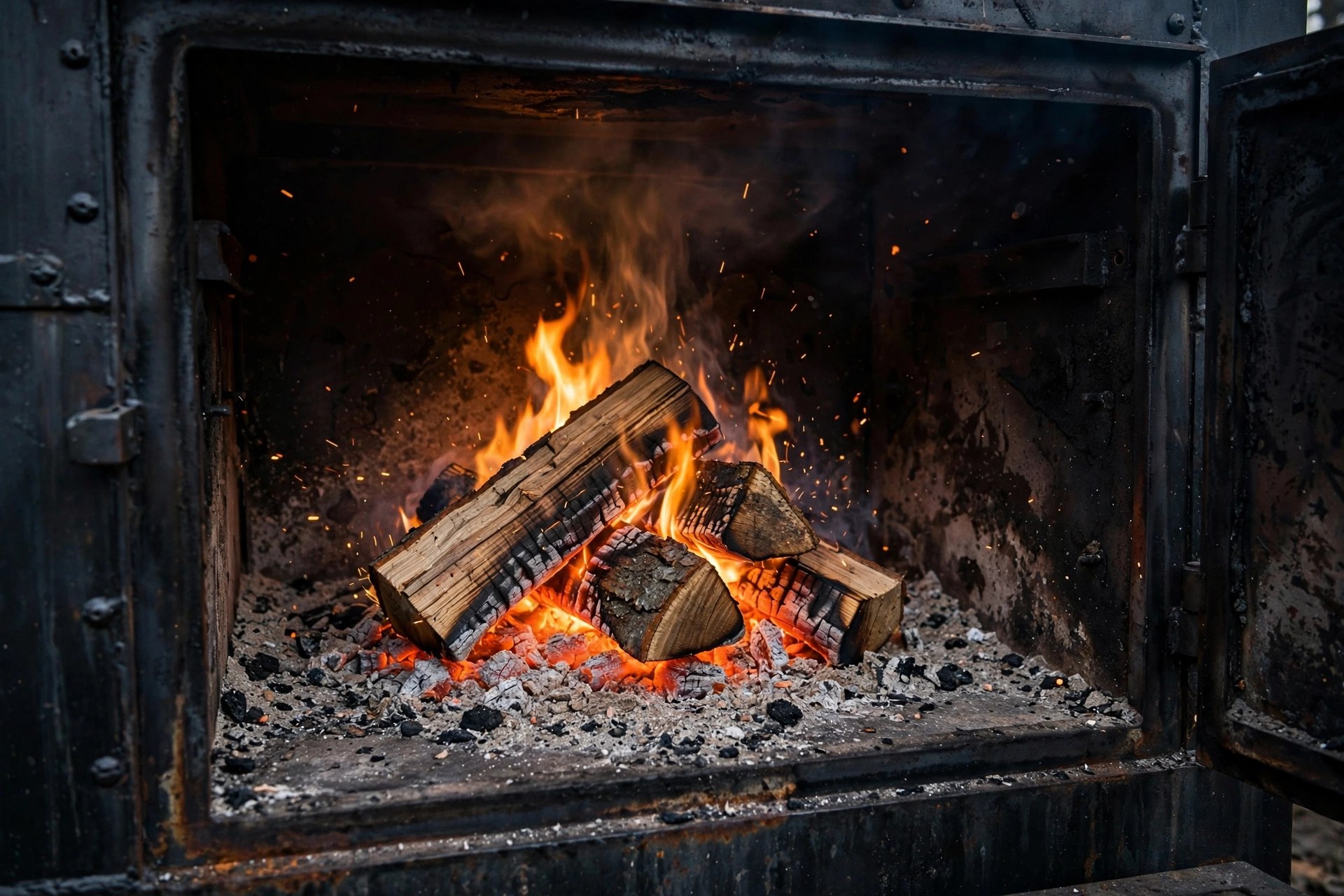
- Offset / stick burner. Keep a small flaming fire in the firebox — visible flame, not just glowing coals. Add small, dry splits while flame is present; if white smoke appears, crack the firebox door until the new wood flames up. Exhaust stays fully open; steer temperature with the firebox intake and split size. Knock ash off the coals hourly.
- Weber kettle. Run a two-zone fire or the snake/fuse method: bank unlit coals to one side, let a small lit section burn progressively around. Top vent fully open, meter with the bottom vent, lid vent over the food side. Keep wood chunks small and well-spaced — buried chunks smolder.
- Weber Smokey Mountain / vertical. Start lit coals over unlit (the Minion method) so the fire grows into a clean burn. Top vent open, bottom vents starting around 25%, adjusted in small steps. Keep the water pan filled and grates grease-free.
- Pellet grill. The easiest path: the controller and fan handle combustion. Expect a short white plume at ignition, then clean exhaust once the controller settles. Persistent white smoke means checking pellet quality (swollen or crumbly = moisture), cleaning the burn pot, and confirming the chimney cap has a visible gap.
- Kamado. Light a small spot in the center of the charcoal and let the fire spread slowly. Start vents wide for heat-up, then dial down in small steps. Kamados are so airtight that overshooting is easy — sneak up on your target rather than chasing it down.
One caution on the kettle snake method: as each new chunk ignites along the fuse, it can briefly produce less-than-ideal smoke. Keep chunks small and well-spaced and the effect is negligible — one more reason to favor modest fuel over big loads.
When to Put the Meat On
The rule of thumb: add meat when the exhaust turns wispy or nearly clear and the cooker has held target temperature for about five minutes. Not one or the other — both. A cooker can hit temperature while still blowing startup smoke, and it can blow clean while still climbing.
Typical wait times once fuel is properly lit (add ~10 minutes in cold, wet, or windy weather, and judge by look and smell rather than the clock):
| Cooker | Add meat when you see… | Typical wait |
|---|---|---|
| Offset (stick burner) | Visible flame in the firebox, wispy to near-clear exhaust at the stack | 10–20 minutes |
| Pellet grill | The short white startup plume settled into light, steady exhaust | 5–10 minutes |
| Kamado / WSM | No billowing white smoke, stable target temp with vents set | 15–25 minutes |
| Kettle | Coals fully ashed over, added wood lit and flaming rather than smoldering | 15–20 minutes |
What if the meat’s already on and the smoke turns dirty? Don’t panic, and don’t pull the meat. Fix the fire — open the intake, knock the ash, remove the offending wet chunk if you can reach it — and wait 5–10 minutes. A brief dirty spell early in a long cook is survivable; hours of it is not. The meat is most vulnerable in the first couple of hours, when the surface is moist and absorbing compounds fastest.
Fixing Dirty Smoke Fast
When the exhaust goes thick and white mid-cook, work through this checklist in order:
- Open the exhaust fully if it isn’t already — a choked stack is the most common cause and the fastest fix.
- Crack the intake 10–20% and wait 5–10 minutes. More oxygen usually cleans up a smoldering fire.
- Check your last fuel addition. A big or damp piece is the likely culprit — pull it out if you can, or crack the firebox door until it flames up.
- Knock ash off the coals. A heavy ash layer smothers the fire from below; a few taps with a poker restores airflow.
- Look for grease. If the smoke smells acrid-greasy rather than woody, drippings are hitting something hot. Check the drip pan and grates.
- On a pellet grill: inspect pellets for swelling or crumbling (moisture), clean out the burn pot, and confirm the chimney cap isn’t seated too low.
As Grill Masters Club puts it, the best pitmasters aren’t just temperature managers — they’re fire and smoke managers. The fixes above take minutes, and they separate the cooks that make people close their eyes on the first bite from the ones that make them reach for water.
Frequently Asked Questions
What is thin blue smoke in BBQ?
Thin blue smoke is the wispy, almost invisible pale-blue exhaust from a clean-burning fire. It signals efficient combustion — hot fire, plenty of oxygen, dry fuel — with very few sooty particles or harsh condensates. Meat cooked in it picks up clean, balanced smoke flavor instead of bitterness.
Is thin blue smoke actually blue?
Sometimes, in bright sunlight, you can catch a faint blue tint — sub-micron particles scattering short light wavelengths. Most of the time it just looks like a faint shimmer or near-invisible wisp above the stack. Judge by thickness and smell more than exact color.
Why is my smoker producing thick white smoke?
Usually one of four things: the fire isn’t fully lit yet (normal at startup — wait it out), the wood is damp or green, the vents are choking the fire, or you added too much fuel at once. Open the exhaust fully, crack the intake, and feed smaller, drier pieces.
Can you have too little smoke?
On most cookers, no — if wood or charcoal is burning, flavor compounds reach the meat even when the exhaust is invisible. The exception is pellet grills at high temperatures, where ultra-efficient combustion drops smoke flavor noticeably. “Barely visible” on an offset or kettle is exactly right.
Does thin blue smoke affect the smoke ring?
Not directly. The smoke ring forms when nitrogen dioxide interacts with the meat’s myoglobin in the first couple of hours, regardless of smoke color. Clean smoke just gives you a defined ring without the bitter, oversmoked flavor that often comes with the thick white smoke people wrongly associate with “good” rings.
Thin blue smoke is the quiet skill behind great BBQ. Nobody applauds the exhaust stream, but everyone tastes the difference. Start watching your stack the way you watch your thermometer — wispy and sweet-smelling means cook on, thick and acrid means fix the fire. Next cook, try the smell test before the meat goes on. You’ll never skip it again.
[…] residues in a smoker, and telling them apart is a genuinely useful skill. Read our breakdown of thin blue smoke to see what clean combustion looks like from the […]
[…] smoke you chase on the big pit: thin, pale, and sweet-smelling rather than choking. Our guide to thin blue smoke explains what clean combustion looks like and why it tastes the way it does, and every word of it […]