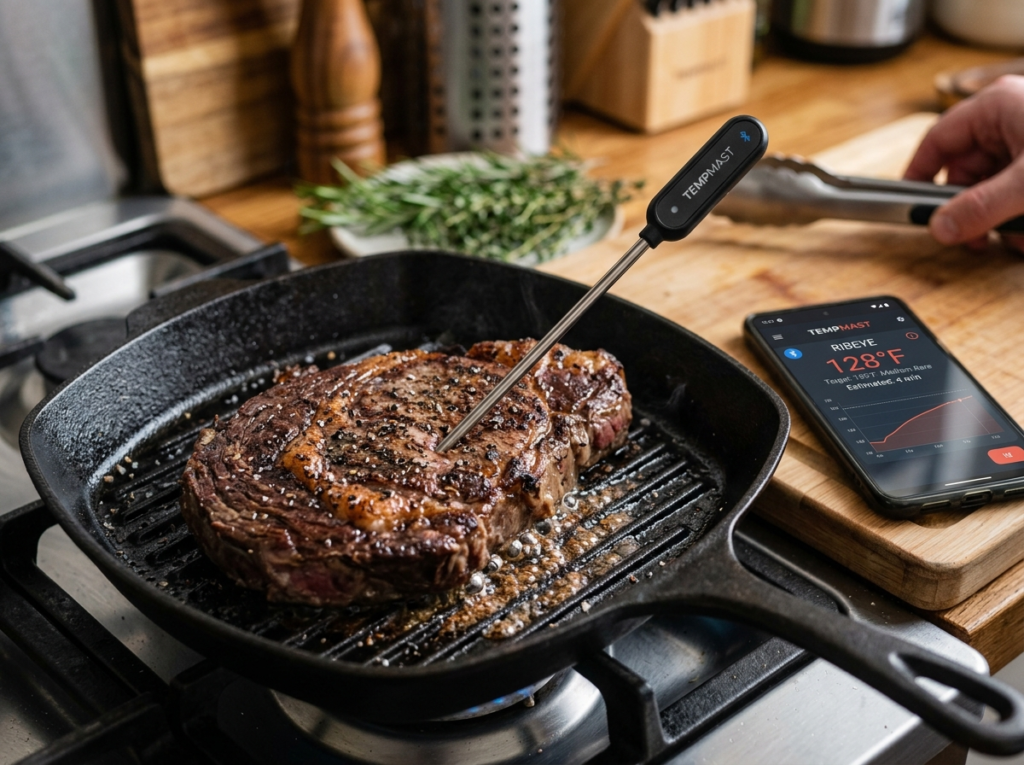
A two-degree difference can turn a perfect brisket into a dry disappointment. That’s not an exaggeration — it’s something every pitmaster and backyard griller eventually learns the hard way. And the frustrating part? You can do everything else right — nail the seasoning, maintain your fire, wrap at the perfect moment — but if your internal temperature reading is off, you’re rolling the dice with your cook.
That’s exactly where a reliable best wireless meat thermometer earns its place in your setup. You don’t have to stand next to the grill for hours, opening the lid every twenty minutes (and losing heat every single time). You get real-time temperature updates right on your phone, whether you’re inside watching a game, mowing the lawn, or just enjoying a cold drink on the porch.
But here’s the thing — the market is flooded with options. Some cost $30 and claim to do everything. Others cost $200+ and look like they belong in a NASA lab. So which ones actually work? Which ones won’t lose their Bluetooth connection the moment you step ten feet away? And which ones give you accurate, dependable readings cook after cook?
I’ve spent serious time testing, comparing, and researching the top wireless meat thermometers available right now. This isn’t a list of twenty random products. It’s a carefully narrowed-down selection of thermometers that genuinely perform — whether you’re smoking a pork butt low and slow, reverse-searing a steak, or roasting a turkey on Thanksgiving.
Let’s get into it.
Why a Wireless Meat Thermometer Changes Everything
If you’ve ever used a basic dial thermometer or even a wired leave-in probe, you already understand the value of monitoring internal meat temperature. But wireless models take it to a completely different level.
Think about a long smoke session. You’re cooking a brisket that might take 12 to 16 hours. With a wired thermometer, you’re tethered. You need to be near the unit to check readings. With a wireless meat thermometer, those readings come straight to your smartphone — some models even send alerts when your target temperature hits.
The real advantage? You stop opening the lid. Every time you lift that lid, you lose 15–25°F of heat and extend your cook time. A wireless probe sitting inside the meat sends continuous data without you touching anything. Your cook stays consistent, and your results improve dramatically.
There’s also the safety factor. Poultry needs to hit 165°F internally. Pork should reach at least 145°F (or 195–203°F if you’re pulling it). Guessing these numbers isn’t just risky for taste — it’s a food safety issue. A good wireless thermometer removes all the guesswork.
If you’re someone who’s already invested in a quality pellet grill or offset smoker, skipping on a proper thermometer is like buying a sports car and never checking the oil.
What to Look for Before You Buy
Before jumping into specific products, you need to understand what separates a genuinely good wireless meat thermometer from one that’ll frustrate you within a month.
Accuracy and Speed
This is non-negotiable. Your thermometer should read within ±1°F of the actual temperature, and it should reach that reading quickly. Cheaper models can be off by 5–10 degrees, which is the difference between a perfectly pulled pork butt and one that’s still tough. Look for thermometers with thermocouple or high-quality thermistor sensors — they tend to be faster and more precise than basic NTC sensors.
Wireless Range and Connection Type
There are three main connection types you’ll see: Bluetooth, Wi-Fi, and hybrid (Bluetooth + Wi-Fi).
Bluetooth-only models are cheaper but limited in range — usually 100 to 200 feet in open air, and much less if there are walls between you and the grill. Wi-Fi models connect through your home network, so you can monitor from anywhere — even from another city, technically. Hybrid models give you the best of both worlds, using Bluetooth for nearby connection and Wi-Fi for extended range.
If your grill is close to your back door and you’re never far from it, Bluetooth works fine. But if you want the freedom to go anywhere during a long cook, Wi-Fi connectivity is worth the extra cost.
Number of Probes
Some thermometers come with one probe. Others come with four or even six. If you’re only cooking a single piece of meat, one probe might be enough — but here’s something most people don’t think about: you want to monitor both the meat temperature and the ambient grill temperature simultaneously. That takes two probes minimum.
If you’re cooking multiple items — say a brisket and some ribs at the same time — you’ll want at least three or four probes. Most serious pitmasters find two-probe setups to be the sweet spot for everyday grilling, while four-probe systems are ideal for competition-style cooks or big family gatherings.
App Quality
This is where a lot of brands fail. The thermometer itself might be great, but if the companion app is clunky, slow, crashes often, or lacks useful features, you’ll hate using it. The best apps offer preset temperature targets for different meats, cook history tracking, graph views of temperature over time, and customizable alerts.
Read app reviews separately from product reviews. A thermometer with a great build but a terrible app is a bad buy.
Build Quality and Probe Durability
Probes take a beating. They sit inside 225°F+ environments for hours. They get washed, sometimes bent, and occasionally dropped. Look for probes rated to handle at least 500°F, and check whether replacement probes are easy to find and affordable. There’s nothing worse than a $150 thermometer that becomes useless because a $15 probe broke and you can’t find a replacement.
Battery Life
For base-station models, battery life usually isn’t a concern since many plug in. But for true wireless probes (the kind with no wires at all — the sensor is completely inside the probe itself), battery life matters. Some truly wireless probes last 24+ hours per charge. Others barely make it through an 8-hour cook. Always check this spec, especially if you do long smokes.
Top Wireless Meat Thermometers for 2025
Here are the models I recommend after extensive research and hands-on comparison. Each one excels in different areas, so I’ve organized them by use case.
ThermoWorks Signals — Best Overall for Serious Cooks
ThermoWorks has a reputation in the temperature measurement world that few brands can match. Their Signals model is a four-channel thermometer that connects via both Bluetooth and Wi-Fi, giving you maximum flexibility.
Accuracy sits at ±1.8°F, which is excellent. The probes are rated to 572°F, and each channel can be set to a different target temperature with high and low alarms. The app is clean, stable, and gives you real-time graphing of all four probes.
What really sets the Signals apart is its build quality. The base unit is splash-proof, the buttons are responsive, and ThermoWorks’ customer support is top-tier. Replacement probes are readily available. It’s not the cheapest option — typically around $229 — but if accuracy and reliability matter to you more than saving a few bucks, this is the one.
Best for: Long cooks, multi-probe monitoring, anyone who demands lab-grade accuracy.
MEATER 2 Plus — Best Truly Wireless Probe
If you hate dealing with cables, the MEATER 2 Plus is your answer. There are no wires at all — the probe itself contains the sensors, battery, and transmitter. You stick it into the meat, close the lid, and get readings on your phone.
The latest MEATER 2 Plus model (released in 2024) improved significantly over the original. Bluetooth range now reaches up to 800 feet with the included MEATER Block charger, and it supports Wi-Fi through the MEATER Cloud for unlimited range. The app uses a guided cook system that actually estimates how long your cook will take and alerts you when to pull the meat.
There are a couple of trade-offs to know about. The probe’s internal ambient sensor can be affected by its position relative to the heat source, so placement matters. And because the electronics are inside the probe, the maximum internal temperature rating is 212°F for the internal sensor (the ambient tip handles up to 527°F). For most BBQ applications — smoking, roasting, grilling — this is perfectly fine.
Best for: People who want a cable-free experience, oven cooks, casual to intermediate grillers.
ThermoWorks Smoke X4 — Best Value Multi-Probe
The Smoke X series from ThermoWorks is kind of the workhorse option. The X4 gives you four probe channels with a dedicated receiver unit (no phone needed, though an app is available too). The receiver has a long range — up to 2,500 feet line of sight — and uses RF signal, which is far more reliable than Bluetooth alone.
Having a dedicated receiver is actually a huge advantage. Your phone’s battery dying mid-cook won’t affect anything. The receiver sits on your kitchen counter, shows you all four temperatures at a glance, and alarms loudly when your target is hit.
At roughly $150, the Smoke X4 hits a sweet spot between price and performance. Probes are accurate to ±1.8°F, durable, and easy to replace. If you don’t need Wi-Fi connectivity and prefer a more traditional setup with a physical display, this is hard to beat.
Best for: Budget-conscious pitmasters, anyone who doesn’t want to rely solely on a phone app.
Typhur InstaProbe — Honorable Mention for Instant Reads
I know — this article is about wireless leave-in thermometers. But I’d be doing you a disservice if I didn’t mention the Typhur InstaProbe for those moments when you need a quick spot-check. It reads in under 0.5 seconds (yes, half a second) with ±0.5°F accuracy. It’s not a leave-in wireless model, but it pairs beautifully with one.
Think of it this way: use your wireless probe for continuous monitoring during the cook, and pull out the InstaProbe at the end to verify the reading and check multiple spots. If you’re curious about how instant read models compare generally, you might want to look at our breakdown of the best instant read thermometers as well.
FireBoard 2 Pro — Best for Data Nerds
If you’re the type who wants to log every temperature point, analyze graphs, and control your fan attachment to regulate pit temperature automatically, the FireBoard 2 Pro is built for you.
It supports up to six probes, connects via Bluetooth, Wi-Fi, and even cellular (with an optional add-on), and its cloud-based app stores every cook session. You can compare today’s brisket cook against last month’s, side by side.
The Drive mode (sold separately) is what really makes FireBoard unique. It connects to a variable-speed fan that attaches to your smoker’s intake vent. The FireBoard adjusts fan speed automatically to maintain your set pit temperature. It essentially turns any kamado grill or charcoal smoker into a set-it-and-forget-it cooker.
At $199 for the base unit (plus $59 for the Drive fan kit), it’s an investment. But for competition cooks and data-driven grillers, nothing else gives you this level of control.
Best for: Competition pitmasters, tech-savvy grillers, automatic pit temperature control.
How to Set Up and Use a Wireless Meat Thermometer Properly
Buying the right thermometer is only half the equation. Using it correctly is what actually improves your cooks.
Probe Placement Matters More Than You Think
Always insert the probe into the thickest part of the meat, aiming for the geometric center. Avoid touching bone, fat pockets, or the grill grates — all of these give false readings.
For brisket, insert the probe from the side into the thickest section of the flat. For pork butt, go straight into the center from the top. For poultry, the deepest part of the thigh (without touching the bone) gives you the most reliable reading — the breast finishes faster than the thigh, so if the thigh is done, you’re good.
Pro Tip: If you’re cooking something like baby back ribs using the 2-2-1 method, probe placement can be tricky because the meat is thin. In that case, insert the probe at an angle, parallel to the bone, keeping it within the meat layer. Or use the ambient probe to track your pit temperature closely and rely on the bend test for doneness.
Calibrating Your Probes
Even expensive probes can drift over time. Test yours by putting the probe tip into a glass of ice water (it should read 32°F) and then boiling water (212°F at sea level — adjust for altitude). If your readings are more than 2°F off, most quality brands let you calibrate through the app or the base unit.
Do this every few months, or any time you suspect your readings seem off.
Ambient Temperature Monitoring
I mentioned this earlier, but it deserves its own section. Monitoring your pit temperature alongside the meat temperature is one of the most valuable things a multi-probe setup gives you.
Your grill’s built-in thermometer — that dial on the lid — is almost always inaccurate. It measures the temperature at the lid, not at the grate level where your food sits. These two numbers can differ by 25–50°F. Placing an ambient clip or a second probe at grate level gives you the real picture.
This is especially important if you’re smoking a brisket or managing a long pork butt cook, where even small temperature swings over many hours affect your final result significantly.
Common Mistakes People Make With Wireless Thermometers
Trusting a Single Reading at One Spot
Meat isn’t perfectly uniform. A brisket flat might be 200°F in one spot and 190°F two inches away. Before you pull your meat, probe it in at least two or three different spots with an instant read thermometer to confirm doneness throughout.
Ignoring the Stall
If you’re new to low and slow cooking, you’ll see your meat temperature climb steadily until it hits somewhere around 150–170°F — and then it just… stops. For hours. This is the stall, and it’s caused by evaporative cooling (the same science behind sweating). Your wireless thermometer isn’t broken. It’s actually showing you exactly what’s happening.
Don’t crank up the heat in a panic. Either wait it out or wrap your meat in butcher paper or foil. The 3-2-1 ribs method accounts for this stall by design — the wrapping phase pushes through it efficiently.
Not Protecting the Cable Entry Point
For wired-probe wireless thermometers (where the probe has a cable running to a base unit outside the grill), the cable passes through the lid seal. Over time, the repeated closing of the lid can damage the cable at this pinch point. Route the cable through a natural gap or vent, not through the main lid seal, and check for fraying regularly.
Exposing the Base Unit to Rain or Extreme Heat
Even splash-resistant models aren’t waterproof. Keep the base unit or charging block away from direct rain and out of intense radiant heat from the grill. I’ve seen people set their MEATER block right next to a screaming hot kettle grill — that’s a fast way to damage the electronics.
Bluetooth vs. Wi-Fi vs. RF: Which Connection Is Best?
This question comes up constantly, and there’s no single right answer — it depends on how you cook.
Bluetooth is the simplest and cheapest. Pair your phone, get readings. But it’s limited by range and obstructions. Walk behind two walls and into your basement? You might lose the signal. For quick grills and oven roasts where you’re nearby, it works perfectly.
Wi-Fi connects through your home network, so range is essentially unlimited as long as you have internet. You can monitor from your office, the grocery store, or theoretically from another country. The downside? Setup can be fussier, and if your home Wi-Fi goes down, so does your monitoring.
RF (Radio Frequency) is what models like the ThermoWorks Smoke X series use. It’s a dedicated signal between the transmitter (at the grill) and the receiver (with you). No phone required, no Wi-Fi dependency, and range can hit 2,000+ feet. The trade-off is you can’t monitor remotely beyond the receiver’s range, and you’re carrying a separate device.
Many 2025 models now offer hybrid connections — Bluetooth for close range, Wi-Fi for extended monitoring. This combo gives you the most flexibility. If you cook at home mostly and want the simplest reliable solution, a Bluetooth + Wi-Fi hybrid is the way to go.
Do You Really Need to Spend $200+?
Honest answer: probably not, unless you cook frequently and demand precision.
A $50-80 wireless thermometer with two probes and Bluetooth will serve most home cooks perfectly well. You’ll get temperature readings, phone alerts, and basic app features. For the weekend griller who does burgers, chicken, and the occasional pork shoulder, that’s plenty.
The jump to the $150-250 range gets you things like Wi-Fi connectivity, multiple probes, better build quality, longer probe lifespan, and significantly better apps. If you’re smoking meat every weekend, cooking for large groups, or you simply want the peace of mind that your readings are accurate every single time — the investment pays for itself quickly.
Think about it this way. A quality brisket costs $60-80. Overcook it because of a bad temperature reading, and you’ve wasted more than the price difference between a cheap and premium thermometer.
If you’re also shopping for grill accessories to round out your setup, take a look at our guides on the best grill gloves and best grill tools — having the right gear around the grill makes every cook smoother.
Quick Comparison: Top Wireless Meat Thermometers at a Glance
Here’s a fast reference to help you compare the models discussed above:
ThermoWorks Signals — 4 probes, Bluetooth + Wi-Fi, ±1.8°F accuracy, ~$229. Best for serious pitmasters who want no compromises.
MEATER 2 Plus — 1 truly wireless probe (expandable), Bluetooth + Wi-Fi Cloud, ~$130. Best for a completely cable-free experience.
ThermoWorks Smoke X4 — 4 probes, RF with dedicated receiver, ±1.8°F accuracy, ~$150. Best value for reliable multi-probe monitoring without needing a phone.
FireBoard 2 Pro — Up to 6 probes, Bluetooth + Wi-Fi + optional cellular, ~$199 (fan kit extra). Best for data logging and automatic pit temp control.
FAQ
How accurate are wireless meat thermometers compared to wired ones?
The best wireless models are just as accurate as wired ones — typically within ±1-2°F. The key is buying from a reputable brand like ThermoWorks, MEATER, or FireBoard. Budget models from unknown brands can be off by 5°F or more, which makes a real difference during critical cooks.
Can I leave a wireless meat thermometer probe in the oven?
Yes, leave-in probes are specifically designed for this. Just make sure the probe is rated for your oven’s temperature (most handle up to 500°F+). For truly wireless probes like MEATER, the internal sensor is rated to 212°F, which covers most roasting and smoking temperatures. The ambient tip of those probes handles much higher temps.
How do I clean wireless thermometer probes?
Wipe them with a damp cloth or use warm soapy water on the probe tip. Never submerge the entire probe (especially the connector end) in water, and don’t put them in a dishwasher. For truly wireless probes, a quick wipe and dry is all you need. Keeping probes clean extends their accuracy and lifespan.
Will a wireless meat thermometer work through my grill lid?
Absolutely. Bluetooth and Wi-Fi signals pass through metal lids without issue for most models. You might notice a slight range reduction compared to open-air specs, but in practical use, it’s rarely a problem. RF-based models like the ThermoWorks Smoke are especially strong at maintaining signal through metal and walls.
How many probes do I actually need?
Two is the practical minimum — one for meat and one for ambient pit temperature. Four probes give you the flexibility to monitor multiple cuts simultaneously, which is ideal for competition cooks or big cookouts. Most home grillers find two to four probes covers every scenario they encounter.
Your Next Step
Picking the right wireless meat thermometer doesn’t have to be complicated. Match it to how you cook. If you’re a weekend griller who keeps things simple, a MEATER 2 Plus or a two-probe Bluetooth model will make your life easier without overcomplicating it. If you’re chasing perfect briskets every weekend and running long overnight smokes, something like the ThermoWorks Signals or FireBoard 2 Pro will give you the control and data you need.
Whatever you choose, the simple act of monitoring your meat’s internal temperature accurately — without constantly opening the lid — will make a noticeable difference from your very first cook. It’s one of those upgrades where you’ll genuinely wonder how you managed without it.
Now go fire up that grill. You’ve got the knowledge — let the thermometer handle the numbers.