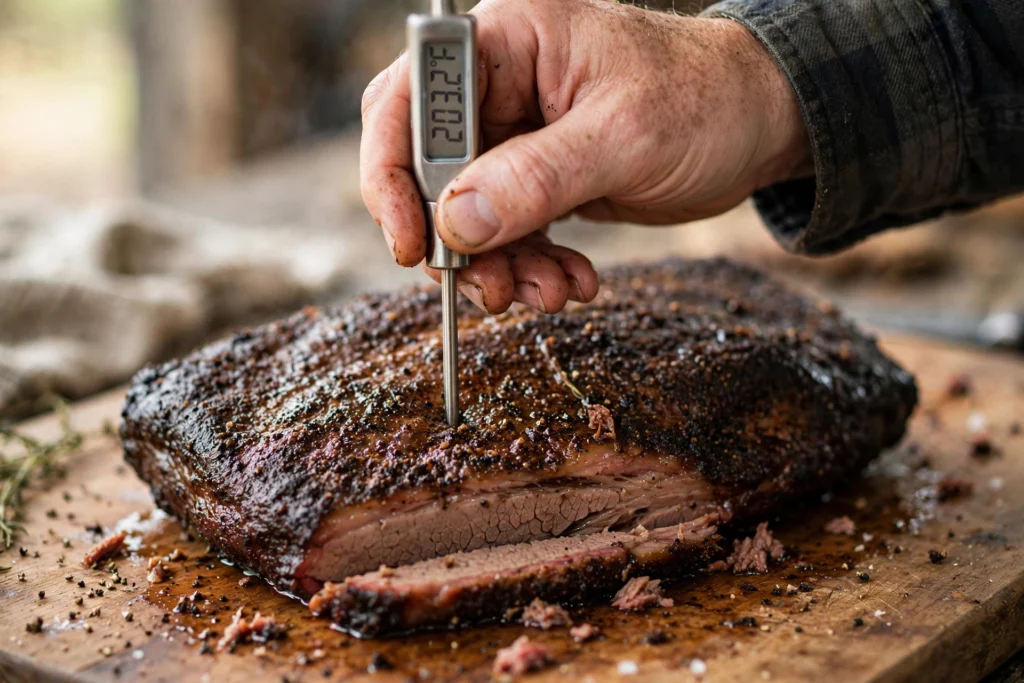
Open the junk drawer of any serious backyard cook and you will find a small museum of thermometers: a dial or two, a cheap digital with a cracked screen, maybe a probe on a wire that nobody fully trusts anymore. We all accumulate them, because temperature is the one variable in barbecue you cannot fake. Color lies. The clock lies. The jiggle of a brisket tells you plenty, but only after you have ruined enough briskets to calibrate your hands. A good thermometer skips the tuition payments — but only if it is the right type, working the way its maker claims. Here is the honest tour of the nine kinds you are likely to meet, and what each one is actually good for.
The Analog Dial Thermometer
The classic: a round dial, a stiff stem, a little nut underneath for calibration. Inside, a coil of two bonded metals unwinds as it heats, which is charmingly mechanical and genuinely slow. A dial thermometer can take twenty seconds or more to settle, and its sensing area is not the tip — it is the stretch of stem up to a small dimple, roughly the first two inches. That means a dial only reads honestly when those full two inches are buried in the food. Sink one into a pork chop and half the sensing stem is out in the air, averaging temperatures and lying to you with confidence.
Dials still earn their keep in one place: deep, thick roasts where insertion depth is easy and speed does not matter. They cost almost nothing and never need batteries. Just calibrate yours before you trust it — more on that below — because they drift every time they get dropped, which is every time they get used.
The Basic Digital Instant-Read
The five-to-twenty-dollar digital stick thermometer is the first real thermometer most of us buy, and it is a genuine step up from a dial. Most of these use a thermistor — a resistor whose electrical resistance changes with temperature — mounted near the probe tip. They are reasonably accurate and the sensing point is small, so thin cuts are fair game.
The catch is speed. Despite the “instant” in the marketing, a budget thermistor thermometer typically needs ten to fifteen seconds to deliver a full, settled reading. Ten seconds with your hand over a hot grill, lid open, heat pouring out, feels much longer than it sounds — and most people do not wait for it. They pull at the first plausible number, which is how chicken gets served at a number the thermometer had not actually reached yet.
The Thermocouple Instant-Read
This is the professional’s tool, and the one we would save from a house fire. A thermocouple measures temperature at the junction of two dissimilar wires, and in a well-made handheld that junction sits in a needle-fine, reduced-diameter tip. Less metal to heat up means the reading arrives almost before your hand registers the grill’s warmth. The current benchmark, ThermoWorks’ Thermapen ONE, delivers a full reading in one second or less, accurate to within half a degree Fahrenheit across the range that matters, and ships with a calibration certificate traceable to national standards. Those are lab-instrument specs in a tool that lives in an apron pocket.
Speed buys you a technique, not just convenience: the pull-through. Slide the tip slowly through a steak or a chicken breast and the display flickers through the temperature gradient — hot surface, cooler center — so you can find the coldest spot and judge the cook by that, which is the only spot that counts. If you buy one serious thermometer in your life, this category is it; our current picks are in the best instant-read thermometer roundup.
The Leave-In Probe on a Cable
Instant-reads answer questions at a moment in time. A leave-in probe answers them continuously. The probe goes into the brisket before the lid closes, its braided cable snakes out under the lid or through a grommet, and the base unit sits on the side table tracking the climb — through the stall, through the long plateau, to the finish — without you opening the cooker and dumping heat every half hour. Set an alarm for your target and it will tap you on the shoulder when the meat gets there.
Two warnings from experience. First, probe placement is everything: the tip must sit in the thermal center of the thickest part, not touching bone, not parked in a fat seam, or your beautiful data describes a place that is not your dinner. Second, cables are consumables. Slam one in a lid a few times, run it over direct flame once, and it will start reporting fiction. Treat a sudden impossible reading — 400°F in a pork butt — as a cable obituary, not a miracle.
Dual-Probe and Wireless Probe Thermometers
Add a second probe on a clip and you can watch the pit itself, and this is where many cooks have a small revelation: the thermometer built into your smoker’s lid is measuring the air up by the dome, not the air at the grate where the meat lives. The two can disagree by 25 to 50 degrees. Your brisket has been cooking at the grate temperature all along; the dial was just telling you a story about the weather near the ceiling. A grate-level pit probe ends the argument permanently.
Fully wireless probes — a single self-contained stick with the electronics in the handle, talking to your phone — fix the cable problem and the leash to the cooker. The trade-offs are a thicker probe (a bigger hole in the meat, and a sensing point that cannot sit as shallow) and a battery to remember. Range and app quality vary enormously between models, which is why we keep a separate, tested list of the best wireless meat thermometers rather than folding them into the instant-read rankings. For long overnight cooks, a wireless probe with a loud phone alarm is the difference between sleep and superstition.
The Rest of the Drawer
Infrared guns are the most misunderstood tool in the pile. They read surface temperature only — the outside of whatever you point them at — which makes them genuinely useful for checking a griddle, a pizza steel, or an oil slick in a cast-iron pan, and utterly useless for judging whether a chicken thigh is done. Anyone temping meat with an infrared gun is measuring the paint, not the house.
Candy and deep-fry thermometers are dial or digital probes built for a pot: long stem, a clip for the rim, a high range. They earn their place during frying and sugar work and are simply the wrong shape for a brisket. Pop-up timers, the little plastic plungers pre-installed in holiday turkeys, pop at one fixed temperature chosen by the manufacturer, usually well past juicy. Ignore them entirely and temp the bird yourself. And the humble oven thermometer — a dial that hangs from a rack — remains the cheapest lie detector ever made for a kitchen oven that swears it is at 350°F.
Calibration: The Two-Minute Habit
Every thermometer drifts eventually, and an accurate-sounding wrong number is worse than no number. The home calibration check needs a glass of crushed ice and water. Stir it, let it sit a minute, insert your probe without touching the glass: a truthful thermometer reads 32°F. Boiling water is the second reference point — 212°F at sea level, dropping roughly a degree for every 500 feet of altitude, so Denver cooks should expect about 202°F. Dials adjust with the nut under the head; better digitals have a trim function. If yours fails the ice test by five degrees and cannot be adjusted, it is not a thermometer anymore. It is a random number generator with a pointy end.
What the Numbers Are For
All of this hardware serves a short list of numbers. The USDA’s safe minimums: 145°F with a three-minute rest for beef and pork steaks, chops, and roasts; 160°F for ground meats; 165°F for all poultry; 145°F for fish. Barbecue targets run higher — brisket and pork butt finish by tenderness up around 200°F and beyond, where collagen has surrendered — but the safety floor is the safety floor, and the only way to know you are standing on the right side of it is a probe in the meat.
Our honest recommendation for most cooks is two tools, not nine: one fast thermocouple instant-read for checking and pulling, and one leave-in setup — wired dual-probe or wireless — for the pit and the long cooks. Everything else is specialization. And when the cook in question is a rack of ribs, where a probe has barely anything to bite into, even the best thermometer steps aside for the bend test and the toothpick — which is why we wrote up how to tell when ribs are done without a thermometer. The instrument matters. Knowing when not to use it matters almost as much.
[…] The thermometer is a testing tool, not an oracle — the difference between “almost” and “right” is a tenderness you can only feel through the probe. If you’re still cooking with a bargain-bin dial thermometer, this is the cook that will convert you: here’s how to pick one worth trusting. […]
[…] And through all of it, the thermometer is doing the real quality control. Injected meat can cook a touch faster thanks to the added moisture, and sugar-heavy injections want a closer eye on the exterior, so check internal temps more often than you think you need to. A reliable thermometer is the whole game on long cooks — here’s how to pick one worth trusti…. […]
[…] platter indoors and don’t let the plate-up become a second cook. We’ve written up how to pick a thermometer worth trusting if yours has been lying to […]
[…] resistance. If you’re still cooking by guesswork, this is the cook that will convince you to cook with a thermometer worth trusting: use it to watch the cooker temperature and confirm the neighborhood, then let the bend test make […]
[…] home you cannot judge doneness by how the meat looks or by how long you think it has been on. Our BBQ thermometer guide explains which types hold up best when you are working fast outdoors, and why the cheap dial […]