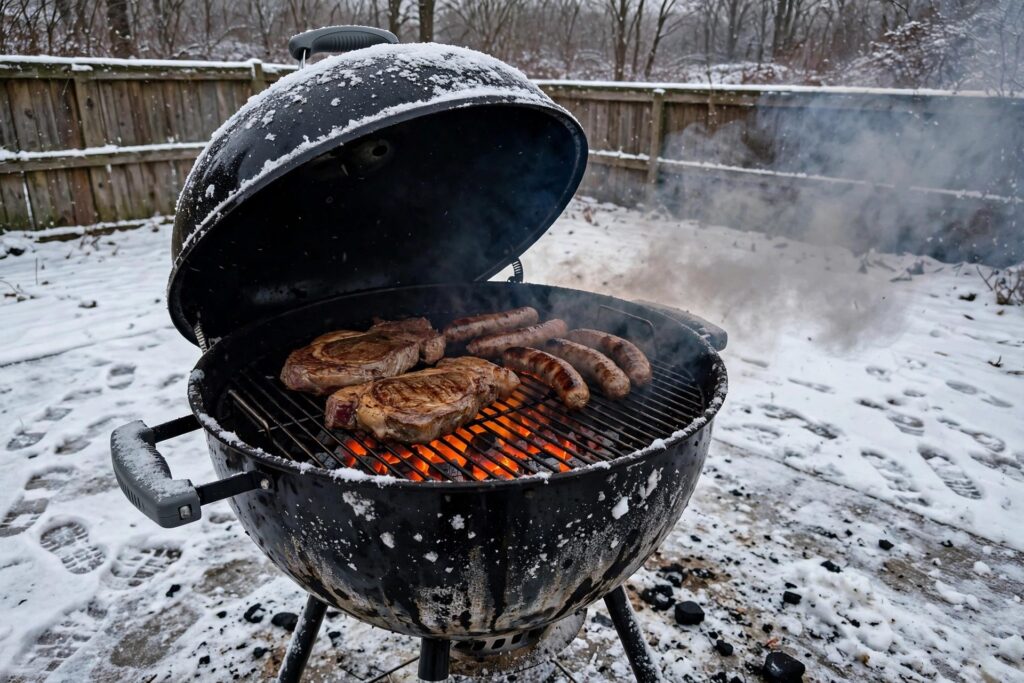
Here in St. Augustine, we don’t get Minnesota winters. Our idea of a cold snap is a January morning at 38 degrees with the wind coming sideways off the water — enough to make your hands sting while you light the chimney. But here’s the thing: cold is cold when it comes to fire. Whether you’re staring down a dusting of snow in the Midwest or a damp Florida freeze, the same physics apply, and the same mistakes ruin dinner. The good news is that winter grilling isn’t some separate sport. It’s the same cook, with a few adjustments for the weather. Here’s how we do it.
The Cold Changes the Rules
Before you touch a vent or a burner knob, it helps to know what you’re fighting. Cold air is denser, which sounds technical and dull, but what it means is simple: every time you open the lid, you’re dumping out hot air and flooding the cook chamber with cold, and the grill has to burn fuel to win that battle all over again. Meanwhile the metal of the grill itself starts at whatever temperature the air is — instead of 75 degrees, it might be 25 — and all that thermal mass has to come up to temperature before your food gets any of the heat.
Two consequences follow. First, everything takes longer. Cooks that run 10 to 25 percent longer than the same cook in July are normal, not a sign something’s wrong. Second, your grill burns through fuel faster just sitting at temperature. Once you accept that, the rest of this list is just common sense — and it’ll save you a ruined roast and a trip to the propane exchange at dusk.
Preheat Longer Than You Think
The most common winter mistake is treating preheating like a summer routine. In July, ten to fifteen minutes with the lid down gets most grills up to speed. In January, plan on twenty to thirty — and don’t just go by the lid thermometer. Give the grates themselves time to heat through, because a hot grate is what gives you a sear, and cold grates are what give you food that sticks and steams instead of browns.
This applies to every fuel type. Gas grills warm up fastest but still need the extra time for the whole cooking chamber to stabilize. Charcoal and pellet cookers are slower, and a pellet grill that’s struggling to climb is usually a pellet grill that was rushed — let it fully reach your target temperature before the meat goes anywhere near it. If the temperature wobbles when you first put the food on, it wasn’t ready.
Start With a Full Load of Fuel
Nothing ends a winter cook faster than running dry halfway through. A propane tank that’s a quarter full in summer might get you through a steak cook; in January, the same tank can sputter out because the cold itself reduces propane pressure on top of the higher burn rate. Start with a full tank, and if the cook is long, keep a spare in the garage — not next to the grill, just close enough to matter.
Charcoal cooks should fill the basket higher than they would in summer. A heaping mound of lit coals holds temperature against the cold the way a full campfire holds against the wind; a sparse bed of coals just smolders and stalls. This is one case where more fuel is insurance, not waste.
Keep the Lid Down and Cook in Two Zones
Every lid lift costs you. In warm weather a quick peek sets you back a couple of minutes. In cold weather, with dense air rushing in, the same peek can take five minutes or more to recover from — and if you’re peeking every ten minutes, the grill never really stabilizes. Decide what you’re doing before you lift: flip, temp, reposition, then close it. Work fast and get the lid back down.
Two-zone cooking is your best friend here. Set up one hot side for searing and one cooler side for finishing, and you’ll stop needing to chase temperatures. Sear the steak hard over direct heat, then slide it to the cool side, lid down, and let carryover heat and the thermometer tell you when it’s done. It’s the most forgiving setup in any weather, and in winter it’s practically mandatory — it means you’re not blasting the burners and scorching the outside of thick cuts while the inside lags behind.
Get Out of the Wind
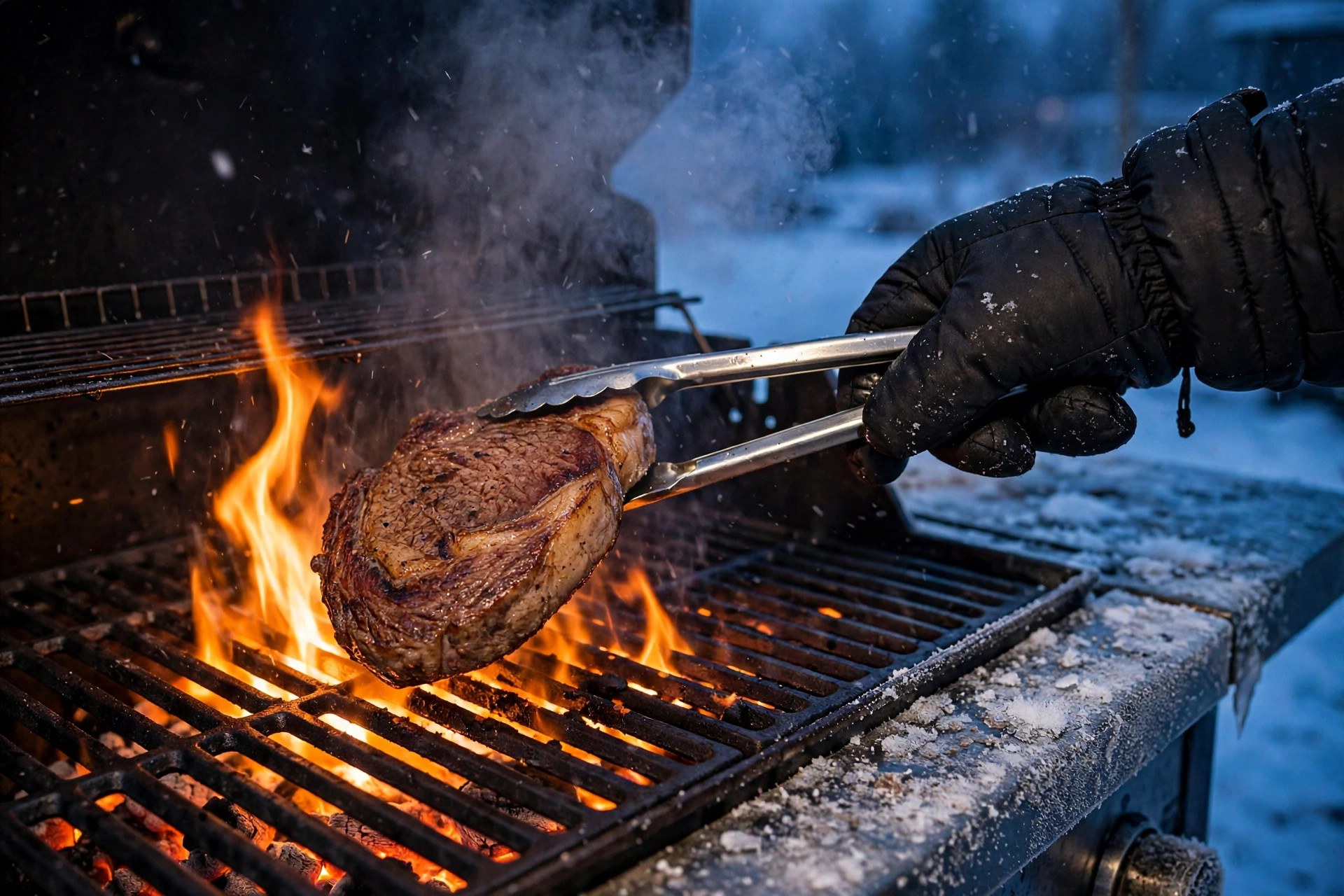
Wind is the single biggest enemy of winter grilling — more than the cold itself. A steady wind strips heat off the grill body and plays havoc with charcoal vents and gas flames. If you have a spot that’s naturally sheltered — against a wall, behind a fence, around the corner of the house — that’s where the grill lives for the winter. Even a half-wall of cinder blocks on the windy side makes a measurable difference.
One non-negotiable: shelter does not mean indoors. Keep the grill at least ten feet from the house, away from overhangs, awnings, and anything that catches fire, and never, ever cook in the garage or a shed with the door open. Carbon monoxide doesn’t care that you’re cold. A windbreak and open sky is the whole list.
Trust the Thermometer, Not the Clock
Winter is when cooks who “just know” when a steak is done start serving surprises. Everything takes longer, and the difference between the grate temperature and the lid thermometer reading gets wider in the cold — one measures the air where your food actually is, the other measures the air up near the dome, and they can disagree by a lot. A dual-probe setup with one probe on the grate and one in the meat takes all the guessing out of it.
Pull food by internal temperature, always, and remember that carryover cooking still happens — a roast pulled at temperature and rested tented in foil will climb a few more degrees while the juices redistribute. That rest also buys you something winter cooks desperately need: time to get the food inside. A hot steak on a cold plate on a cold porch cools fast, so warm your serving platter indoors and don’t let the plate-up become a second cook. We’ve written up how to pick a thermometer worth trusting if yours has been lying to you.
Keep the Finish Line Warm
Most winter grilling failures don’t happen on the grill — they happen in the sixty seconds after the food comes off. A steak that was perfect on the grate can be merely warm by the time it reaches the table if it’s sitting on a freezing plate in freezing air. Warm your serving dishes inside before you carry them out. Rest meat tented in foil — loosely, so the crust doesn’t steam — and move it indoors quickly.
For big cuts like roasts or whole birds, the rest is doing double duty: it relaxes the meat and it keeps it out of the cold while you get everything else together. A full rest of twenty to thirty minutes under foil on the counter indoors is plenty. Don’t shortcut it just because you’re chilly; the meat deserves better than that.
Dress for the Cook, and Mind the Grill After
You’ll be outside longer than you think, so dress like it. Layers, warm socks, and heat-resistant gloves for handling the grill — regular winter gloves near hot grates are a burn waiting to happen. One safety note that matters in January: skip the dangling scarf and the loose sleeves. They look cozy and they catch fire. If you need light — and in winter you’ll often be cooking after dark — a headlamp beats holding a flashlight in your teeth, which beats trying to read a thermometer by porch light.
When the cook’s done, the grill deserves winter care too. Brush off snow and ice, let it cool completely, and then cover it — a quality cover keeps moisture out of the electronics on pellet grills and off the metal on everything else. Keep the path to the grill clear through the season; nothing ends a cook before it starts like a locked-up gate and a sheet of ice between you and dinner.
That’s the whole playbook. The grill doesn’t know what month it is — it only knows heat, fuel, and time. Give it the extra preheat, the extra fuel, and the closed lid it needs, and January cooks just as well as July. Probably better, honestly. There’s nobody crowding you, the smoke smells incredible in cold air, and the first bite of something hot off the fire on a freezing night tastes like you earned it. Because you did.
Leave a Reply