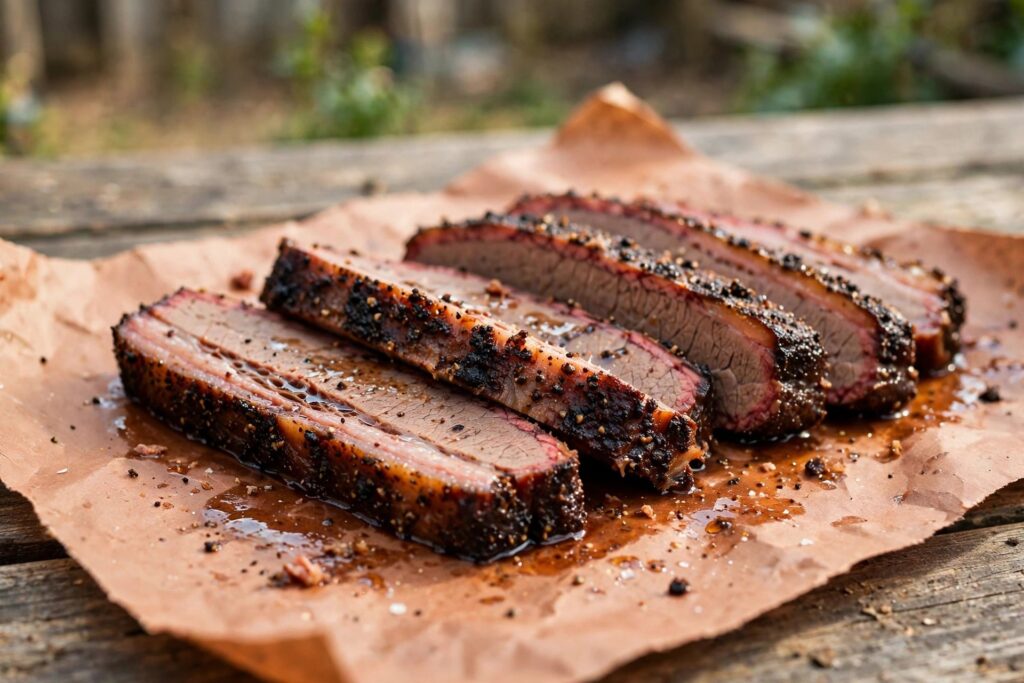
Brisket is the cook that separates the curious from the committed. Ribs forgive you. Pork shoulder forgives you. Brisket sits there for fourteen hours, quietly deciding whether all that faith you put in it was earned. But here’s the truth nobody at the pit wants to admit on their first try: a great brisket isn’t about secrets. It’s about a dozen small, unglamorous decisions made correctly, in order, without rushing any of them.
This is the full walkthrough, the way it’s done when nobody’s watching. Buy right, trim cold, season simply, hold your fire steady, wrap when the bark tells you to, pull by feel, and rest longer than your patience wants. Get those right and the slices will barely hold themselves together on the way to the plate.
Start With a Whole Packer, Not Just the Flat
A brisket is two muscles in one awkward package: the lean, flat muscle that gives you neat slices, and the thick, marbled point sitting on top of it. Buy the whole packer — flat and point still joined. The point’s fat and collagen are what keep the whole cook forgiving, and it’s where your burnt ends come from. A flat by itself has nowhere to hide; it dries out faster and punishes every mistake.
Plan on a 12 to 15 pounder. Between trimming, rendering, and moisture loss, a brisket shrinks 30 to 40 percent over a long cook — that 14-pound packer becomes 8 or 9 pounds of finished meat. Buy for the crowd, then buy a little more.
On grade, Choice is the sweet spot for low and slow. Prime’s extra marbling mostly renders clean out over a 12-hour cook, and Select gives you less margin for error. Pick a thick flat — thin flats turn to jerky before the point finishes — and give the packer a gentle bend in the store. A flexible brisket with a soft fat cap is telling you the fat will render properly.
Trim It Cold, Trim It Honest
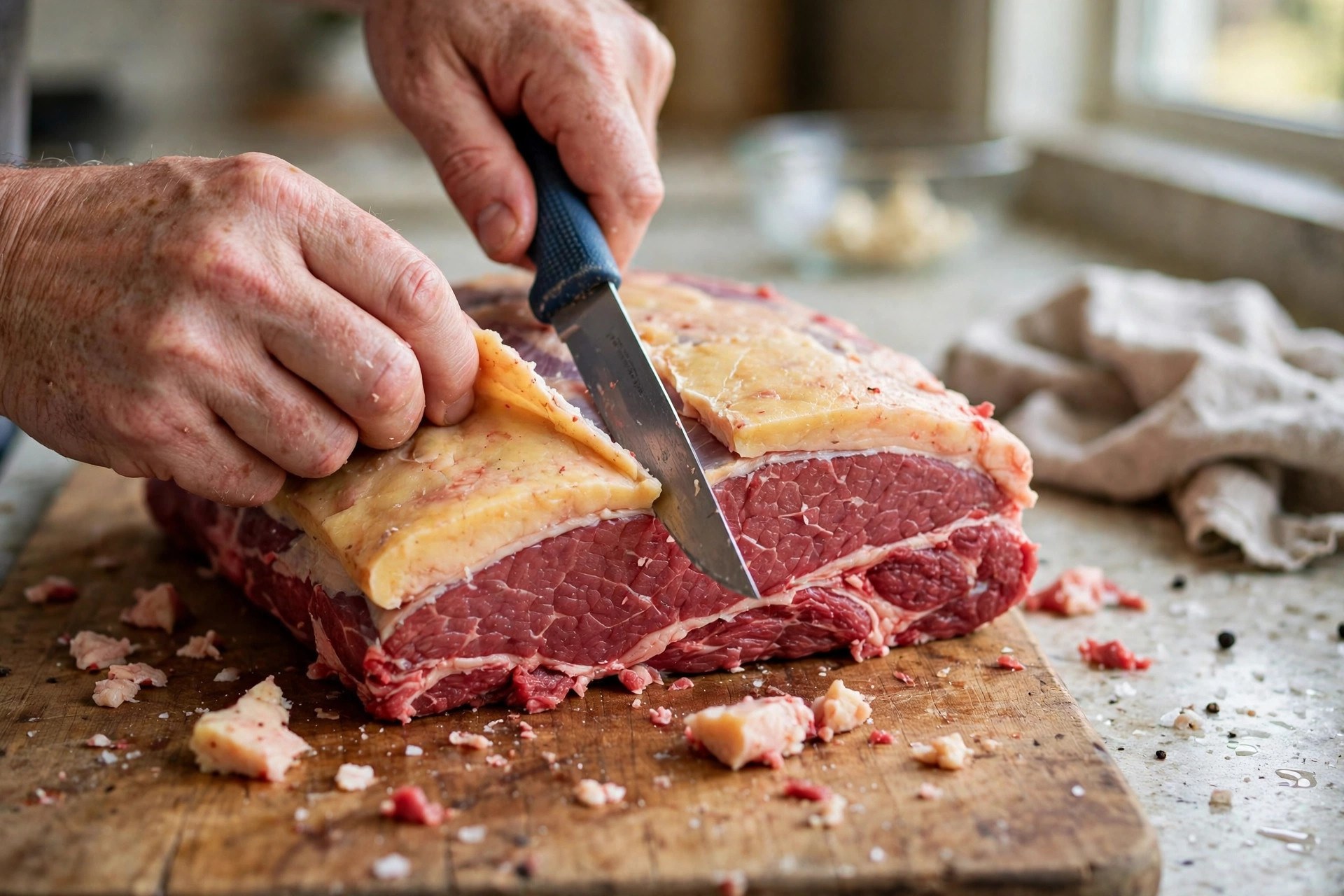
Work it straight out of the fridge — cold fat cuts cleanly, warm fat smears and fights the knife. Shape it for a twelve-hour ride: smooth, even, no thin flaps sticking out to incinerate.
Take the fat cap down to about a quarter inch — enough to baste the meat as it renders, not so much that the brisket swims. Flip it over and dig out the hard, waxy deckle fat wedged between the flat and the point. That stuff will never render, no matter how long it rides in the smoker; it just sits there, chewy and disappointing. Square off the thin, papery edges. Round the whole thing into a shape that’ll cook evenly.
Use a sharp boning knife — a dull one turns this into a wrestling match and leaves ragged edges that catch smoke unevenly. Ten minutes here pays off for the next ten hours.
Keep the Seasoning Simple
Central Texas figured this out a long time ago and never looked back: equal parts coarse kosher salt and coarse black pepper, and that’s the whole rub. If you can find 16-mesh butcher-grind pepper, use it — those big, visible flakes are what build the classic dark, craggy bark. Coat every surface heavily and press it in. Brisket is a big, dense cut; timid seasoning disappears into it.
A thin smear of yellow mustard or hot sauce underneath helps the rub stick — you won’t taste it after twelve hours of smoke. If you can plan ahead, season the night before and leave the brisket uncovered in the fridge; the overnight dry brine builds a deeper bark.
Steady Heat and Clean Smoke
Run your smoker at 225 to 250°F and let it fully stabilize before the meat goes on. Oak — post oak if you can get it — is the classic brisket wood; hickory and pecan both do fine work. You want thin, clean smoke, not a billowing white cloud. Heavy, dirty smoke is what makes brisket taste like an ashtray.
Put the brisket on with the fat cap facing your heat source. On most backyard smokers that means fat-side down; on an offset with heat rolling over the top, fat-side up. The point isn’t a rule — it’s protection. The fat cap is a shield for the meat underneath it, so aim the shield at the fire. Then close the lid and leave it alone — every peek sets the cook back and gains nothing. If you spritz, wait until the meat has color, three or four hours in, and keep it light: beef broth, or broth cut with apple cider vinegar, once an hour at most.
The Stall Is Not Your Enemy
Somewhere between 145 and 165°F internal, the brisket stops climbing — sometimes for hours — and first-timers are convinced something broke. Nothing broke. The meat is sweating: moisture evaporating off the surface cools it as fast as the smoker warms it. Cranking the heat to fight it is the classic rookie move; let the stall work, because the bark is building while the temperature sits still.
When the bark is dark and set — press it and it doesn’t smear — and the internal temp is around 165°F, wrap. Butcher paper breathes: it pushes through the stall faster while keeping the bark you spent all morning building. Foil, the famous Texas crutch, finishes faster but braises the meat and softens the bark toward pot roast. Paper costs a little time and pays you back in texture. Wrap tight, no air pockets, and put it back on.
Pull by Feel, Not by Number
Here’s the belief worth correcting before your first brisket: 203°F is not a finish line. It’s a neighborhood. Two briskets from the same case can finish eight degrees apart because collagen breaks down on its own schedule, not the clock’s. Start probing around 195°F in the thickest part of the flat, and pull the brisket when the probe slides in with almost no resistance — like pushing into warm butter. If it grabs or drags, it’s not done, whatever the display says.
The thermometer is a testing tool, not an oracle — the difference between “almost” and “right” is a tenderness you can only feel through the probe. If you’re still cooking with a bargain-bin dial thermometer, this is the cook that will convert you: here’s how to pick one worth trusting.
Rest It Longer Than You Want To
This is the step people skip and the step that matters most. A brisket sliced straight off the smoker bleeds its juices all over the cutting board; the same brisket, rested, holds together and eats like a different animal. Keep it wrapped, put it in a dry cooler, and pack old towels around it to fill the air gaps. Rest a minimum of one hour. Two is better. The juices redistribute, the collagen finishes its conversion into gelatin, and the whole thing relaxes.
Done right, the cooler holds a brisket for three or four hours — so the rest doubles as schedule insurance. If it finishes early, it waits. If it finishes late, that’s why you started at dawn.
Slice Against the Grain — Then Cube the Point
Separate the point from the flat where the fat seam joins them. Slice the flat against the grain, about a quarter inch thick — pencil-width. Thick enough to hold together when you pick it up, thin enough to be tender. The point’s grain runs a different direction, roughly ninety degrees off the flat’s, so turn it before you slice.
Or cube the point into rough one-inch chunks, toss with more rub and a light hand of sauce, and return them to the smoker until the edges caramelize and char. Burnt ends — the Kansas City tradition of double-cooked point meat — are the best bite on the packer: all crust, rendered fat, and concentrated smoke. Make more than you think you need; they disappear first, every time.
Plan the day backward from dinner. A 12 to 14 pound packer at 250°F runs about an hour a pound — 12 to 15 hours with the stall — plus two hours of rest. Trim and season the night before, meat on at 4 or 5 in the morning, wrap midday, rest through the afternoon. Brisket rewards the cook who starts early and refuses to hurry. It always has.
[…] rack, and if that sounds a lot like smoking a brisket, it should — the two cuts are cousins, and everything you know about a long brisket cook transfers straight […]
[…] cook, that restraint matters more than intensity. We’ve run post oak on every brisket in our full brisket walkthrough for exactly that […]
[…] joints repay study. Franklin’s method is the one most often written down, and our guide to smoking a beef brisket follows the same fundamentals of trimming, seasoning, wrapping, and resting. Snow’s is a […]
[…] is about, and it is a useful reference point for anyone learning to cook the cut at home — our smoked beef brisket guide covers why that eighteen-hour patience matters more than any […]