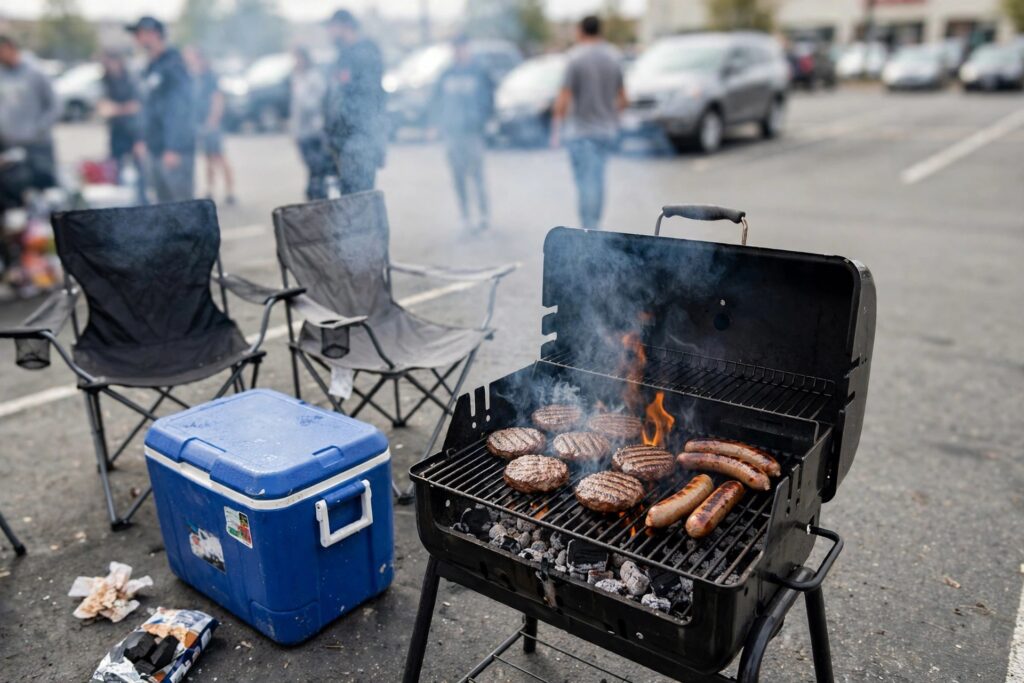
Grilling at home is forgiving. You forget the tongs, you walk inside and get them. You run out of charcoal, there is a bag in the garage. You misjudge the wind, you move the grill six feet to the left. Grilling away from home removes every one of those safety nets at once, which is exactly why it is so satisfying when it goes right — and so memorable, in the worst way, when it goes wrong.
The difference between a great tailgate cook and a miserable one is almost never the recipe. It is the packing, the timing, and the willingness to cook a simpler menu than you would at home. Here are ten things that actually move the needle, learned the usual way: by forgetting each of them at least once.
1. Practice on the travel grill before the big day
A portable grill is not a smaller version of your home grill. It has less grate space, thinner metal, faster heat swings, and a lid that may not seal the way you expect. The worst time to discover any of that is with a dozen hungry people standing around a parking lot. Run a test cook at home first — same grill, same fuel, same menu — and note the hot spots and how long a load of charcoal actually lasts.
2. Pack the grill like it is a kit, not a pile
The classic away-from-home failure is not forgetting the grill. It is forgetting one small thing the grill needs: the lighter, the chimney starter, the grate brush, the propane adapter. Keep a dedicated bin for the travel setup — grill, fuel, fire starters, long tongs, a sturdy spatula, heat-resistant gloves, foil, paper towels, trash bags, and a metal container for ash — and do not raid it for home cooks. Then packing becomes grabbing one box instead of reconstructing a checklist from memory at 7 a.m.
Bring two sets of everything that touches food: one plate and set of tongs for raw meat, another for cooked. In a parking lot, with one folding table and everybody reaching, that takes deliberate packing — and nobody ever regretted the second platter.
3. Let the cooler do the food-safety work
Perishable food needs to stay below 40°F until it hits the grill, and a cooler sitting in the sun is not a refrigerator just because it has ice in it. Pre-chill the cooler, pack it tight, and keep it in the shade with the lid shut as much as possible. Raw meat goes in sealed containers at the bottom, where a leak cannot drip onto anything you will eat cold. A second small cooler for drinks, if you can manage it, keeps the food cooler from being opened every ten minutes — which is how most tailgate coolers lose the battle.
The numbers here are not negotiable, and they are the same numbers you would use at home: poultry to 165°F, ground beef to 160°F, whole cuts of beef and pork to at least 145°F followed by a three-minute rest. An instant-read thermometer is the single most valuable thing in the kit, precisely because away from home you cannot judge doneness by how the meat looks or by how long you think it has been on. Our BBQ thermometer guide explains which types hold up best when you are working fast outdoors, and why the cheap dial thermometer bouncing around in a glove box is not the one to trust.
4. Check the rules before you check the menu
Some venues ban charcoal outright; some allow gas only, or grills only in designated areas, or open flames only until a certain hour. Campsites have fire restrictions that change with the season, and a burn ban does not care that you already bought the brisket. A five-minute check of the venue or park rules — and a backup plan if charcoal is out — beats an argument with a ranger. The same check covers how far the grill must sit from vehicles and tents, and where hot ash is supposed to go.
5. Build the fire for the space you have, not the fire you want
Small grills punish ambition. A full chimney of blazing charcoal in a fourteen-inch portable grill leaves nowhere to move food when it flares, and fatty foods over a single roaring hot zone go from seared to scorched in seconds. Set up two zones whenever the grill allows it: coals banked to one side for searing, an empty side where food can retreat from flare-ups and finish gently with the lid down. On a gas portable, that means one burner on and one off, or one burner low. Two zones turn a tiny grill into a workable kitchen. One zone turns it into a bonfire with a grate on top.
Wind is the other half of this: a portable grill in open wind burns fuel faster and runs cooler on the windward side. A windbreak — the car, a folding screen, even turning the grill so vents face away from the gusts — is worth more than an extra bag of charcoal. Cold weather steals heat through thin metal the same way; our cold weather grilling tips cover how wind and low temperatures change fuel and timing, and most of it applies double far from the garage.
6. Cook a menu that travels well
The best away-from-home menus are short and forgiving. Burgers, sausages, chicken thighs, and skewers cook fast, tolerate temperature wobble, and can be eaten standing up. A brisket or rack of ribs needing six hours of steady heat is a heroic plan for a tailgate and a miserable one for a windy campsite. If slow-smoked meat is the point, smoke it at home, transport it cold, and reheat it gently on the grill.
Prep at home is the quiet version of this tip: marinate the night before, pre-form patties with parchment between them, chop vegetables and pack them sealed. Every minute moved to your own kitchen is a minute not spent doing knife work on a wobbly camp table while the coals burn down.
7. Time the cook backward from when people actually eat
At home, dinner is ready when it is ready. Away from home, it is ready when the game starts, or the group gets back from the hike, or the sun goes down. Work backward from that moment — when must food come off, go on, the grill be lit, you arrive — then add thirty minutes of slack, because setup always takes longer than you think. A grill lit early is a minor inconvenience; a grill still cold when hungry people arrive is the whole story of the day.
8. Keep the cooking area clear and the fire attended
This sounds obvious until you see a tailgate where the grill sits six inches from a cooler and somebody’s lawn chair. Keep a clear perimeter — no vehicles, tents, dry grass, or flammable gear crowding it — and never leave a lit grill unattended. Propane adds its own rules: transport tanks upright and disconnected, never light a gas grill with the lid closed, and turn burners off before swapping a tank mid-cook.
9. Plan the cleanup before you light anything
Cleanup away from home fails for one reason: nobody brought a way to deal with hot ash and greasy grates. Charcoal ash must be fully cold before it goes near a trash bag — drown it, stir it, feel it with the back of your hand, then pack it in a metal container if there is no ash bin. While the grill is still warm, brush the grates; it takes two minutes hot and twenty cold. Bring trash bags, soap, and a rag, and leave the spot cleaner than you found it.
10. Let the grill cool completely before it goes back in the car
The last tip is the one people skip because they are tired and it is dark. A grill that feels “cool enough” outside can still hold enough heat inside to melt a bag or scorch a trunk liner. Give it real time — eat, pack the food, break down the chairs, then check with your hand near, not on, the metal. For gas, shut the tank valve and disconnect before loading; for charcoal, confirm the ash is dead cold, not just gray.
None of these ten tips is complicated on its own. Together they add up to the real skill of grilling away from home, which is not fire management in the abstract — it is doing all the boring, unphotogenic work before the fire ever starts, so that when the food hits the grate you can actually enjoy being wherever you are. Pack the kit, check the rules, cook a menu the grill can handle, and keep a thermometer in your pocket. The parking lot will take care of the rest.
Leave a Reply