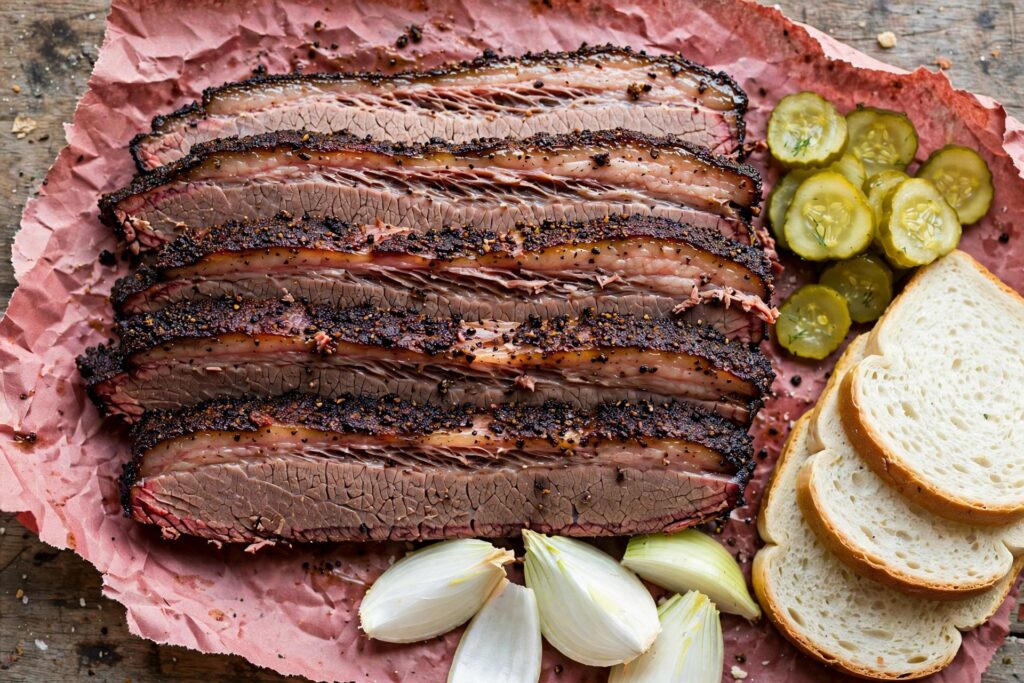
Texas style BBQ is beef — mostly brisket — rubbed with little more than coarse salt and black pepper, smoked low and slow over post oak for 10 to 20 hours. Sweet rubs stay home, and sauce arrives on the side, if it arrives at all. That’s the short version. The full one contains four distinct regional styles inside a single state.
What Makes Texas Style BBQ Different
Most of the South is a pork place. Drive through the Carolinas or Memphis and the pit is full of shoulders and ribs. Texas went the other way, because Texas is cattle country. When German and Czech immigrants started opening meat markets in the Hill Country back in the 1800s, brisket was the cheap, tough cut nobody else wanted. Salt, time, and hardwood smoke turned it into the most famous meat in American barbecue.
The whole philosophy fits in one sentence: the meat does the talking. You’ll find no sugar-heavy rubs, no mop sauce drowning every rib, no finishing glazes. A Texas pitmaster’s seasoning arsenal is mostly salt, coarse black pepper, and patience. Smoke and fire do the rest. If a brisket needs sauce to taste good, Texas figures something went wrong about 8 hours ago.
That minimalism is exactly what makes it hard. With nothing to hide behind, every flaw shows up on the plate — dry flat, bitter smoke, under-rendered fat. Bark on a Texas brisket is dark, rugged, and peppery, built from hours of smoke rather than a thick coat of sugar that burns and turns sticky.
Texas isn’t one style, though. Say “Texas style BBQ” in Austin and everyone pictures Central Texas brisket. Say it in Houston, El Paso, or Brownsville and you’ll get a different answer. The state holds four regional styles, and knowing which one somebody means changes what lands on your plate.
| Style | Home turf | Signature meats | Cooking method | Sauce policy |
|---|---|---|---|---|
| Central Texas | Austin, Lockhart, Hill Country | Brisket, sausage, beef ribs | Low-and-slow indirect smoke, 12–20 hours | On the side or skipped |
| East Texas | Houston, Piney Woods | Brisket, chopped pork, ribs | Slow-smoked, often finished sauced | Tomato-based, sweet, served on the meat |
| West Texas | Desert country, El Paso | Chicken, turkey, sausage, ribs | Direct heat “cowboy style” over mesquite | Thin, chili-spiced, tomato-based |
| South Texas | Border country, Brownsville | Barbacoa: beef head, goat | Buried pit, wrapped in leaves, 12 hours | Salsa and guacamole instead |
Central Texas: Brisket Is the Religion
When somebody says “Texas style BBQ” without specifying, this is what they mean. Central Texas is the oldest and most famous version, born in the meat markets of towns like Lockhart, Elgin, and Taylor. The format barely changed in 150 years: walk up to a counter, order by the pound, get your meat wrapped in pink butcher paper with white bread, pickles, and onion.
Brisket is the headliner, but the trinity has three parts — brisket, sausage, and pork ribs. The sausage is a direct import from the German and Czech settlers: coarsely ground pork, sometimes mixed with beef, seasoned with garlic and spices, smoked slow until the casing snaps. It doesn’t get talked about as much as brisket, but plenty of locals order it by the link, not by the pound.
The cook runs long. A whole packer brisket goes into an offset pit at 250°F and doesn’t come out for 10 to 14 hours — sometimes closer to 18 at the famous joints. The target isn’t a number on a thermometer so much as a feel: the probe should slide into the flat like it’s going through soft butter, usually somewhere around 200 to 205°F. Then the brisket rests at least an hour, ideally two to four, before anyone slices it. That rest is non-negotiable — resting a brisket is what keeps the juices in the meat instead of on the cutting board.
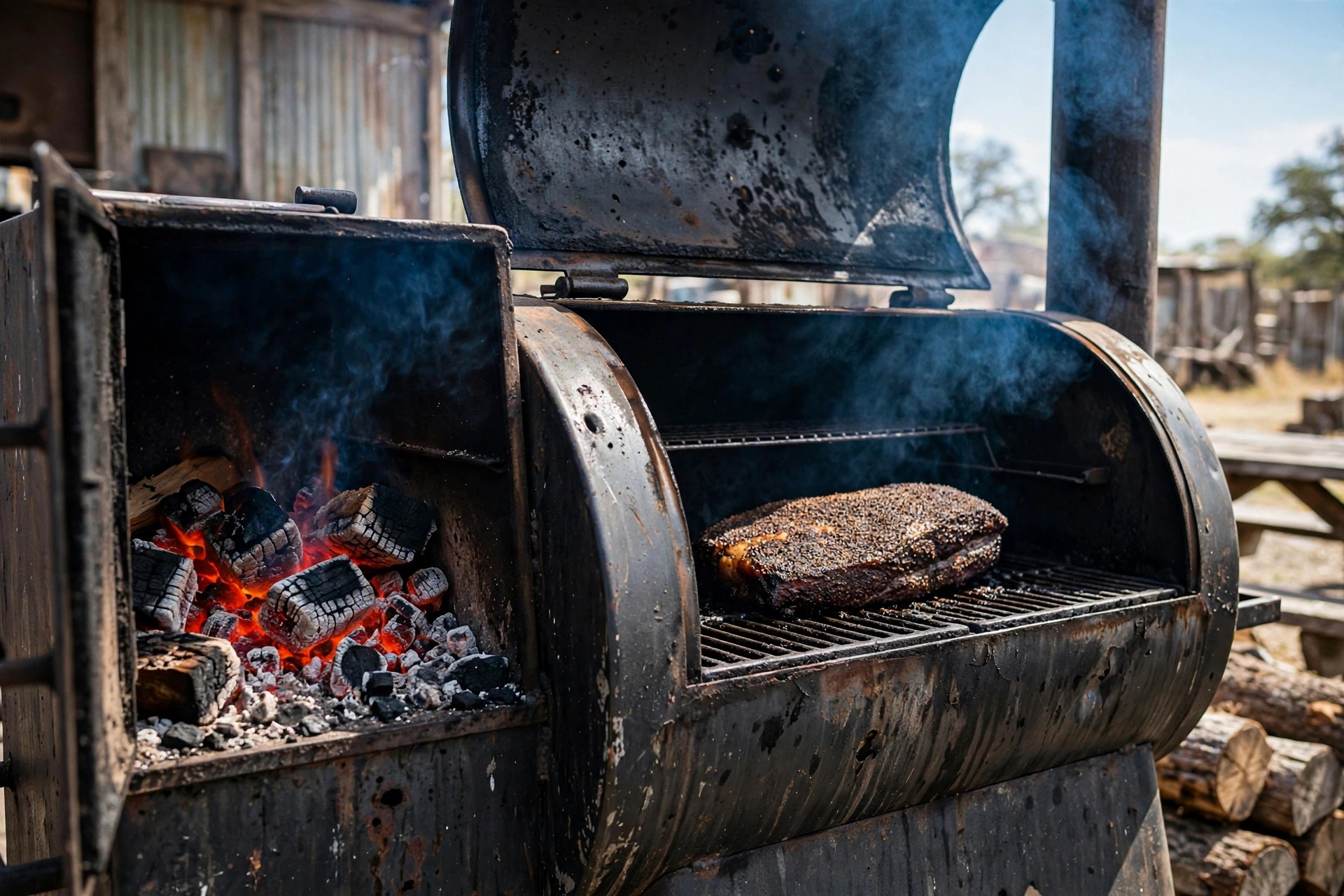
Legendary names in this style include Franklin Barbecue in Austin, where the line starts before sunrise, and the Lockhart originals — Kreuz Market and Smitty’s — that have been smoking meat since the days when they were butcher shops that happened to cook lunch. Texas Monthly publishes a Top 50 list that pitmasters treat like the Oscars.
The Salt-and-Pepper Code
Walk into most of the country’s BBQ regions and you’ll find pitmasters guarding complex rubs with a dozen ingredients. Central Texas rubs have two. Kosher salt and 16-mesh coarse black pepper, usually in a 50/50 mix by volume. Some pitmasters — Aaron Franklin famously among them — add an equal part of garlic powder and call it the trinity. That’s the entire spice program.
The simplicity isn’t laziness; it’s confidence. Sugar, the backbone of most American BBQ rubs, caramelizes then burns over a 12-hour cook, and a sweet crust clashes with beef’s natural savoriness. Salt and pepper build a dark, savory bark and let the smoke and the beef speak for themselves. A brisket smoked at 250°F over post oak needs nothing else.
A few details matter more than people expect:
- Pepper grind: 16-mesh coarse grind holds up for 12+ hours. Fine table grind turns bitter and vanishes into the bark.
- Salt type: Kosher salt is standard. Diamond Crystal is about half as dense as Morton’s by volume, so match your brand to your measurements.
- No sugar: If your rub browns too fast or tastes sweet on the bark, sugar is probably in it.
- No binder needed: The brisket’s own moisture holds the rub just fine — see our notes on SPG seasoning, the pitmaster shorthand for this exact mix.
The result is a brisket you judge three ways: how it slices, how the bark looks, and how it tastes plain on butcher paper before the pickles and onions come anywhere near it. This Central Texas brisket walkthrough shows the same discipline — 12 to 14 pound packer, salt-and-pepper rub, post oak at 250°F, probe-tender around 203°F.
Wood and Fire: Post Oak Country
Every Texas region smokes with what grows nearby. In Central Texas that means post oak — a mild, clean-burning hardwood that gives brisket a savory baseline smoke without any sharpness. It’s the workhorse of Texas BBQ the way hickory is the workhorse in Memphis or Kansas City. Mesquite is the other famous Texas wood, but it burns hotter and turns bitter past about four hours, so it’s a West Texas short-cook wood, not a brisket wood.
The fire matters as much as the wood. Texas pits run on thin blue smoke — the almost-invisible kind that means wood is burning cleanly. Thick white smoke is unburnt fuel and it tastes like a chimney; too much of it and a 12-hour brisket comes out tasting like an ashtray instead of beef. Our guide to wood for smoking brisket breaks down which woods pair with which cooks, and mesquite versus post oak is the single most common question in it.
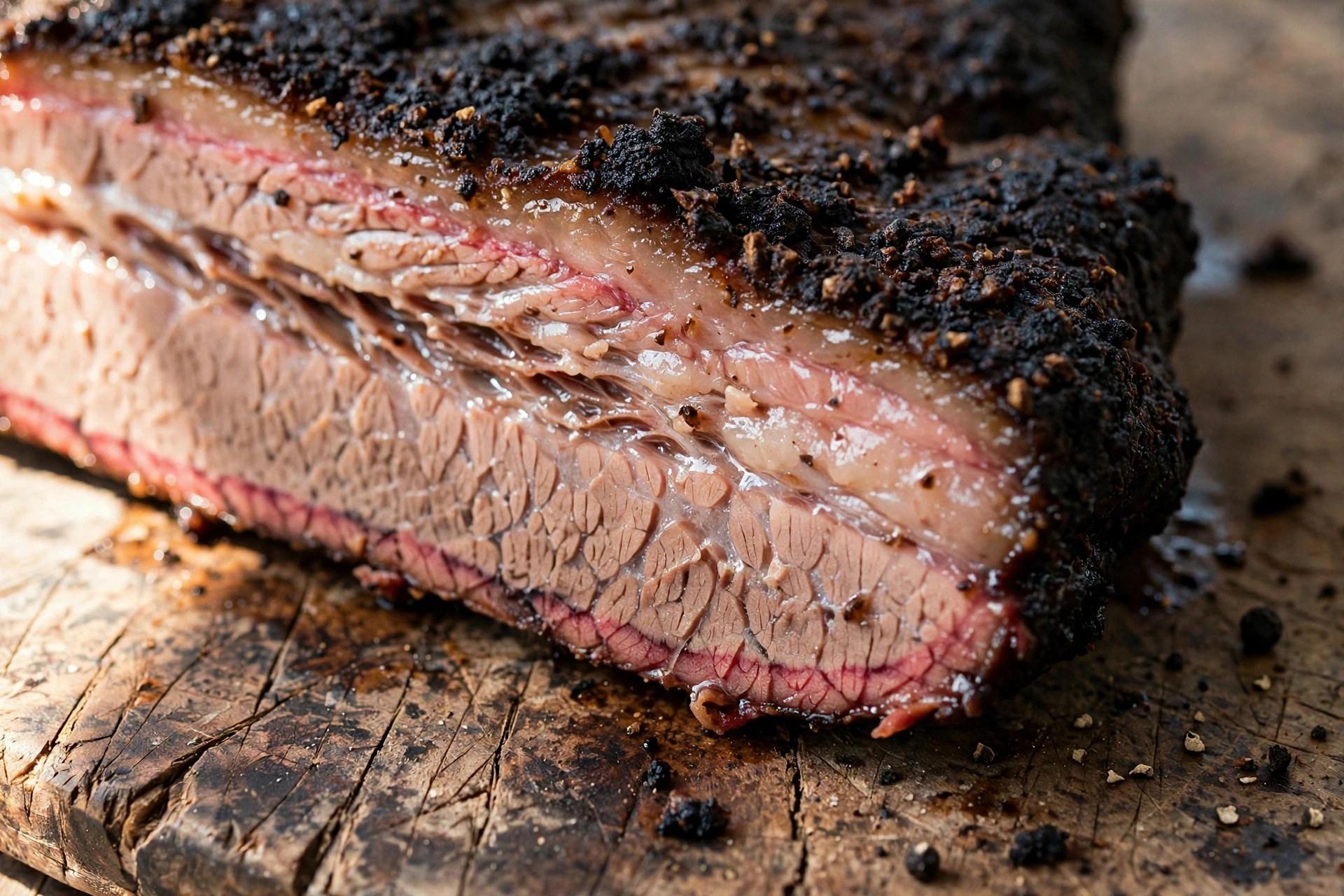
Offset smokers are the traditional tool — a firebox on one end feeding heat and smoke down a long chamber — but the style translates to anything that can hold 250°F steady and burn clean wood. Plenty of home cooks now run pellet smokers or kettles with a snake of charcoal and oak chunks. The pit is just hardware. The style is the fire management.
How Texas Brisket Is Served
Texas serving style is as minimal as the seasoning. Meat comes sliced or chopped on pink butcher paper, priced by the pound. No plates, no garnish, no finishing sauce. The standard accompaniments are humble: white bread, dill pickles, and raw yellow onion. That’s the table.
Slicing has its own craft. A whole packer has two muscles — the lean flat and the fatty point — and their grains run in different directions, so you separate them first and slice each against its own grain. Slices should be pencil-thick, about a quarter inch. Hold one up by the end and bend it: it should flex, hold briefly, and break cleanly. Our brisket slicing guide walks through finding the grain on both muscles.
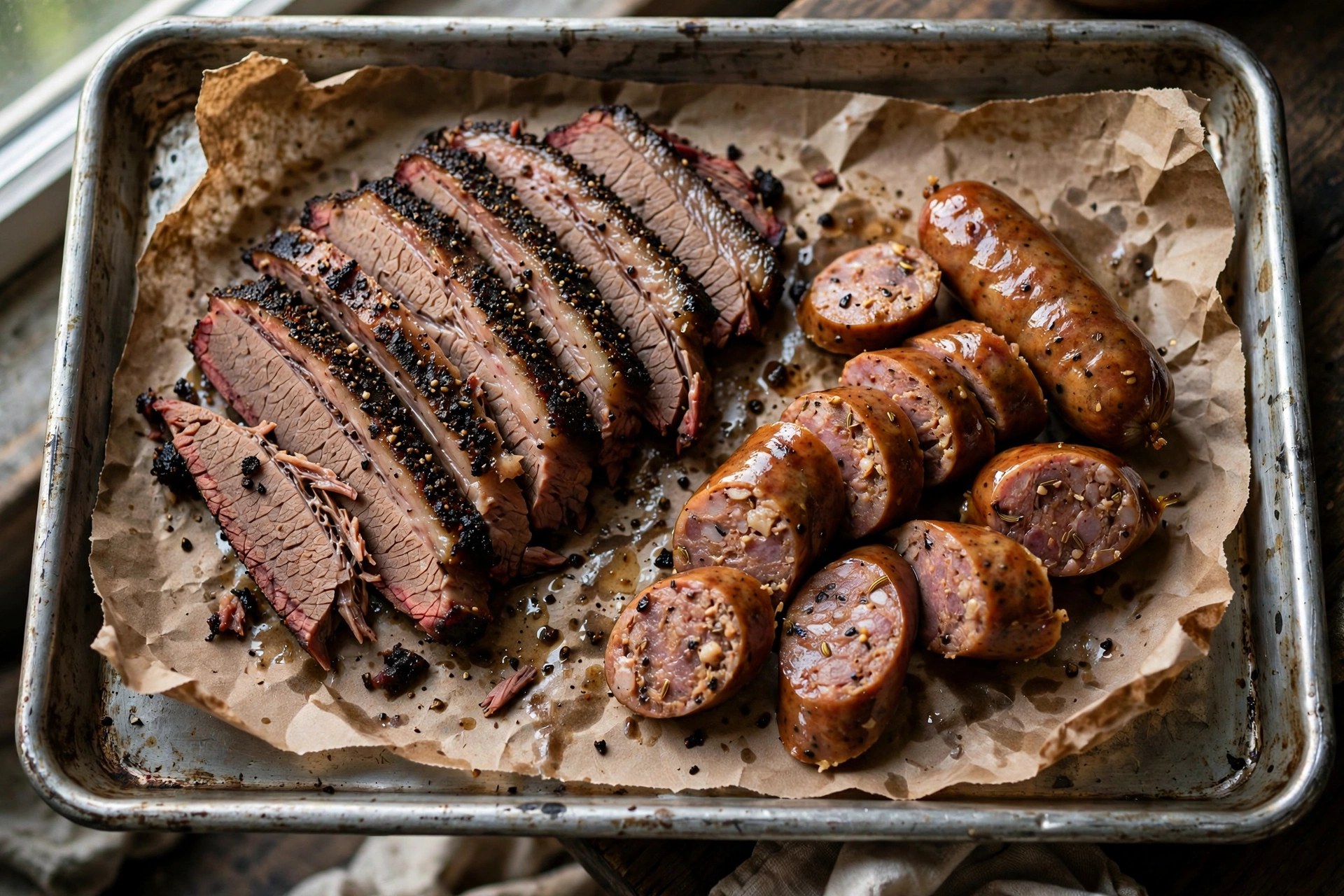
Sauce, when a joint offers it, sits in squeeze bottles on the counter — usually thin, peppery, and tomato-based. Using it is personal choice, and nobody will judge you for skipping it. Plenty of the great spots in Lockhart don’t bother offering any. Pickles and onions do the acid-and-crunch job that sauce does in other regions: they cut the fat of the brisket and reset your palate between bites.
East, West, and South Texas: The Other Three Styles
Central Texas gets the spotlight, but the other three styles are where Texas shows its range — and where a lot of people eat barbecue every week.
East Texas sits closer to the rest of the South. The smoke runs the same, but the finish changes: meats get chopped or pulled instead of sliced, served on sandwiches, and finished with a sweet tomato-based sauce right on the meat. Cajun influence drifts over from Louisiana — boudin shows up on menus — and the sides go full Southern comfort: collard greens, mac and cheese, banana pudding. If you like your BBQ saucy, this is your Texas.
West Texas cooks cowboy style. This is desert country where mesquite is the only tree around, and the method matches the fuel: meats seasoned simply and cooked directly over the flame, closer to grilling than to the low-and-slow smoking of Central Texas. Less smoke flavor, more char and wood taste. Brisket is rare out here — it demands slow cooking — but chicken, turkey, ribs, and sausages all take to the direct heat beautifully.
South Texas is barbacoa country, rooted in Mexican technique. Tough cuts — traditionally the whole cow head, sometimes goat — get wrapped in agave or banana leaves and buried overnight in a pit of mesquite coals for up to 12 hours. The meat turns fall-apart tender and lands in tortillas with salsa, cilantro, and onion. Salsa and guacamole replace barbecue sauce entirely. Much of it happens in backyards on weekends rather than in restaurants, which makes it the hardest style to find and the most rewarding to taste.
Tasting Table’s breakdown of all four Texas styles is a solid companion read for the regional differences, and our guide to the four regions of American BBQ puts Texas in context against Memphis, Kansas City, and Carolina.
Texas Style BBQ FAQs
What is Texas style BBQ known for?
Slow-smoked beef brisket seasoned with just salt and coarse black pepper, cooked over post oak for 10 to 20 hours. Sauce is served on the side or skipped entirely, and meat is sold by the pound on butcher paper.
What wood is used for Texas BBQ?
Post oak is the classic choice for Central Texas brisket — mild, clean-burning, and savory. Mesquite is the West Texas wood, best for shorter, hotter direct-heat cooks since it turns bitter over long smokes.
Why is there no sauce on Texas BBQ?
The philosophy is that properly smoked beef doesn’t need it. Most pitmasters serve sauce on the side for anyone who wants it, and many legendary joints don’t offer any at all — pickles and onions provide the contrast instead.
Is Texas BBQ only brisket?
No. The Central Texas trinity is brisket, sausage, and pork ribs, and East Texas adds chopped beef, pulled pork, and boudin. Brisket is just the cut Texas is famous for.
What’s the difference between Central Texas and East Texas BBQ?
Central Texas keeps it simple — salt-and-pepper rub, unsauced, sliced, served on butcher paper. East Texas chops or pulls the meat, serves it on sandwiches, and finishes it with a sweet tomato-based sauce.
If Texas style BBQ has a single takeaway, it’s restraint: salt, pepper, post oak, time, and beef good enough to carry the whole show. Start with the trinity of brisket, sausage, and ribs, order it by the pound on butcher paper, and skip the sauce on your first plate — you’ll taste exactly why Texas never needed it.
Leave a Reply