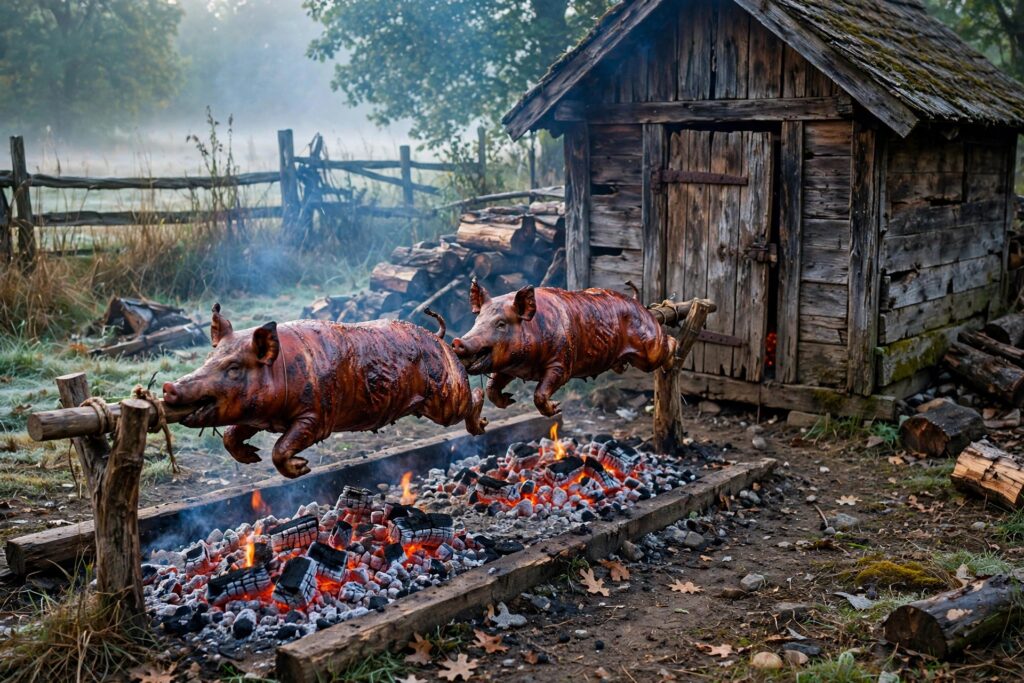
Southern BBQ is America’s oldest cooking tradition: whole cuts of meat — most often pork — cooked low and slow over hardwood coals for hours until tender, then chopped or pulled and seasoned. The history of southern BBQ stretches back 500 years, from a Caribbean cooking technique called barbacoa through colonial Virginia pits to the four regional styles we argue about today.
Ask three pitmasters where BBQ was born and you’ll get four answers. Some trace it to the Caribbean, some say Virginia, some swear it started wherever their grandfather learned it. They’re all a little bit right: Southern BBQ wasn’t invented in one place by one person. It was built, layer by layer, by Indigenous cooks, enslaved Africans, and European colonists over centuries.
True Southern BBQ is meat cooked low and slow over hardwood coals — typically 225-250°F, anywhere from 4 hours for ribs to 18+ for a whole hog. That’s different from grilling, which is fast cooking over direct flames. If you’re fuzzy on the line between them, this breakdown of smoking vs grilling clears it up.
It Started in the Caribbean: The Barbacoa Story
The oldest ancestor of Southern BBQ lived on the island the Spanish named Hispaniola. The Taíno people there built a framework of green wood sticks, laid meat on top, and cooked it slowly over an indirect flame — the green wood kept everything from burning while the meat absorbed smoke for hours. The Spanish called this method barbacoa: the original barbecue.
As Spanish explorers pushed north from the Caribbean, they carried the technique with them. In 1540, near present-day Tupelo, Mississippi, Hernando de Soto’s expedition recorded the Chickasaw cooking a feast of pork over a barbacoa. From there the method drifted into the English colonies, traveling as far north as Virginia. The Smithsonian’s history of American barbecue traces this exact path, from Caribbean roots through the conquistadors to the colonial South.
Here’s where sources genuinely disagree. Virginia pitmaster Joe Haynes argues that writers have confused the origin of the word “barbecue” with the origin of the technique of slow-cooking meat: in his view, English colonists and the Powhatan in Virginia were developing their own coal-cooked meat traditions concurrently, independent of the Caribbean. The Smithsonian’s account leans the other way, treating barbacoa as the direct ancestor. Both agree on what came next: by the colonial era, the South had a slow-cooked, smoke-flavored meat tradition that was unmistakably its own.
The word itself is a side quest: the folk theories — French barbe à queue (“head to tail”), a tavern sign reading BAR-BEER-CUE-PIG — make good bar conversation, but the barbacoa derivation is the one linguists take seriously.
Why the Pig Won the South
Barbecue is built on pork for the simplest of reasons: in the colonial South, pigs were the easiest meat to come by. Cattle needed fences and feed; pigs just needed a forest. Settlers turned semi-wild hogs loose to root for acorns, then rounded them up when meat was needed. These tough, rangy animals were exactly the kind of meat that rewards 12 hours of gentle smoke.
The numbers tell the story. In the decades before the Civil War, Southerners ate roughly five pounds of pork for every one pound of beef. Pork wasn’t just dinner; it was currency, pride, and patriotism. Farmers began fattening hogs on corn before slaughter and keeping Southern-raised pork in the South instead of exporting it north. What started as subsistence became identity.
William Byrd, surveying the line between Virginia and North Carolina in the early 1700s, complained that hog meat was “the staple commodity of North Carolina” and that the locals lived “so much upon swine’s flesh” that it made them “extremely hoggish in their temper.” He meant it as an insult. History read it as documentation. Pig slaughtering became a neighborhood event — and the traditional Southern barbecue grew directly out of those communal gatherings. From the start, barbecue was a party, not just a cooking method.
The Colonial Pit: Whole Hog Over Hardwood Coals
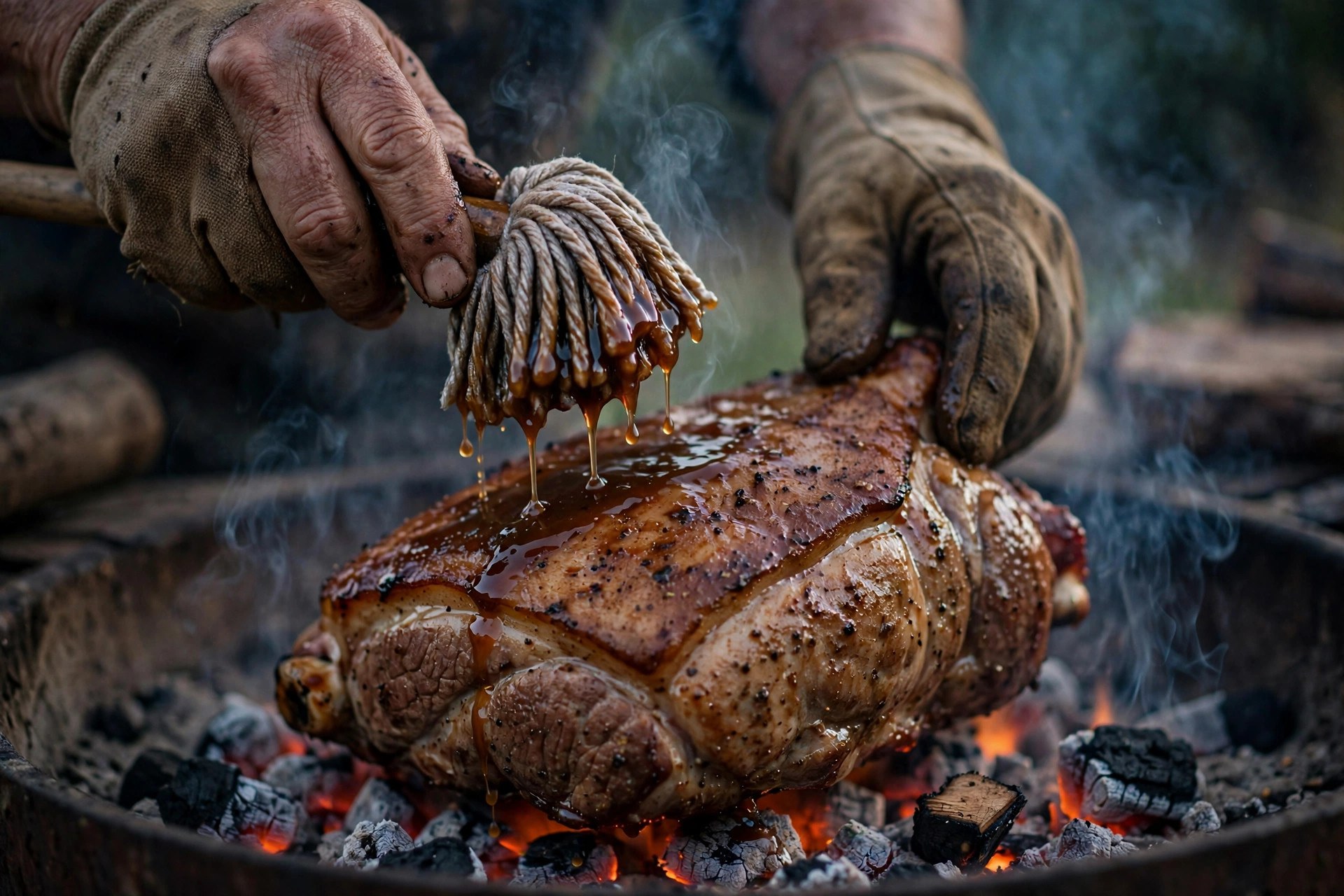
By the end of the colonial period, the neighborhood barbecue was a fixture of Southern life: a whole hog split over glowing hardwood coals in a shallow pit, turned and basted for most of a day. The British colonists contributed the basting habit — slathering the meat as it cooked to keep the juices in — which is why Eastern Carolina’s vinegar sauces have a tartness that reads distinctly British.
An English traveler named Isaac Weld captured the scene on the James River in 1795, describing parties gathered “to partake of a sturgeon or pig roasted in the open air, on a sort of hurdle, over a slow fire.” That’s barbecue as a social institution, not a recipe — and it was already old by the time he wrote it down.
Richmond’s barbecue scene has deep roots. Future Chief Justice John Marshall founded the Buchanan’s Spring Barbecue Club in 1788 — often called America’s first barbecue club — with celebrated free Black cook Jasper Crouch, famous for barbecuing young pigs with heavy cayenne, mustard, and mushroom ketchup, as its major-domo. In 1824, Mary Randolph published The Virginia Housewife with a pepper vinegar barbecue sauce she called “greatly superior to black pepper.” Richmond Magazine’s look at Virginia’s barbecue pioneers shows the colonial pit era already had its celebrities and its arguments.
What made colonial Virginia-style barbecue distinctive:
- Direct heat, no flames. Meat cooked over glowing coals — the strict definition of Southern BBQ.
- Vinegar-based basting. A thin mop of vinegar, cayenne, salt, and herbs, brushed on through the cook.
- Whole animals. Hog first, but also lamb and whatever the neighborhood brought.
- Community by default. A whole hog feeds dozens. Nobody barbecued alone.
The Cooks History Nearly Forgot
For all the romance of the colonial pit, here’s the essential fact: before the Civil War, enslaved Black cooks were the primary barbecue pitmasters of the South. The big plantation barbecues — the “pig pickin’s” feeding hundreds — were cooked by Black men whose names rarely made the written record. The fire management, the sauce instincts, the techniques that define Southern BBQ came largely through their hands.
After emancipation, barbecue became one of the few paths to independence for Black Southerners. Black pitmasters opened roadside pits and weekend stands across the South, building the foundation of the commercial barbecue world.
The church and community barbecue might be the most purely Southern institution of all. In the 1800s, barbecue anchored church picnics and political rallies — a popular, inexpensive way to feed a crowd and, for politicians, to win votes. Mid-century journalist Jonathan Daniels put it best: “Barbecue is the dish which binds together the taste of both the people of the big house and the poorest occupants of the back end of the broken-down barn.” Those gatherings are still going in much of the South — the living continuation of the oldest BBQ tradition there is.
One Tradition, Four Regions
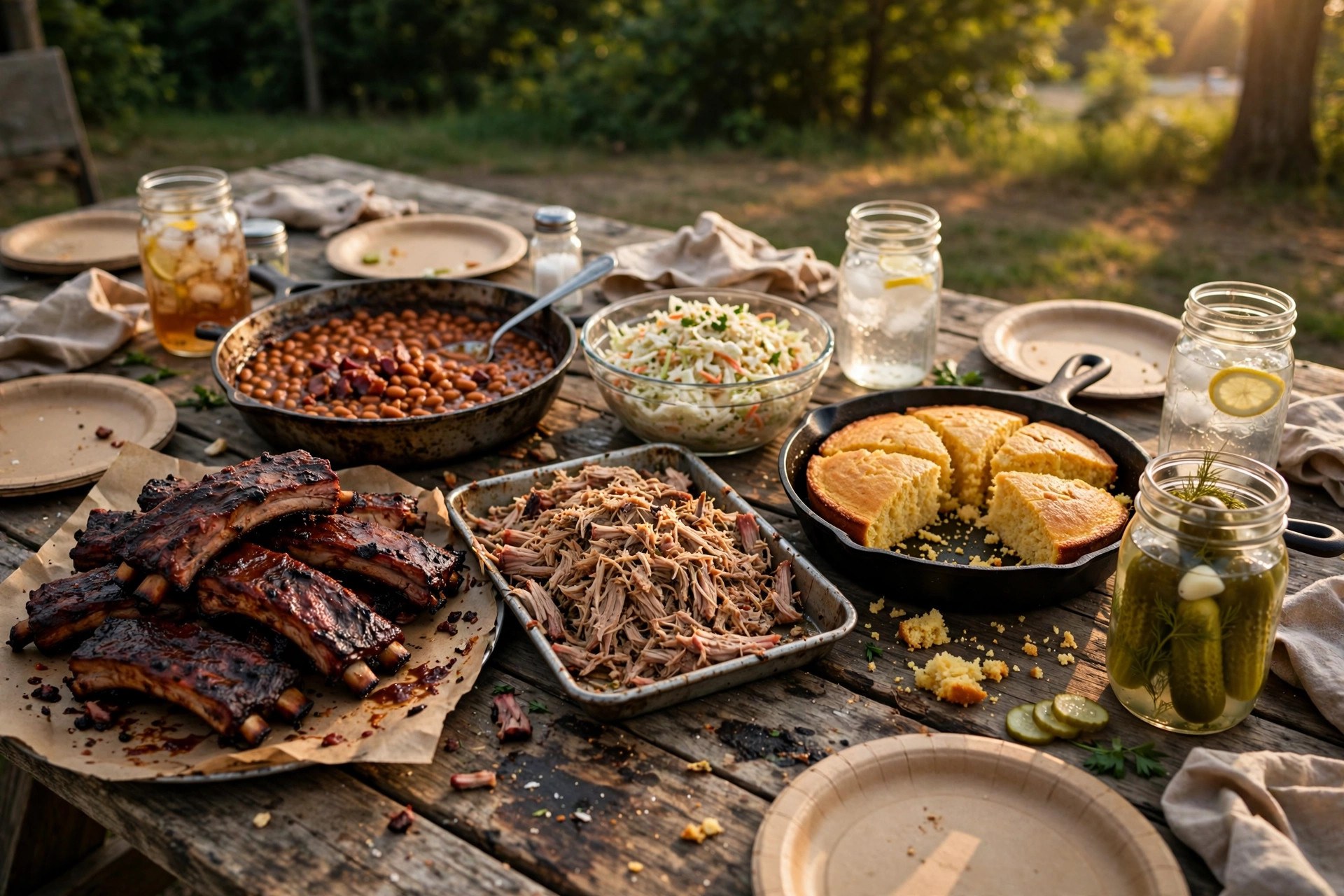
Barbecue started on the East Coast and moved west, picking up local character everywhere it went. By the early 1900s, four distinct regional styles had crystallized.
| Region | Signature meat | Signature sauce | What shaped it |
|---|---|---|---|
| Carolina | Whole hog, pulled pork | Vinegar-pepper (east); mustard (midlands) | British basting; French/German immigrants brought mustard |
| Texas | Brisket, beef ribs, sausage | Thin, peppery; sauce optional | German/Czech meat markets meet cattle-ranching culture |
| Memphis | Pork ribs, shoulder | Sweet tomato-based | River-port trade brought molasses and sugar |
| Kansas City | Everything: brisket, ribs, burnt ends, pork, chicken | Thick, sweet, tomato-based | Stockyards; Henry Perry’s Memphis-rooted restaurant, early 1900s |
Each style has a story. The Carolinas hold the oldest American style — whole-hog, vinegar-based, descended from the colonial pits, with a mustard sauce from the French and German immigrants who settled South Carolina. Texas applied Carolina techniques to beef because German and Czech settlers had land for cattle and the meat markets to process it. Memphis, a busy river port, had easy access to molasses, so its sauce went sweet and tomato-based. Kansas City was born when Memphis native Henry Perry opened a restaurant there in the early 1900s, mixing Memphis sweetness with Texas’s willingness to cook every cut. Saveur’s tour of America’s barbecue regions is a great companion read on how each style tastes today.
If you want the deep dive on each style, start here:
- Carolina BBQ — whole hog, vinegar, and the oldest style in America
- Texas BBQ — brisket, beef ribs, and the German-Czech market tradition
- Memphis BBQ — ribs, sweet sauce, and the river-port influence
- Kansas City BBQ — burnt ends and the most diverse menu in BBQ
- American BBQ Regions — the full map, side by side
The 20th Century: Joints, Cars, and Hard Battles
The modern barbecue restaurant grew out of the weekend pit man. In the early 1900s, many pitmasters worked farms during the week and tended pits on weekends. The classic shack was a bare concrete floor under a corrugated tin roof — then stools, then tables, then the grinning pig sign out front. The automobile gave these shacks a ready-made clientele: travelers stopping for a cheap, filling meal.
Because so much of the trade was takeout, the barbecue joint became an interracial meeting place long before forced integration. Many early joints were Black-owned. That comity largely broke down in the 1950s and 1960s as joints segregated, and barbecue entered the legal record in the desegregation fights over Ollie’s Barbecue in Alabama and Maurice’s Piggy Park in South Carolina (Newman v. Piggy Park Enterprises ruled the chain’s discrimination unlawful).
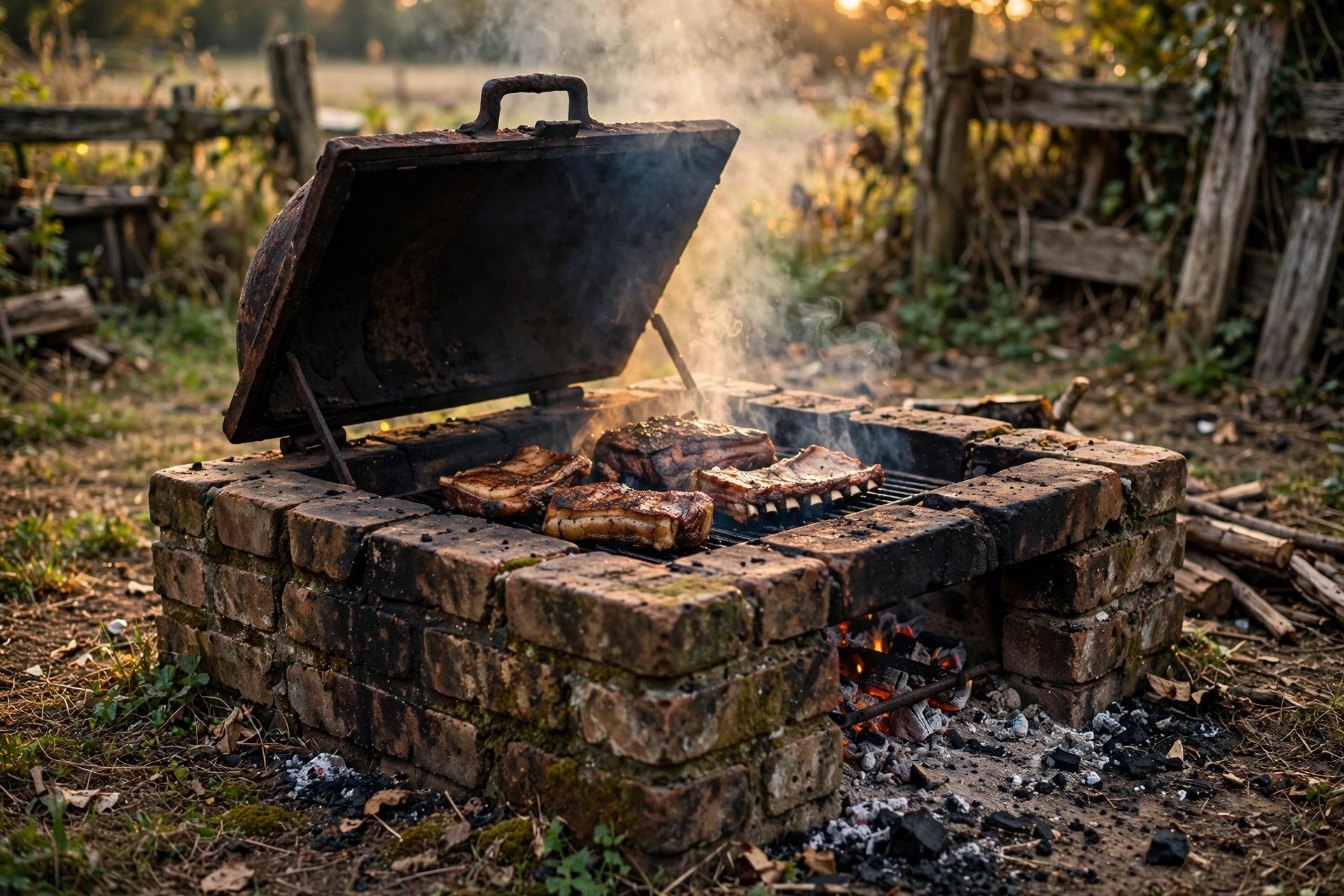
Postwar prosperity scattered the tradition across the country. Black pitmasters and their descendants carried Carolina and Memphis techniques north to Chicago and west to Texas and Kansas City, adapting to local meats along the way. Festivals, competitions, and eventually cable TV turned a regional craft into a national obsession — but the core never changed: low heat, hardwood smoke, time, and patience.
The History of Southern BBQ: 500 Years at a Glance
| Era | What happened |
|---|---|
| Pre-1500s | Taíno people of Hispaniola cook meat over indirect flame on green-wood frames — barbacoa |
| 1540 | De Soto’s expedition records the Chickasaw cooking pork over barbacoa near Tupelo, Mississippi |
| 1600s | English colonists and Native peoples develop coal-cooked meat traditions in Virginia and the Carolinas |
| 1700s | Pigs become the South’s staple; neighborhood and plantation barbecues are established |
| 1788 | John Marshall founds the Buchanan’s Spring Barbecue Club — America’s first barbecue club |
| 1795 | Isaac Weld describes James River barbecues: pig roasted “on a sort of hurdle, over a slow fire” |
| 1824 | Mary Randolph’s The Virginia Housewife publishes a pepper vinegar barbecue sauce |
| Pre-1865 | Enslaved Black cooks become the South’s primary pitmasters; ~5 lbs of pork eaten per 1 lb of beef |
| 1865–1900 | Emancipation; Black pitmasters open roadside pits; church picnics and political barbecues spread the tradition |
| Early 1900s | Henry Perry brings Memphis style to Kansas City; barbecue shacks spread with the automobile |
| 1960s | Desegregation battles at Ollie’s Barbecue and Piggy Park enter the legal history books |
Frequently Asked Questions
Who invented Southern BBQ?
No single person. The technique descends from the Taíno barbacoa method seen by the Spanish in the Caribbean, was shaped by English colonists and Native peoples in the colonial South, and was refined — especially the pit work — by enslaved and later free Black cooks. It was built by many hands over centuries.
Why is pork the traditional BBQ meat?
Economics. Pigs foraged in forests on their own, while cattle needed fences and feed. Before the Civil War, Southerners ate about five pounds of pork for every pound of beef — and slow smoking was the perfect way to tenderize tough, lean hogs.
What are the four regional styles of Southern BBQ?
Carolina (whole hog, vinegar or mustard sauce), Texas (brisket and beef, peppery and sauce-optional), Memphis (pork ribs, sweet tomato sauce), and Kansas City (everything — brisket, ribs, burnt ends — in thick, sweet tomato sauce). Each grew out of local wood, immigrants, and trade.
Is barbecue the same as grilling?
No. Barbecue is low-and-slow cooking over hardwood coals or indirect heat — hours at 225-250°F. Grilling is fast cooking over direct flame. Different techniques, different tools, different results, though the words get mixed up constantly.
When did barbecue restaurants start?
In the early 1900s, when weekend pit men started selling from roadside shacks — bare concrete floors, tin roofs, and a grinning pig sign. The automobile turned them into destinations, and many legendary joints trace back to those stands.
That five-century arc is why Southern BBQ argues with itself so much: every era left its mark, and every region kept its favorite layer. Curious where the styles diverged? Our tour of American BBQ regions puts Carolina vinegar against Texas beef, Memphis sweetness against Kansas City everything. Taste them all and pick your side.
Leave a Reply