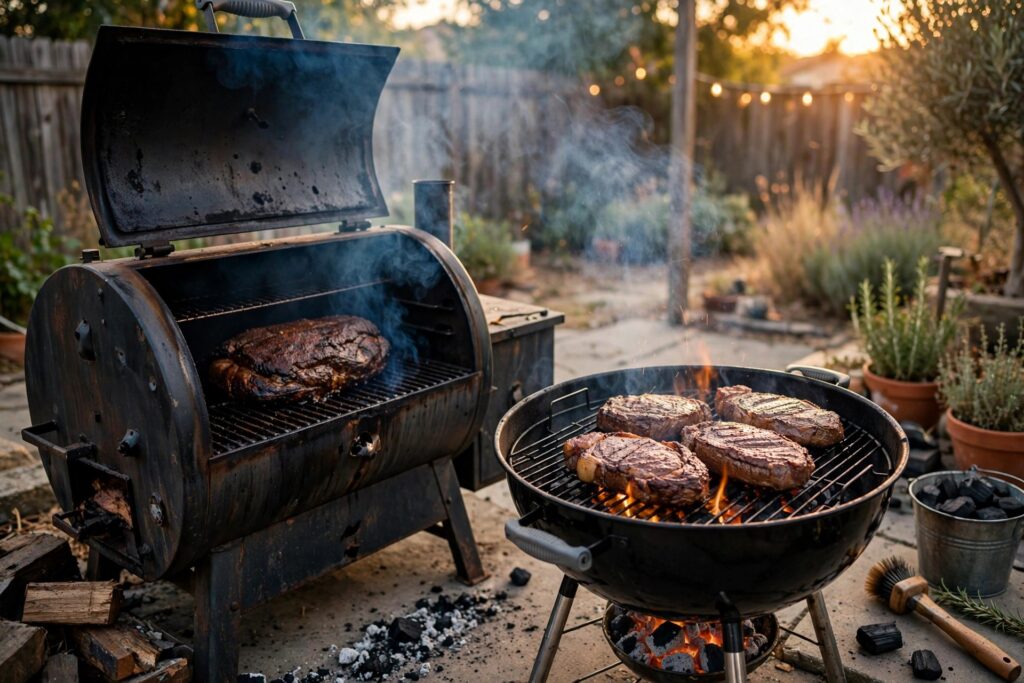
The real difference between smoking and grilling comes down to heat, time, and how that heat reaches the food. Grilling cooks fast — 400 to 550°F over direct heat, done in minutes. Smoking cooks low and slow — 225 to 275°F with indirect heat and wood smoke, taking hours. One sears tender cuts; the other melts tough ones.
People use the words interchangeably at cookouts, and that’s where the trouble starts. Throw a brisket on a screaming-hot grill and you’ll get shoe leather in twenty minutes. Try to grill a steak in a 225°F smoker and you’ll get gray, steamed beef with no crust. Smoking vs grilling isn’t a style preference — it’s two different kinds of cooking that happen to involve fire and meat.
Smoking vs Grilling: The Short Answer
If you only remember one thing, remember this: grilling is a sprint, smoking is a marathon. The table below puts the core differences side by side.
| Factor | Grilling | Smoking |
|---|---|---|
| Cooking temperature | 400–550°F (up to 600°F+ for searing) | 225–275°F |
| Cook time | Minutes — 5 to 30 for most foods | Hours — 4 to 14+ depending on the cut |
| Heat type | Direct heat, food right over the fire | Indirect heat, food beside or away from the fire |
| Flavor | Charred, caramelized crust from the Maillard reaction | Deep smoke flavor infused through the meat |
| Best for | Tender, thin cuts: steaks, burgers, chops, vegetables | Tough, fatty cuts: brisket, pork shoulder, ribs |
| Fuel | Gas, charcoal, or electric — heat matters most | Wood, pellets, or charcoal — smoke is the point |
What Is Grilling, Exactly?
Grilling means cooking food fast over direct, high heat — usually on a grate positioned right above the fire. The intense heat triggers the Maillard reaction, the chemical browning between proteins and sugars that builds that savory, caramelized crust on a steak. That’s the flavor grilling is all about: char, sear, and the natural taste of the meat, turned up loud.
Because the heat is so aggressive, grilling suits foods that are already tender and cook through quickly: ribeyes, burgers, chicken pieces, pork chops, sausages, shrimp, and most vegetables. A 1-inch steak hits medium-rare in about 8 to 10 minutes over 450–500°F. Leave anything on a grill much longer than 30 minutes and you’re usually overcooking it.
Grills come in every fuel type — gas for convenience, charcoal for flavor, kamado cookers for versatility. Charcoal adds a mild smokiness from dripping fat vaporizing on the coals, while gas gives you precise, repeatable heat with the turn of a knob. Neither is wrong; they’re just different tools. A basic 22-inch kettle grill costs under $200 and can both grill and smoke, which makes it the best first cooker for most people. And here’s a useful distinction: direct vs. indirect grilling are two setups on the same cooker. Direct means food over the flames; indirect means food beside them with the lid closed — which, at low temps with wood added, starts to blur the line toward smoking.
https://woodpeckersbbq.com/wp-content/uploads/2026/09/steaks-searing-grill.jpg
What Is Smoking, Exactly?
Smoking means cooking food slowly with indirect heat while it’s bathed in wood smoke. The fire never touches the food directly. Instead, heat and smoke drift through the cooking chamber for hours, and the meat absorbs that smoke the entire time — building flavor deep into the cut, not just on the surface.
The magic number is 225 to 275°F. That gentle heat does something high heat can’t: it gives collagen — the tough connective tissue in hard-working muscles — time to melt into gelatin. A brisket held at 250°F for 12 hours transforms from tough to spoon-tender. The same brisket blasted at 500°F just seizes up.
Smoke flavor comes from the fuel, and pitmasters choose it deliberately. Post oak for Texas brisket, hickory for pork, apple and cherry for a sweeter touch on ribs and poultry. The goal is thin blue smoke — a faint, almost invisible wisp. Thick white smoke tastes bitter and acrid, which is how good meat gets ruined by a dirty fire.
There’s also cold smoking, a different animal entirely. Cold smoking happens below 100°F and flavors food without cooking it — think smoked salmon, cheese, and bacon. It takes specialized setups and careful food-safety handling, so it sits outside what most backyard cooks mean by “smoking.” When this guide says smoking, it means hot smoking: 225–275°F, the low-and-slow BBQ method.
Smokers built for the job include offset smokers, pellet grills, kamado cookers, and vertical cabinet smokers. A reverse flow smoker adds a baffle plate that evens out heat across the chamber — worth knowing about if you’re shopping for an offset.
https://woodpeckersbbq.com/wp-content/uploads/2026/09/brisket-low-slow-smoker.jpg
Why Tough Meat Needs Low and Slow
This is the science most smoking vs grilling explainers skip, and it’s the real reason the two methods exist. Tender cuts (ribeye, tenderloin, chicken breast) are tender because the animal barely used those muscles — little connective tissue, so fast heat works fine. Tough cuts (brisket, chuck, pork shoulder, ribs) come from hard-working muscles loaded with collagen.
Collagen starts breaking down around 160°F, but it needs time at temperature to convert into silky gelatin. Rush it with high heat and the muscle fibers contract, squeeze out their moisture, and turn tough before the collagen ever melts. Hold it low and slow and the collagen dissolves while the fat renders, basting the meat from the inside.
That conversion is also why smoked meats stall — the BBQ stall around 150–165°F internal, where evaporative cooling holds the temperature steady for hours while the connective tissue does its work. Patience through the stall is what separates tender from tough. No grill sprint can substitute for it.
Which Cuts Belong on the Smoker, Which on the Grill?
Match the method to the muscle. Tough, fatty, and thick goes low and slow. Tender, lean, and thin goes hot and fast.
| Smoke it (low and slow) | Grill it (hot and fast) |
|---|---|
| Brisket (10–14 hrs at 250°F) | Ribeye / strip steak (8–10 min at 450–500°F) |
| Pork shoulder / butt (10–12 hrs at 250°F) | Burgers (4–5 min per side at 450°F) |
| Spare ribs / baby backs (5–6 hrs at 250°F) | Chicken thighs and breasts (6–8 min per side) |
| Beef short ribs (8–10 hrs at 250°F) | Pork chops (5–7 min per side) |
| Whole turkey / chicken (3–5 hrs at 275°F) | Sausages and hot dogs (10–15 min) |
| Chuck roast (8–10 hrs at 250°F) | Vegetables, shrimp, fish fillets (minutes) |
There’s a gray zone in the middle. Thick pork chops, tri-tip, and whole chickens do well with a hybrid: smoke first at 225°F, then finish over direct high heat for a crust — the reverse sear. You get smoke depth and a grilled crust in one cook.
https://woodpeckersbbq.com/wp-content/uploads/2026/09/ribs-smoker-grate.jpg
Can You Smoke on a Grill? (And Grill on a Smoker?)
Yes to both — with caveats.
Smoking on a charcoal grill works surprisingly well. Bank lit coals to one side, put the food on the other side with the lid closed, add a few wood chunks, and hold 225–275°F with the vents. That’s genuine indirect smoking; plenty of great ribs have come off a kettle grill this way. WebstaurantStore’s smoker-vs-grill guide lays out the same charcoal-grill smoking setup step by step, water pan included. A gas grill can do a lighter version with a smoker box of wood chips, though the smoke flavor stays mild.
Grilling on a smoker is harder. Most smokers can’t reach searing temperatures — a pellet grill might top out around 500°F on its hottest setting, which sears acceptably but not spectacularly. An offset smoker’s firebox, though, gets ripping hot, and plenty of pitmasters grill steaks directly over the firebox coals. A pellet grill is the true crossover cooker: it smokes at 225°F and grills at 500°F, which is why it’s the most popular “one cooker” choice for backyards.
If you’re choosing equipment, our guides to the best pellet grill and best offset smoker break down which cookers handle both jobs and which are single-purpose specialists.
Smoking vs Grilling: Which Should You Choose?
- Pick grilling when dinner needs to happen tonight. Weeknight steaks, burgers for a crowd, anything under 30 minutes — the grill wins on speed and simplicity.
- Pick smoking when you have the day and want the payoff. Weekends, holidays, and parties are smoker territory — brisket, pork shoulder, and ribs reward the wait.
- Pick both if you cook outdoors regularly. A grill plus a smoker (or one pellet grill that does both jobs) covers every cut and every occasion.
- Start with a grill if you’re new. It’s cheaper, faster to learn, and teaches fire control. Add a smoker once weeknight grilling feels easy. Still on the fence? Fit Men Cook’s smoking vs grilling breakdown walks through the same decision with a helpful pros-and-cons list for each method.
One last terminology note that clears up years of confusion: smoking is a form of barbecue — “low and slow” cooking. Grilling is not barbecue, no matter what the backyard invitation says. When a Texan says “BBQ,” they mean smoked meat, not burgers off a gas grill.
One practical tip if you’re new to smoking: plan the cook backwards. A 12-pound packer brisket at 250°F takes roughly 12 hours plus a 2-hour rest — so for a 6 PM dinner, the meat goes on around 2 AM. Most first-time smokers underestimate the timeline and end up serving at midnight. When in doubt, start earlier than you think; a finished brisket holds beautifully in a cooler for hours, but an unfinished one can’t be rushed.
FAQs About Smoking vs Grilling
Is smoking better than grilling?
Neither is better — they do different jobs. Smoking wins for tough cuts like brisket and pork shoulder, where hours of low heat build tenderness and smoke flavor. Grilling wins for tender cuts like steaks and burgers, where high heat builds a caramelized crust in minutes.
Is smoked meat healthier than grilled meat?
Smoked meat avoids the intense charring of high-heat grilling, which some studies link to harmful compounds forming on heavily blackened meat. But both are fine in normal amounts — just don’t incinerate your food on either cooker.
Can you smoke meat on a regular charcoal grill?
Yes. Push the coals to one side, place the meat on the other side, close the lid, add wood chunks, and hold 225–275°F using the vents. It’s real indirect smoking — just with less room and shorter fuel life than a dedicated smoker.
Is it better to smoke or grill chicken?
Depends on the cut. Whole birds and bone-in pieces turn out juicier smoked at 275°F, with deeper flavor in the skin. Boneless breasts and thighs are faster and just as good grilled hot — about 6 to 8 minutes per side.
Do I need both a smoker and a grill?
Not necessarily. A pellet grill or kamado cooker handles both: smoking at 225°F and searing near 500°F. Dedicated offsets smoke beautifully but grill poorly, and gas grills grill beautifully but barely smoke. One versatile cooker covers most backyards.
Your next step: pick one cook for this weekend and commit to the method it needs. Got a pork shoulder? Go low and slow and watch your thermometer, not the clock. Got steaks? Fire the grill hot and don’t look back.
[…] beats a gas grill on flavor. If you want the fundamental split between the two cooking styles, our smoking vs. grilling guide covers when low-and-slow beats […]
[…] fast cooking over direct flames. If you’re fuzzy on the line between them, this breakdown of smoking vs grilling clears it […]