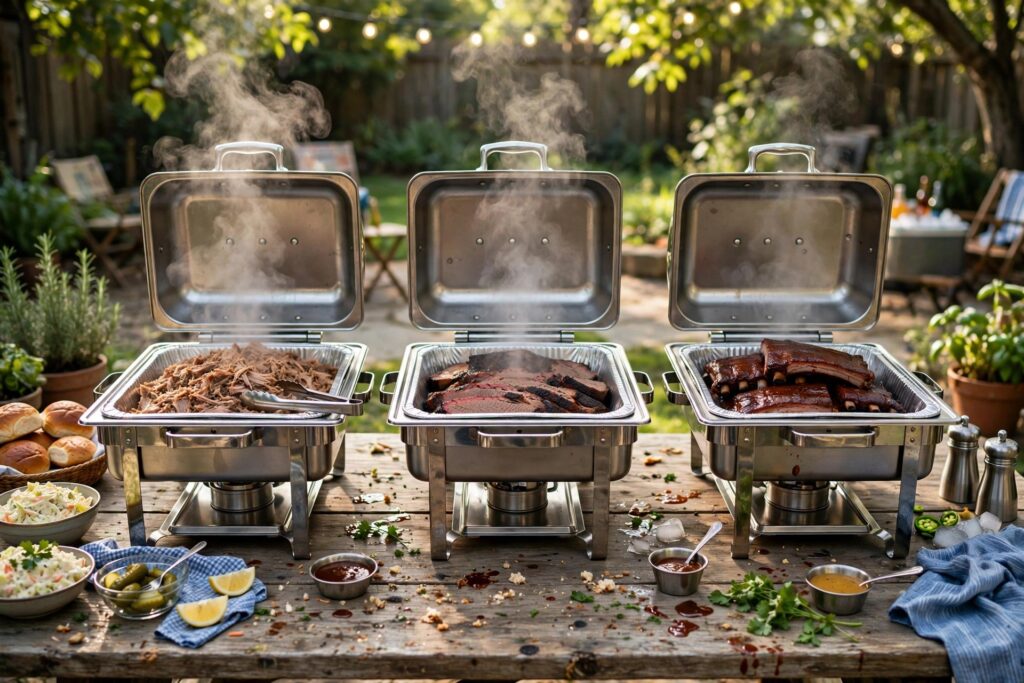
How to keep BBQ warm for a party comes down to one rule and one choice: hold the meat at 140°F or warmer, and pick a holding method that fits your timeline. For waits under 30 minutes, tent the meat and rest it. For 30 to 90 minutes, use a low oven or preheated cooler. For 1 to 4 hours, use an insulated carrier like a Cambro. For active buffet service, run chafing dishes with fresh fuel and water pans. Whatever you choose, check the temperature with a thermometer — “still warm” is not a safety check.
Here’s the scenario everyone knows: the brisket finished at 2 p.m., the guests arrive at 5. Panic is optional. Cooked meat that stays hot is actually easier to manage than meat that’s still on the smoker — as long as you hold it right. Too cool and you’re gambling with food safety. Too hot and you’re still cooking the meat into mush. This guide covers the exact temperatures, the best method for every time window, and the mistakes that turn a great cook into a dry one.
The One Rule: 140°F or Warmer
Everything else in this article is technique. This is the law. The USDA and FoodSafety.gov both say the same thing: keep hot cooked food at 140°F or above. Between 40°F and 140°F lies the danger zone, where bacteria multiply fast. Perishable food shouldn’t sit in that range for more than 2 hours total — and if it’s a hot day above 90°F outside, that window shrinks to 1 hour.
Three numbers to memorize for party day:
- 140°F — the minimum safe holding temperature. Below this, the clock starts.
- 2 hours (1 hour above 90°F) — the maximum cumulative time food can spend in the danger zone.
- 165°F — the reheat target. If meat has cooled too far but is still within safe time limits, bring it all the way back to 165°F before holding or serving again.
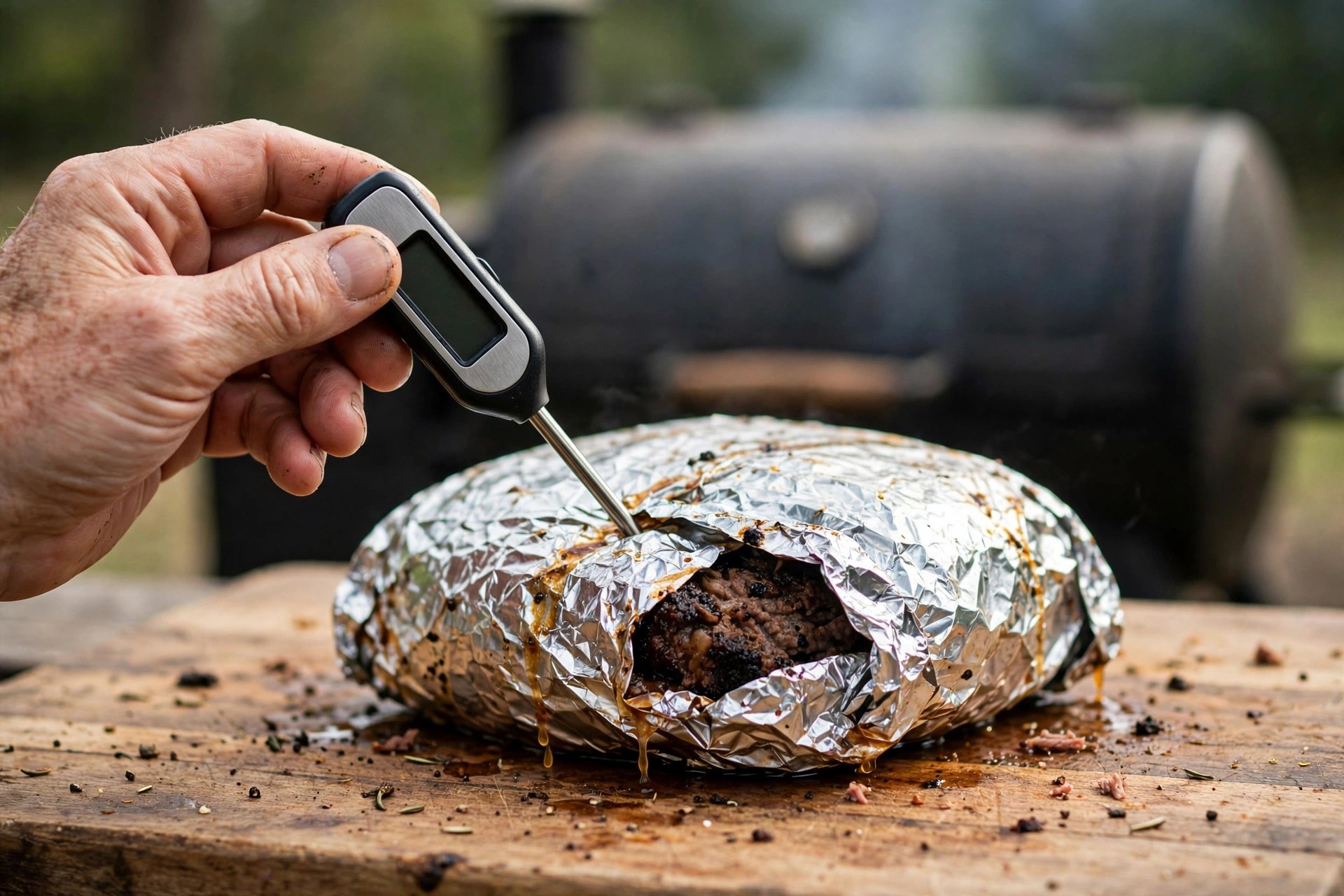
If your brisket drops below 140°F and you don’t know how long it’s been there, the safe move is to reheat it to 165°F or serve it immediately — not to wrap it tighter and hope. A probe thermometer is the only honest judge here; meat at 120°F can still feel warm in your hand while being firmly unsafe.
Match the Method to Your Timeline
The right holding method depends almost entirely on how long the meat has to wait. Short waits need almost nothing. Long waits need real equipment. Here’s the decision table — pick your window before the meat comes off the cooker.
| Time until serving | Best method | Setup | Watch out for |
|---|---|---|---|
| Under 30 minutes | Rest, loosely tented | Whole cuts on a board or pan, foil tented loosely | Not a true hold — fine only for short delays |
| 30–90 minutes | Low oven or smoker on warm | Wrapped meat at 150–170°F | Too much heat keeps cooking the meat |
| 45 min – 2 hours | Preheated cooler | Hot-water preheated cooler, wrapped meat, towels filling gaps | Safe only while meat stays at 140°F+ |
| 1–4 hours | Insulated carrier (Cambro-style) | Preheated carrier, full pans, lid kept closed | Still needs temperature checks |
| Active service | Chafing dishes / electric warmers | Water pan, lit fuel, small batches | Steam softens bark; ~2-hour quality window |
| Over 4 hours | Reassess the plan | Heated holding cabinet, or cool and reheat to 165°F | Casual methods stop being safe here |
A full cooler in a cool garage and a half-empty cooler on a hot tailgate will not behave the same way. The table gives you planning ranges, not promises — the thermometer makes the final call. The holding-temperature guidance from Girls Can Grill breaks this down further by scenario, from backyard cooks to competition teams.
The Cooler Method: Best for 1–2 Hour Holds
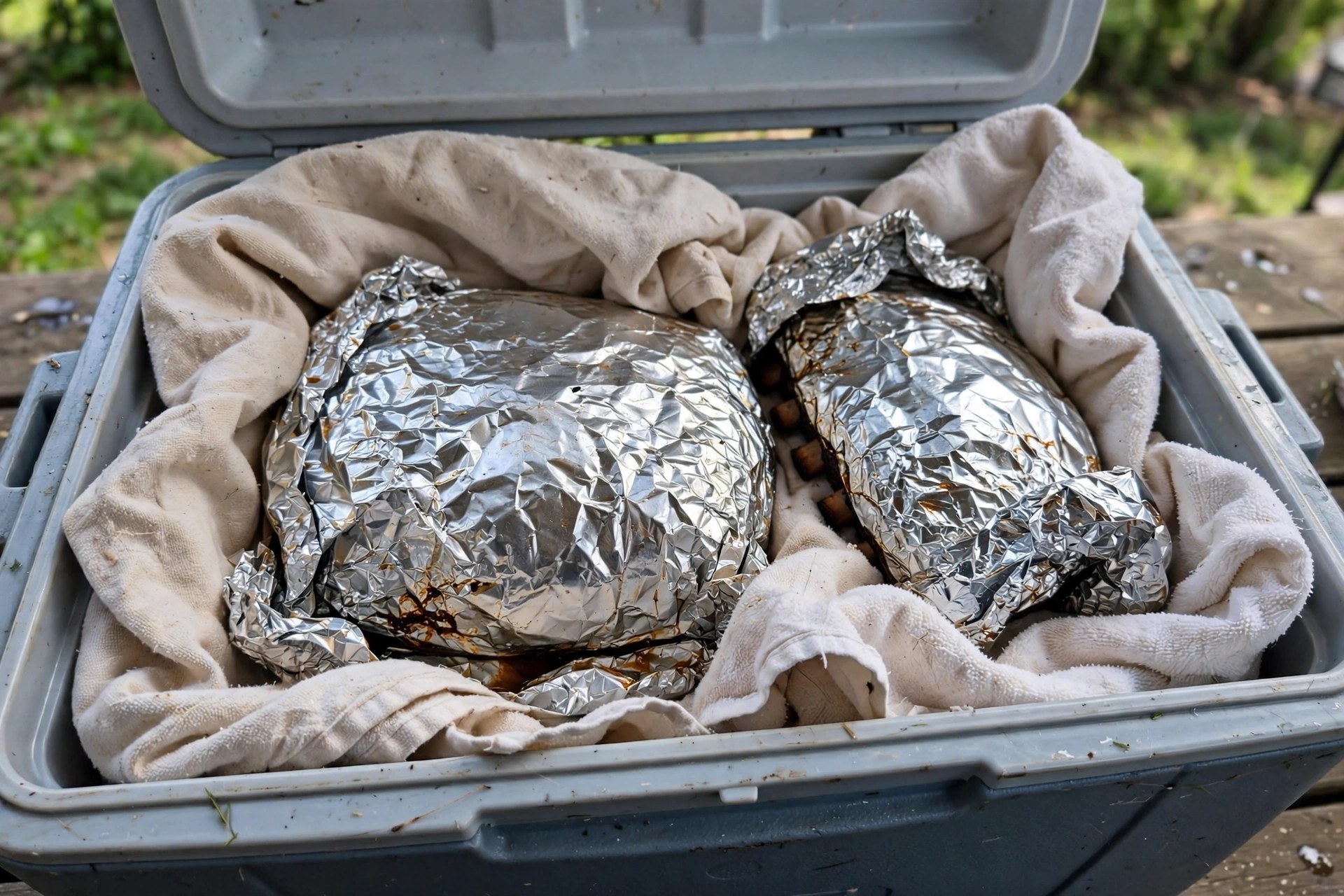
The preheated cooler — sometimes called a “faux Cambro” — is the backyard pitmaster’s best trick. A cooler doesn’t make heat; it just slows heat loss. Done right, a well-packed cooler holds a wrapped brisket above 140°F for 2 hours or more. Here’s the exact setup, in order:
- Preheat the cooler. Fill it with hot tap water, close the lid for 10–15 minutes, then drain and dry it completely. A cold cooler steals the first 20 degrees of your hold.
- Keep big cuts whole. Briskets, pork shoulders, and whole racks hold heat far better than sliced meat. Don’t slice anything until serving time.
- Wrap tight. Wrap each piece in foil (or leave it in its butcher-paper wrap and add a foil outer layer). Wrapped meat leaks less and loses heat slower.
- Fill the dead space. Pack clean bath towels around and over the wrapped meat. Air gaps are the enemy — every pocket of air is a pocket of cooling.
- Close it and leave it. Every time you open the lid, you dump heat. Check temperature at the 1-hour mark the first time you do this; after that you’ll know your cooler’s personality.
Expect the bark to soften — hot, wrapped meat in a humid box will do that no matter what. For a party, slightly soft bark on juicy meat beats crisp bark on dry meat every time. Our brisket resting guide covers the shorter version of this same technique.
Using Your Oven or Smoker as a Warmer
If the meat is done and the guests are an hour out, the simplest move is often the oven you already have. Set it to its lowest stable temperature — ideally 150–170°F — wrap the meat in foil, and put it in. Most home ovens bottom out around 170°F, which works fine for holds under 90 minutes.
Two cautions. First, 170°F is still cooking temperature, just very slowly. A brisket held at 175°F for 3 hours will keep rendering and can turn mushy — the flat starts to crumble instead of slice. If your oven runs hot, crack the door or cycle it. Second, some ovens have a “warm” setting that cycles between 140°F and 180°F; that’s fine for holding, but put a probe in the meat and confirm it stays above 140°F.
Your smoker works the same way if it has a reliable low setting. Pellet grills with a 165°F “warm” or “smoke” mode are excellent holders — steady, gentle, indirect heat. Just remember the controller temperature is not the meat temperature. An independent probe in the thickest piece tells you the truth.
Chafing Dishes and the Party Buffet
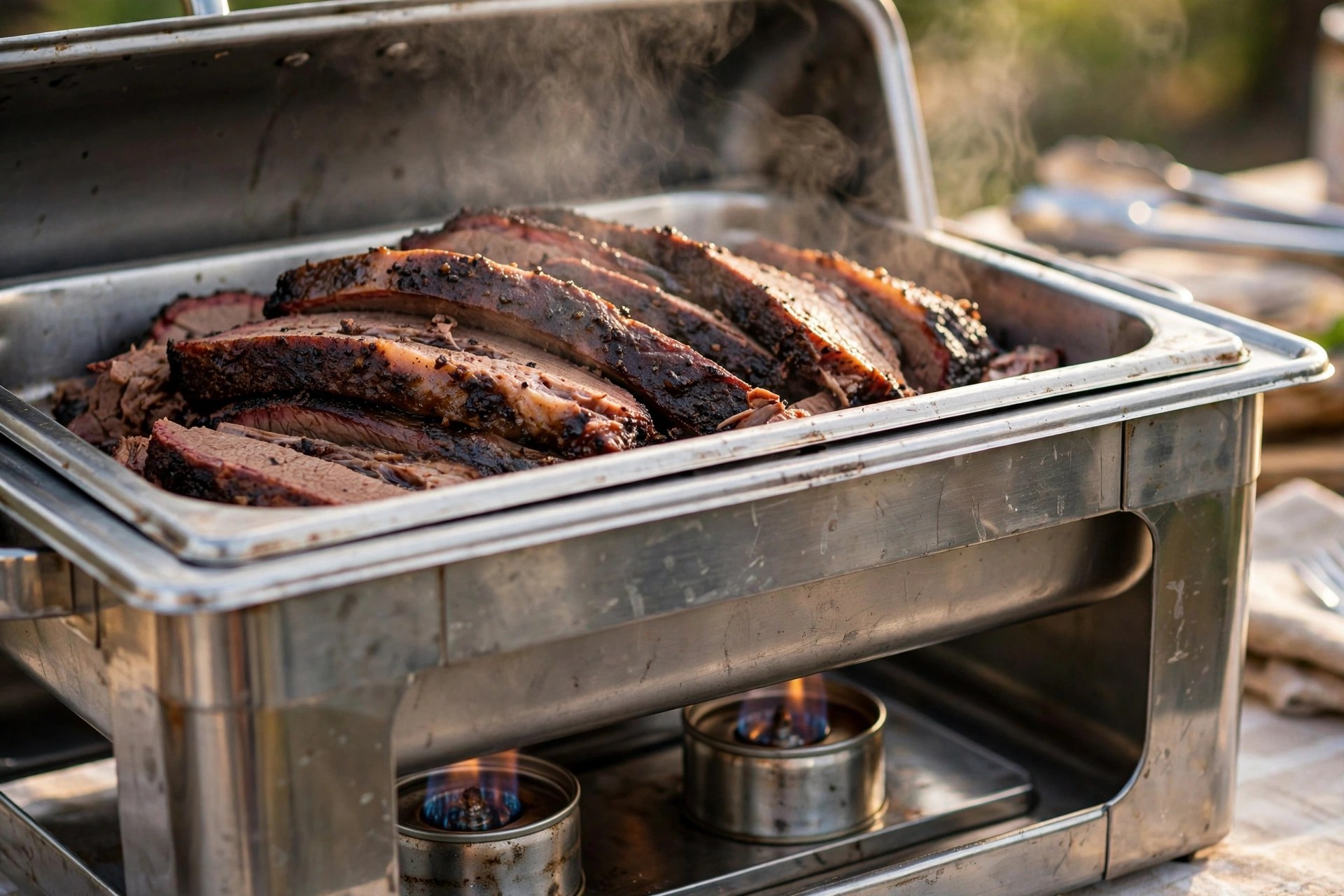
For the actual serving window — guests grazing for a couple of hours — chafing dishes are the standard. Set them up right and they’ll hold pulled pork, sliced brisket, and ribs at safe temperatures through the whole party. Set them up wrong and you get lukewarm meat in a dried-out pan.
- Water pan, always. Fill the lower pan with hot (ideally boiling) water before the food goes in. The water buffers the flame’s heat so the food steams gently instead of scorching on the bottom. No water pan is the single most common chafer mistake.
- Light fuel 30 minutes early. Standard fuel canisters burn about 2 hours; check them and have spares ready. Assign one person to fuel duty — canisters burn out silently.
- Small batches, refilled often. Don’t load four hours of food at once. Caterers plan on a 2-hour quality window and a 4-hour maximum in the chafer, then rotate in a fresh pan. Keep backup pans in a 150°F oven for instant swaps.
- Keep it covered. Lids on between servings. An open chafer in a breeze loses heat fast.
- Sauce on the side. Hold sliced meat plain and put warm sauce in a separate pan. Sauce in the main pan breaks down and gets gluey over a long hold.
If you’re running a full catering-style setup, the catering equipment guide from The Restaurant Warehouse has the complete workflow: preheating carriers for 20–30 minutes, checking temps every 30–45 minutes, and logging start times so you know when the 4-hour clock expires.
Catering and Transport: Getting Hot BBQ to the Venue
Keeping BBQ warm at home is one problem. Moving it across town and holding it at a venue with no kitchen is a harder one. The professional workflow has five steps:
- Cook or reheat to 165°F in your own kitchen before anything goes into a carrier. Warmers and carriers hold temperature — they don’t build it safely.
- Preheat insulated carriers with hot water for 20–30 minutes, then drain, dry, and load immediately. Transfer food straight from the oven into the pan and into the carrier — every minute on the counter is heat lost.
- Transport sealed and level. Don’t open the carrier until you reach the venue. Full carriers hold heat dramatically better than half-empty ones, so fill gaps with towels if you’re light.
- Move fast at the venue into chafers or electric warmers that are already lit and preheated. Cold chafers drag food temperature down before service even starts.
- Check and log. Probe internal temps every 30–45 minutes and write down start times. When the 4-hour clock on a pan expires, that pan is done — rotate in a fresh one.
For big events, plan quantities before you plan holding — our brisket per person and pulled pork per person guides help you size the cook so you’re holding the right amount, not twice what you need.
Mistakes That Ruin Held BBQ
Most holding failures aren’t equipment failures. They’re timing and judgment failures, and they’re all avoidable.
Slicing too early. Sliced brisket has ten times the surface area of a whole one, which means ten times the moisture loss. Slice in batches as guests eat, not all at once when the meat comes off. The same goes for pulling pork — pull what you need, hold the rest whole.
Holding too hot. The most common home mistake is a 200°F oven “to be safe.” At that temperature you’re still cooking. Brisket held too hot turns mushy, ribs over-tenderize into mush, and everything dries out faster. The target is 140–150°F, not 200°F.
Using the warmer as a reheater. A chafer or cooler cannot safely bring cold meat up through the danger zone — they’re not powerful enough, and the meat sits in the danger zone for hours. Cold meat gets reheated to 165°F in an oven first, then held.
Never checking the temperature. “It was in the cooler for two hours, it should be fine” is how people get sick. Probes are cheap. Use one.
Wrapping ribs airtight for hours. Wrapped ribs held too long steam in their own juices and the bark turns to mush. For holds over 90 minutes, it’s often better to hold ribs unwrapped in a low oven and re-crisp for a few minutes before serving. The rib-holding guide at Destination BBQ covers the moisture-versus-bark tradeoff in detail.
If meat does cool past the point of no return, don’t try to rescue the hold — switch to the reheat plan. Our guides for reheating brisket, reheating pulled pork, and reheating ribs cover how to bring each one back without drying it out.
FAQs: Keeping BBQ Warm
How long can you keep BBQ warm in a cooler?
A well-packed, preheated cooler typically holds wrapped brisket or pork shoulder above 140°F for 1–2 hours, sometimes longer. Check with a thermometer at the 1-hour mark — the cooler slows heat loss but doesn’t add heat.
What temperature should I set the oven to keep BBQ warm?
150–170°F is the sweet spot: warm enough to stay above the 140°F safety line, cool enough not to keep cooking the meat. Most home ovens bottom out around 170°F, which works for holds under 90 minutes.
Can you keep BBQ warm in a chafing dish for 4 hours?
Chafing dishes hold food safely up to about 4 hours with fresh fuel and full water pans, but quality drops after 2 hours. For long events, rotate in a fresh pan every 2 hours instead of serving from one pan all day.
Should you slice brisket before holding it warm?
No. Hold brisket whole and slice in batches close to serving. Sliced meat loses moisture far faster and cools quicker than a whole packer.
What if my BBQ dropped below 140°F — is it ruined?
Not necessarily. If it’s been under 2 hours total in the danger zone (1 hour if it’s above 90°F outside), reheat it to 165°F and it’s safe to serve. If you don’t know how long it’s been there, discard it.
Next step: before your next cook, decide your hold method while the meat is still on the smoker — preheat the cooler or clear oven space an hour before the meat comes off, so you’re never scrambling with hot meat and no plan.
Leave a Reply