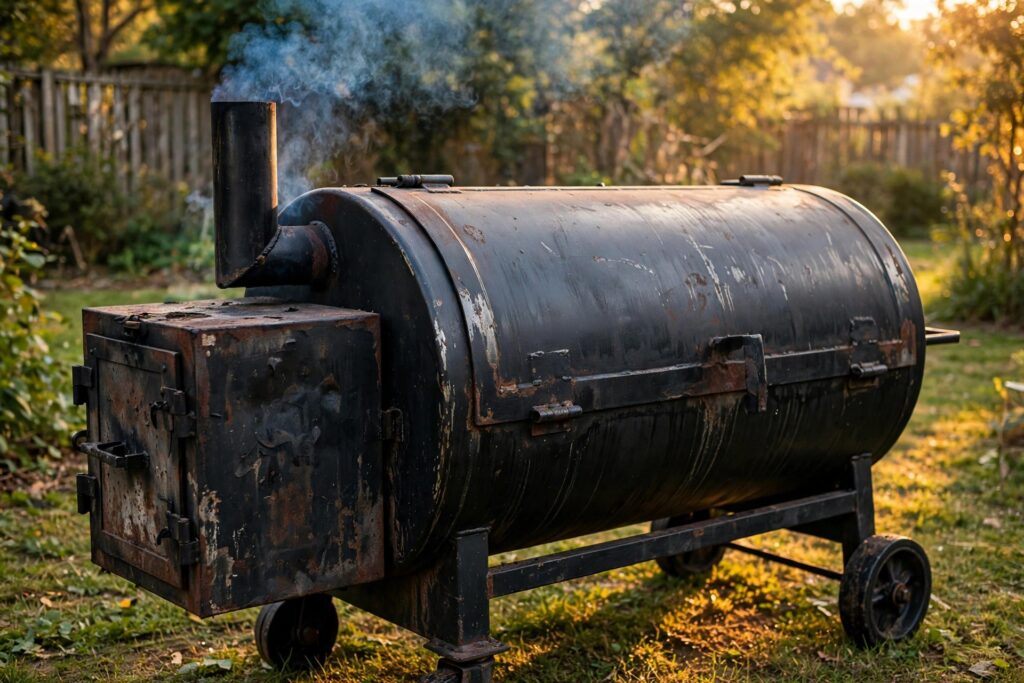
A reverse flow smoker is an offset smoker that sends heat and smoke under a steel baffle plate to the far end of the cook chamber, then reverses the flow back across the meat to a chimney by the firebox. This double pass evens out temperatures, so food cooks uniformly without rotating or babysitting hot spots.
If you have ever smoked a brisket on a standard offset and found one end charred while the other lagged behind, you already understand the problem reverse flow was designed to solve. This article covers exactly how the design works, how it stacks up against a standard offset, who should buy one, and how to run your first cook.
What Is a Reverse Flow Smoker, Exactly?
Start with a standard offset smoker: a firebox bolted to one end of a horizontal cooking chamber, with a chimney on the opposite end. Smoke flows one way — firebox to chimney — straight across the grates. Simple, but the end near the fire always runs hotter — on a thin-walled offset, that gap can reach 50-75°F from one end of the chamber to the other.
A reverse flow smoker changes three things:
- A steel baffle plate sits just below the cooking grates and runs almost the full length of the chamber, dividing it into a lower smoke channel and an upper cooking zone.
- The chimney moves from the far end to the firebox end of the cooker.
- The smoke path doubles back. Heat and smoke travel under the baffle to the far end first, then turn around and pass back over the meat before exiting.
That steel plate is not just a traffic cop for smoke. Once it heats up, it becomes a giant radiant heat source under your food, smoothing out the temperature across the whole chamber. It also catches dripping grease, which vaporizes on the hot metal and sends flavorful steam back up at the meat. And because the smoke travels roughly twice the distance before leaving, every inch of your cook gets more exposure to it.
Builders like Lang BBQ Smokers helped make the design famous, and today you will find it in everything from backyard units to trailer-sized competition rigs. Some models, like the Oklahoma Joe’s Highland Reverse Flow, ship with a removable baffle so you can run the same cooker as a reverse flow or a traditional offset. If you are shopping around, our best offset smoker guide breaks down what to look for in either style.
How Does a Reverse Flow Smoker Work?
Forget the technical diagrams for a second and picture the smoke’s journey like a commuter who overshoots their stop and doubles back:
- The fire starts the trip. You build your fire in the firebox — charcoal, wood splits, or a mix. Heat and smoke pour through the opening where the firebox meets the cook chamber.
- Under the baffle. Instead of rising straight to the meat, the hot gases hit the steel baffle plate and are forced underneath it, traveling the full length of the chamber to the far end.
- The turn. At the far end, past where the baffle plate stops, the smoke rises and reverses direction. This is the “reverse” in reverse flow.
- Back over the meat. Now the smoke flows across the cooking grates — the long way, over your brisket, ribs, or pork shoulder — before exiting through the chimney on the firebox side.
That round trip matters for three reasons. First, the smoke travels about twice as far, doubling contact time with your food. Second, the baffle absorbs the fire’s harshest heat and releases it gently as radiant warmth, so the side near the firebox does not scorch while the far side lags. Third, dripping fat lands on the hot plate and vaporizes instead of pooling, which keeps the chamber humid and adds flavor — you can often skip the water pan entirely. Our smoker water pan guide explains the few situations where you still want one.
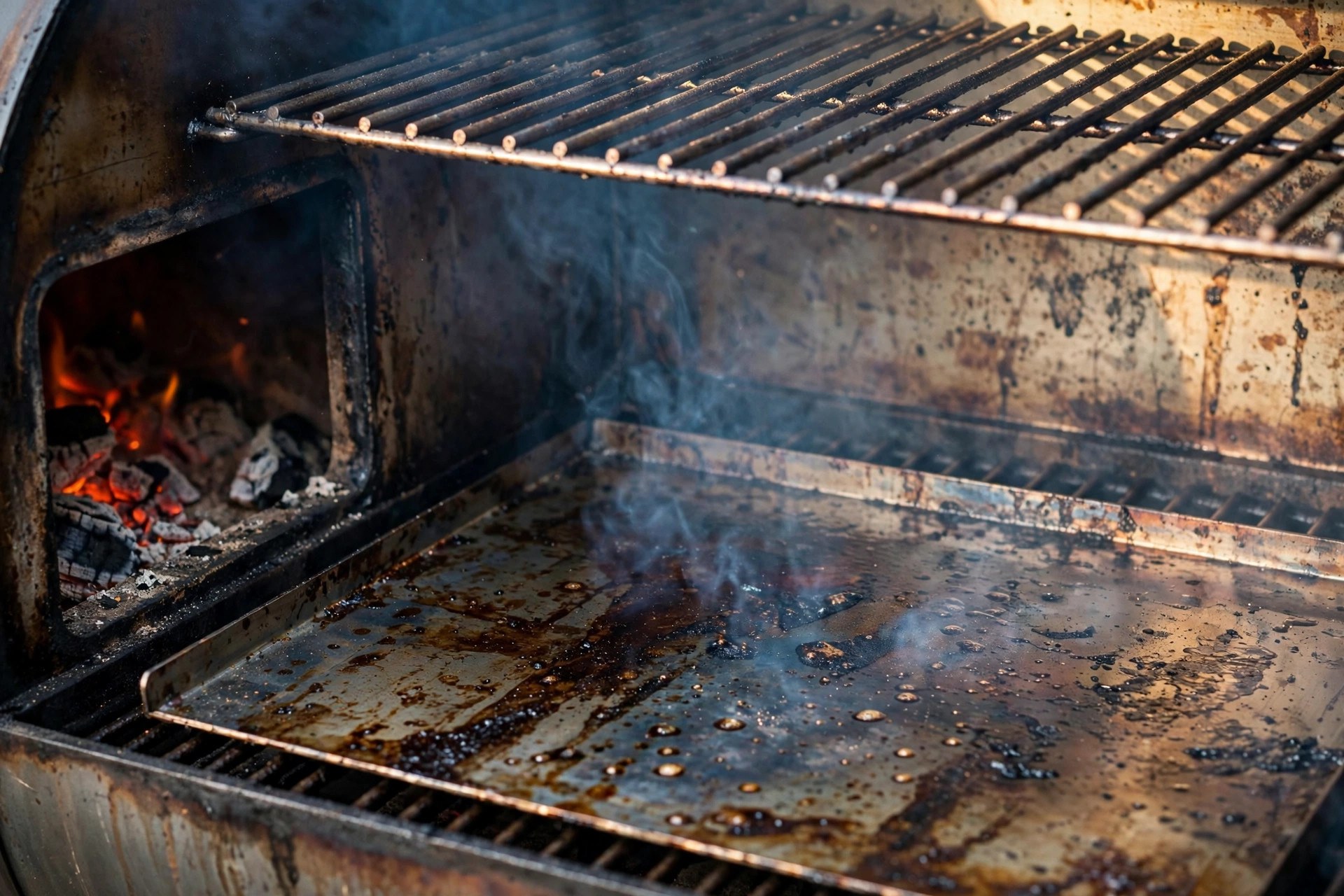
One practical number to remember: a dialed-in reverse flow typically holds within 10-20°F from end to end. On a standard offset, the firebox end might run 275°F while the far end sits at 215°F. The reverse flow lets you load the whole chamber — front to back — and trust that everything finishes together, with no rotating or shuffling.
Reverse Flow vs Standard Offset: The Real Difference
On paper the two designs look almost identical: same horizontal chamber, same side firebox, same fuel. In practice the reversed smoke path changes how they cook, how they burn fuel, and how much attention they demand. Here is the honest side-by-side:
| Reverse flow | Standard offset | |
|---|---|---|
| Smoke path | Under the baffle to the far end, then back over the meat | Straight across from firebox to chimney |
| Chimney location | Same side as the firebox | Opposite side from the firebox |
| Temperature spread | About 10-20°F end to end | Often 50-75°F, hotter near the firebox |
| Heat-up time | 45-60 minutes — the baffle plate needs time to absorb heat | 30-45 minutes |
| Fuel use | Noticeably thirstier; roughly 10-20% more wood or charcoal | More efficient |
| Smoke quality | Slightly restricted airflow; easier to over-smoke if you are careless | Cleaner burn, better airflow |
| Meat rotation | Rarely needed | Rotate every couple of hours |
| Moisture | Grease vaporizing on the baffle adds humidity | Drier chamber; a water pan often helps |
| Max temperature | Many top out around 325°F — poor for searing | Runs hotter; more grilling versatility |
| Cleaning | Grease tray and drain to manage; some baffles are welded in | Simpler — fewer hidden corners |
The trade-off: you give up some fuel efficiency, some maximum temperature, and a bit of airflow cleanliness. In exchange you get a cooker that practically runs itself at 225-275°F. As Smoked BBQ Source notes in their breakdown, the baffled airflow makes a clean burn harder to achieve — so managing your fire still matters, even on a forgiving cooker.
If the offset-versus-grill question is still open for you, our smoking vs grilling guide covers the broader picture of low-and-slow cooking against direct heat.
The Pros and Cons, Honestly
Every pit design is a compromise. Here is where reverse flow wins and where it costs you.
What you will love:
- Even temperatures across the entire cooking chamber — load it front to back with confidence.
- No rotating meat mid-cook. A full chamber of ribs finishes together, which matters at 3 a.m. on an overnight brisket cook.
- Less drama when you add fuel or open the lid; temperatures recover faster and spike less.
- The baffle doubles as a grease tray, and vaporized drippings keep meat moist — many cooks ditch the water pan.
- Forgiving for beginners — the design covers up plenty of fire-management mistakes.
What might bug you:
- Slower to heat up — give it a full 45-60 minutes before meat goes on.
- Burns more fuel than a standard offset of the same size.
- Restricted airflow can turn into creosote and bitter smoke if you choke the fire or burn green wood. Keep fires small and hot, and aim for thin blue smoke, not billowing white clouds.
- Some models weld the baffle plate in, which makes deep cleaning awkward.
- Most will not get hot enough to sear a steak properly — plan on a separate grill or griddle for that.
Who Should Buy a Reverse Flow Smoker (and Who Shouldn’t)
Get one if you are new to stick-burning and want a forgiving first offset, if you cook for crowds and need every square inch to cook evenly, or if you simply hate rotating meat. Competition cooks and caterers love them for exactly this reason.
Think twice if you are on a tight fuel budget — the extra 10-20% wood adds up over a season of long cooks. Skip it too if searing and high-heat grilling matter to you; a reverse flow is a low-and-slow specialist. And if you genuinely enjoy managing hot spots on a traditional offset, this design will feel like it removed the fun.
Budget-wise, expect to pay more than an equivalent standard offset for the extra steel and drain hardware. Entry-level reverse flows start in the few-hundred-dollar range; quarter-inch all-welded rigs climb into the thousands. For a deeper look at what your money buys, Project Smoked’s buyer checklist covers metal thickness, seals, and thermometers worth checking before you buy.
Running a Reverse Flow Smoker for the First Time
The learning curve is short. Follow this sequence on your first cook:
- Season it first. Coat the interior (baffle plate included) with a thin layer of cooking oil and run a hot fire — around 300°F — for 2-3 hours. This burns off manufacturing residues and starts the seasoning that protects the steel. Our season a new smoker walkthrough has the full process.
- Start 45-60 minutes early. Light a chimney of charcoal or a small wood fire and let the cooker climb slowly. Do not rush it — the baffle needs time to soak up heat, and a cold baffle means cold spots.
- Settle at your target. For most BBQ, that is 225-275°F. Adjust the firebox intake damper to control heat; leave the chimney damper wide open.
- Load the meat. Place larger cuts like brisket and pork shoulder anywhere — front, middle, or back, it genuinely does not matter much. Put a probe in the thickest part.
- Feed the fire on schedule. Add a split or two of seasoned wood every 45-60 minutes, or a scoop of charcoal as needed. Small, frequent additions beat big dumps that spike the temperature.
- Watch the smoke, not the clock. You want thin blue smoke barely visible against the sky. Thick white smoke means the fire is smoldering — open the intake and let it breathe.
- Cook to temperature, not time. Brisket and pork shoulder finish around 200-205°F internal; ribs are done when they bend and the bark cracks. Rest everything before slicing.
If you are still deciding what to cook first, Carnivore Style’s six-step guide is a solid second opinion on the workflow.
Keeping It Clean: Grease, Drains, and the Baffle
The one maintenance habit that matters most is also the easiest to forget: the grease drain. Most reverse flows have a drain valve at the low end of the baffle. Open it and drain the collected grease after every cook — or at least every couple of cooks. Let it sit and it turns rancid, and then your next brisket tastes like old fryer oil.
Scrape the baffle plate while it is still warm; a putty knife takes off the bulk of the buildup in minutes. If your baffle is welded in (common on cheaper units), you cannot remove it for a deep clean — just scrape, drain, and accept some seasoning buildup as character. Empty the firebox ash every cook, since ash buildup chokes airflow and kills your fire’s efficiency.
Frequently Asked Questions
Are reverse flow smokers better than regular offset smokers?
Neither is strictly better — they solve different problems. Reverse flow wins on even heat and hands-off cooking, which suits beginners and big cooks. A standard offset burns cleaner, heats faster, uses less fuel, and gives experienced cooks usable hot spots for cooking different foods at different temperatures.
Do you still need to rotate meat on a reverse flow smoker?
Usually not. With only a 10-20°F difference across the chamber, everything finishes at roughly the same rate. Some cooks still rotate out of habit, but the design exists precisely so you do not have to.
Can you grill or sear on a reverse flow smoker?
Most cannot do it well. The baffled design and long smoke path mean many reverse flows top out around 325°F, which is short of real searing heat. Some models with removable baffles can be converted to direct grilling — check before you buy if that matters to you.
Why does my reverse flow smoker take so long to heat up?
That thick steel baffle plate is a giant heat sink. It has to absorb heat before the chamber stabilizes, which typically takes 45-60 minutes. Start your fire early and do not judge the cooker until the baffle is fully hot.
Does a reverse flow smoker use more fuel?
Yes, roughly 10-20% more than a comparable standard offset. Heating that extra steel and pushing smoke along a longer path costs energy. Thicker-walled cookers hold heat better and narrow the gap somewhat.
Now you know the whole picture: the reversed smoke path, the baffle plate doing triple duty as heat sink, grease tray, and humidity source, and the trade-offs in fuel, speed, and airflow. If a set-it-and-forget-it offset sounds like your style of BBQ, the next step is straightforward — compare the best offset smokers and find the one that fits your budget and your backyard.
Leave a Reply