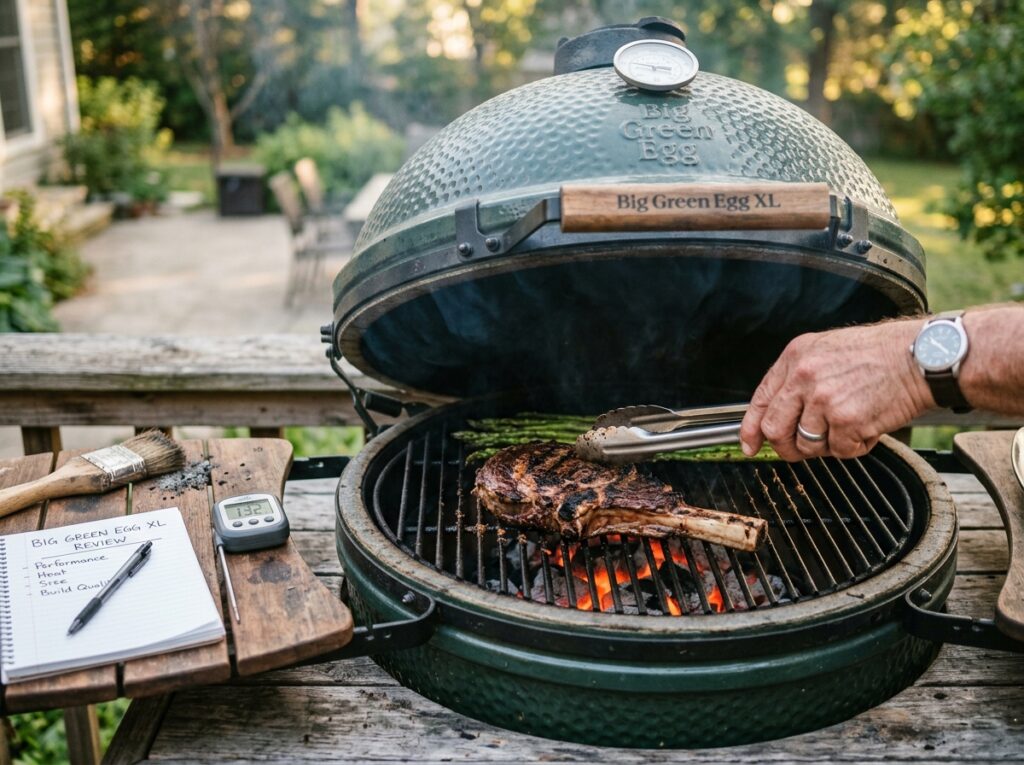
A single ceramic cooker that grills, smokes, bakes, and roasts — and people swear it lasts 20+ years. The Big Green Egg XL has something close to a cult following, and if you’ve spent any time in BBQ forums or backyard cookout circles, you’ve probably heard somebody rave about theirs. But here’s the real question: does a kamado grill that costs well north of $1,500 actually deliver enough to justify emptying your wallet?
I’ve spent serious time cooking on the Big Green Egg XL, testing it through long overnight brisket smokes, high-heat pizza sessions, and everything in between. This review breaks down what this cooker does well, where it falls short, and most importantly, whether it’s the right fit for your backyard.
What Exactly Is the Big Green Egg XL?
Before we get into performance, let’s cover the basics. The Big Green Egg (often just called “BGE”) is a kamado-style ceramic charcoal cooker. The design traces its roots back to ancient Japanese clay cooking vessels called “mushikamado.” Big Green Egg, the company based out of Atlanta, Georgia, popularized this style in the American market starting back in 1974.
The XL is the second-largest model in the Big Green Egg lineup, sitting right below the massive 2XL. It gives you a 24-inch diameter cooking grid, which translates to roughly 452 square inches of primary cooking space. Add a second tier with an accessory rack, and you’re looking at well over 600 square inches total.
Quick Specs at a Glance:
- Cooking grid diameter: 24 inches
- Primary cooking area: 452 sq. in.
- Weight: Approximately 219 lbs (without nest/stand)
- Fuel type: Natural lump charcoal
- Temperature range: 200°F to 750°F+
- Construction: NASA-grade ceramic
- Made for: 12–20+ people per cook
That weight is no joke, by the way. Once you set this thing in its nest and place it on your patio, it’s pretty much staying there. You’re not wheeling it around casually like a standard gas grill.
Build Quality and Construction
Let’s talk about why people become lifelong Big Green Egg owners. The construction quality is where this cooker genuinely earns its reputation.
The XL’s body is made from a proprietary ceramic blend that Big Green Egg has refined over decades. The walls are thick — noticeably thicker than cheaper kamado alternatives you’ll find on the market. This ceramic acts as a massive insulator. Once the Egg reaches your target temperature, it holds it with almost eerie consistency. I’ve set mine at 225°F for an overnight pork butt smoke and woke up to find it sitting at 228°F. That kind of thermal stability isn’t something you’ll get from a thin-walled steel smoker.
The stainless steel draft door at the bottom and the dual-function metal top (the “daisy wheel” vent cap) give you precise airflow control. You’re basically fine-tuning the oxygen supply to your charcoal, and the Egg responds predictably. Close the vents slightly, the temp drops. Open them a bit, the temp rises. No guesswork.
Pro Tip: The hinge system on newer Big Green Egg models is a significant upgrade over older versions. It’s a spring-assisted, patented hinge that makes the heavy ceramic lid feel almost weightless when you open it. If you’re buying used, check the hinge — older Eggs didn’t have this feature, and the lid can feel dangerously heavy without it.
One thing worth noting: ceramic, while incredibly durable over time, is breakable if you’re careless during setup. Dropping a component during assembly or bumping the lid hard against something can crack it. Handle with care during the initial build, and you’ll likely never have another issue.
Cooking Performance: Where the XL Truly Shines
This is where the Big Green Egg XL separates itself from the crowd. The cooking performance across different styles is genuinely impressive.
Low-and-Slow Smoking
If you’re into smoking briskets, pork shoulders, ribs, or whole chickens, the XL delivers a smoking experience that rivals dedicated offset smokers costing twice as much. The thick ceramic walls trap heat and moisture beautifully. Your meat comes out juicy because the Egg doesn’t hemorrhage moisture the way a standard metal smoker does.
I’ve smoked full packer briskets on the XL at 250°F and the bark development was excellent — deep, mahogany, and crackly. The smoke flavor was clean, not acrid, which I attribute to the way the ceramic naturally manages combustion. You burn less charcoal, the fire burns cleaner, and the smoke tastes better.
For ribs, the XL has more than enough room to fit four full racks with a rib rack accessory. If you’re following a 3-2-1 ribs method, the stable temperature makes the process almost foolproof.
High-Heat Grilling and Searing
Here’s something that surprises a lot of first-time Egg users. This cooker doesn’t just smoke — it sears like an absolute beast. Open those vents wide, let the lump charcoal rip, and the Big Green Egg XL will climb past 700°F without breaking a sweat. I’ve hit 750°F+ on multiple occasions.
At those temperatures, you’re searing steaks with a crust that rivals high-end steakhouse results. Two minutes per side on a thick ribeye, and you’ll get that deep caramelized Maillard reaction crust with a perfectly pink interior. It’s the kind of result that makes your neighbors suddenly want to come over more often.
Baking and Roasting
Drop in a convEGGtor (Big Green Egg’s branded heat deflector plate) and the XL becomes an outdoor convection oven. Pizza is a standout here. With a pizza stone and the Egg cranked up to 600°F–700°F, you can bake Neapolitan-style pizzas with charred, bubbly crusts in under three minutes.
I’ve also baked bread, roasted whole turkeys for Thanksgiving, and even done desserts like cobblers. The moist heat environment inside the Egg produces results that genuinely match or beat a kitchen oven.
Did You Know? Some Big Green Egg loyalists use their XL as their primary oven year-round, even during winter. The ceramic insulation works both ways — it keeps heat in regardless of what’s happening outside, so cooking at 20°F ambient temperature barely affects performance.
Charcoal Usage and Fuel Efficiency
One of the biggest advantages of the Big Green Egg XL over other grills and smokers is fuel efficiency. The ceramic insulation means you burn significantly less charcoal than an open grill or a thin-walled smoker.
For a typical low-and-slow cook at 225°F–250°F lasting 10–12 hours, I use roughly 8–10 pounds of lump charcoal in the XL. Compare that to an offset smoker that might burn through a full bag of charcoal plus splits of wood in the same timeframe, and the savings add up over time.
Big Green Egg recommends using natural lump charcoal rather than briquettes. Lump charcoal burns cleaner, produces less ash, and lights faster. Brands like Fogo, Jealous Devil, and Big Green Egg’s own brand work well. Avoid cheap lump charcoal with lots of small pieces and dust — it restricts airflow in the fire box and leads to inconsistent temperatures.
Here’s a practical tip that experienced Egg owners swear by: you don’t need to empty your charcoal after every cook. After you shut the vents and extinguish the fire, the remaining lump charcoal can be reused next time. Just shake the ash out through the bottom grate, add fresh charcoal on top, and light it up. This reusability factor genuinely cuts your fuel costs over a season.
If you’re curious about fire-starting techniques, there’s a solid guide on different ways to light a kamado grill that covers everything from electric starters to natural fire starters.
Temperature Control: Easier Than You Think
People who’ve never used a kamado grill often worry about temperature control. They imagine constantly babysitting vents, chasing numbers, obsessing over every degree. The reality with the Big Green Egg XL is almost the opposite.
Once you learn the basics — and honestly, it takes maybe two or three cooks to get comfortable — temperature control becomes second nature. The process works like this: light your charcoal, let the Egg come up to temperature slowly, and adjust the bottom draft door and top daisy wheel vent to dial in your target. Once you’re there, the Egg will hold that temperature with minimal fiddling.
The key lesson most new Egg owners learn the hard way? Don’t overshoot. It’s much easier to bring the temperature up slowly than to bring it back down. If you open the vents wide and let the fire roar past your target, the thick ceramic retains that heat, and cooling it down takes patience. Start conservative. Crack the bottom vent about an inch, leave the daisy wheel partially open, and let the temperature creep up gradually.
For those who want even more precision, adding a wireless meat thermometer with a pit probe gives you real-time monitoring on your phone. You can track both the internal meat temp and the ambient pit temp without lifting the lid.
Warning: Every time you open the lid on a kamado grill, you flood the firebox with oxygen. This can cause a sudden temperature spike — sometimes 50°F–100°F or more. Open the lid slowly, and keep it open as briefly as possible. Experienced Egg users call the phenomenon “flashback,” and it can briefly torch food sitting directly over the coals.
The Size Factor: Is the XL Too Big or Just Right?
This is one of the most common questions people wrestle with before buying. The Big Green Egg lineup includes the Mini, MiniMax, Small, Medium, Large, XL, and 2XL. The Large is the bestseller by a wide margin, so why go bigger?
The XL makes sense if you regularly cook for groups of 10 or more. Think about it practically — if you’re smoking three briskets for a neighborhood block party, hosting family holiday dinners, or tailgating with a serious crew, the XL’s 452 square inches of primary cooking space gives you room to work without cramming food together.
But here’s the honest truth: if you’re a family of four who occasionally entertains six to eight guests, the Large model will serve you just fine. The XL costs several hundred dollars more, weighs significantly more, and uses more charcoal per cook. Bigger isn’t always better if your typical cook involves two racks of ribs and a chicken.
That said, there’s one counterargument I hear from XL owners repeatedly: “I’ve never regretted going bigger, but I would’ve regretted going smaller.” Extra space means better airflow around your food, room for accessories like rib racks and drip pans, and the flexibility to do multi-zone cooking with heat deflectors on one side.
If you’re comparing kamado grills across brands and sizes, a broader look at the best kamado grills can help you weigh all your options.
Accessories and Ecosystem
Big Green Egg has built an enormous accessory ecosystem around their cookers, and for the XL, the options are extensive. Some are borderline essential, while others fall into “nice to have” territory.
Accessories you’ll genuinely want:
The convEGGtor (plate setter) is practically mandatory. It creates indirect heat for smoking and baking by deflecting direct flame away from your food. Without it, the Egg is basically a charcoal grill. With it, it becomes a smoker and oven. Some newer Egg packages include this, but check before you buy.
A nest and handler (the wheeled cart) make moving the heavy XL possible and keep it elevated at a comfortable working height. You don’t want 219 lbs of ceramic sitting directly on your deck.
An accurate instant-read thermometer is also a must. The Egg’s built-in dome thermometer gives you a general idea of pit temperature, but it reads the air near the top of the dome — not necessarily the temperature at grate level where your food sits.
A good pair of heat-resistant grill gloves is also worth grabbing. The ceramic exterior gets hot during cooks, and you’ll be handling the lid, moving grates, and adjusting the convEGGtor in a hot environment.
Beyond the essentials, Big Green Egg offers pizza stones, cast iron grates, wok inserts, rotisserie kits, and more. Third-party manufacturers like Ceramic Grill Store and Smokeware also make compatible accessories that are often just as good — and sometimes better — than the branded options.
The Price Question: Let’s Be Honest About Cost
There’s no way around it. The Big Green Egg XL is expensive. As of 2025, the XL model alone typically retails around $1,800–$2,000, and that’s before you add a nest, convEGGtor, and other accessories. A fully set-up XL with essential accessories can easily push past $2,500.
That’s a lot of money for a grill. And you can’t buy it online directly from Big Green Egg — they sell exclusively through authorized dealers. There are no Amazon listings, no big-box store discounts. This pricing model keeps the resale value high (used Big Green Eggs hold their value remarkably well), but it also means you’re paying full retail.
So what are you actually paying for? Longevity is the main answer. A well-maintained Big Green Egg can last decades. There are people cooking on Eggs they bought 25 years ago with only minor component replacements (a new gasket here, a fire ring there). Compare that lifespan to a gas grill that might give you 5–8 good years, and the cost-per-year math starts looking different.
You’re also paying for versatility. Instead of buying a separate smoker, pizza oven, and charcoal grill, the Egg does all three. If you were to purchase a quality offset smoker, a standalone pizza oven, and a charcoal kettle, you’d easily spend as much or more — and take up far more patio space.
Still, if the price makes you flinch, there are strong kamado alternatives. Brands like Kamado Joe (their Classic III is a direct competitor), Char-Griller Akorn (budget-friendly but steel, not ceramic), and others offer similar functionality at lower price points. The trade-offs usually involve thinner walls, fewer accessories, or shorter warranties.
Big Green Egg XL vs. Kamado Joe Classic III
This comparison comes up constantly, and for good reason. The Kamado Joe Classic III is the most direct competitor to the Big Green Egg Large and XL, and in several areas, Kamado Joe has pushed innovation faster than Big Green Egg.
Kamado Joe includes more accessories out of the box — their Classic III comes with a divide-and-conquer flexible cooking system, a built-in sliding draft door, and a multi-level half-moon grate setup. Big Green Egg’s approach is more barebones at purchase, with accessories sold separately.
Kamado Joe’s SloRoller hyperbolic smoke chamber (included with the Classic III) distributes smoke and heat more evenly than a traditional plate setter. It’s a genuine performance advantage for low-and-slow cooks.
On the other hand, Big Green Egg’s ceramic quality is arguably the best in the industry. The brand’s longevity, dealer network, and resale value are hard to match. BGE also has a more established community, more compatible third-party accessories, and a reputation built over 50 years.
If you’re a value-conscious buyer who wants more included features, Kamado Joe is tough to beat. If you prioritize brand heritage, ceramic quality, and long-term investment, Big Green Egg still holds its ground.
Who Should Buy the Big Green Egg XL?
Not everyone needs this cooker. Let me be straight about who benefits most from the XL specifically.
The XL is a strong choice if you:
Regularly cook for large groups — think family reunions, holiday gatherings, or competition BBQ. The cooking surface comfortably handles multiple briskets, several racks of ribs, or a whole turkey alongside side dishes.
Want one cooker that does everything. You don’t want a crowded patio with five different cooking appliances. The Egg replaces your smoker, oven, grill, and pizza oven in a single footprint.
Value long-term investment over short-term savings. You’re comfortable spending more upfront knowing you won’t replace this cooker for potentially decades.
Enjoy the process of charcoal cooking. The Egg isn’t a “set it and forget it” gas grill. There’s a learning curve, a ritual to lighting it, and a hands-on element that some people love and others find tedious.
You might want to skip the XL if you:
Cook mostly for a small household and rarely entertain large crowds. The Large model covers most everyday needs at a lower price and lighter weight.
Prefer convenience above all else. If you want to press a button and grill burgers in ten minutes, a quality gas grill is more your speed.
Don’t want to deal with charcoal. Ash cleanup, charcoal restocking, and longer startup times are part of the kamado experience. Some people love it. Some find it annoying.
Tips for Getting the Most Out of Your Big Green Egg XL
If you do pull the trigger on the XL, here are some practical lessons that’ll save you time, money, and frustration.
Season your Egg before the first real cook. Run it through a few temperature cycles — bring it to 350°F, hold for an hour, shut it down. Then do a higher-heat run. This conditions the ceramic and the gasket, reducing the chance of thermal shock cracks.
Keep the gasket clean and replace it when it wears. The felt gasket around the lid creates the airtight seal that makes temperature control possible. Over time, it compresses and deteriorates. A worn gasket means air leaks, which means inconsistent temperatures. Replacement gaskets are cheap and easy to install.
Don’t use lighter fluid. Ever. Natural fire starters or an electric charcoal starter work perfectly. Lighter fluid leaves chemical residues in the ceramic pores that can taint your food’s flavor for multiple cooks afterward.
Invest in a good ash tool. The XL produces more ash than smaller models simply because you’re burning more charcoal. Clean the ash out regularly to maintain proper airflow. A clogged ash pan chokes the fire and makes temperature control unpredictable.
Experiment beyond BBQ. Some of the best meals I’ve made on the Egg weren’t traditional barbecue at all. Bread, stir-fries in a cast iron wok, smoked mac and cheese, cedar-planked salmon — the XL handles all of it. Don’t pigeonhole a $2,000 cooker into just smoking brisket.
FAQ
How long does the Big Green Egg XL last?
With proper care, a Big Green Egg XL can last 20 years or more. The ceramic body doesn’t rust or corrode like metal smokers. Internal components like the fire ring, fire grate, and gasket will need occasional replacement — usually every few years depending on use — but the main body stays solid for decades. Big Green Egg also offers a limited lifetime warranty on the ceramic components.
Can the Big Green Egg XL be used in the rain or cold weather?
Yes. The ceramic insulation works regardless of outside weather conditions. Rain, snow, and cold temperatures have minimal impact on the Egg’s internal cooking temperature. Many owners use their XL year-round in climates that drop well below freezing. Just avoid extreme temperature shocks — don’t pour cold water on a hot Egg, for example. A rain cap for the top vent helps prevent water from dripping onto your food during rainy cooks.
What type of charcoal should I use in the Big Green Egg XL?
Natural lump hardwood charcoal is the recommended fuel. Avoid charcoal briquettes — they contain binders and fillers that produce more ash and can impart off-flavors. Good lump charcoal brands include Fogo, Jealous Devil, Rockwood, and Big Green Egg’s own branded charcoal. Look for large, solid chunks rather than bags full of small pieces and dust. Larger chunks provide better airflow and more consistent burns, which makes temperature control much easier during long cooks.
Is the Big Green Egg XL worth the money compared to cheaper kamado grills?
It depends on what you value. The Big Green Egg XL uses thicker, higher-quality ceramic than most budget kamado options. It holds temperature more consistently, has a larger accessory ecosystem, and boasts a resale value that cheaper alternatives can’t match. If you plan to keep this cooker for 10–20+ years, the cost per use drops significantly. If budget is a primary concern and you’re okay with a shorter lifespan or thinner ceramic walls, alternatives like the Kamado Joe or Char-Griller Akorn offer good performance at lower price points.
Final Thoughts
The Big Green Egg XL isn’t a casual purchase, and it shouldn’t be. It’s a serious piece of outdoor cooking equipment built for people who care about flavor, versatility, and durability. The cooking performance across smoking, grilling, baking, and roasting is genuinely outstanding. The fuel efficiency is impressive. The build quality is something you can feel the moment you put your hand on that thick ceramic lid.
But it’s also heavy, expensive, and requires a real commitment to learning charcoal cooking. If you’ve never used a kamado grill before, spending a few sessions understanding airflow and vent control is non-negotiable.
If you regularly feed a crowd, love the craft of outdoor cooking, and want one cooker that’ll be on your patio long after your neighbors have replaced their third gas grill — the Big Green Egg XL earns its place. Start with quality lump charcoal, pick up the essential accessories, and give yourself a few cooks to get comfortable. Once the Egg clicks for you, you’ll understand why people talk about these things the way they do.