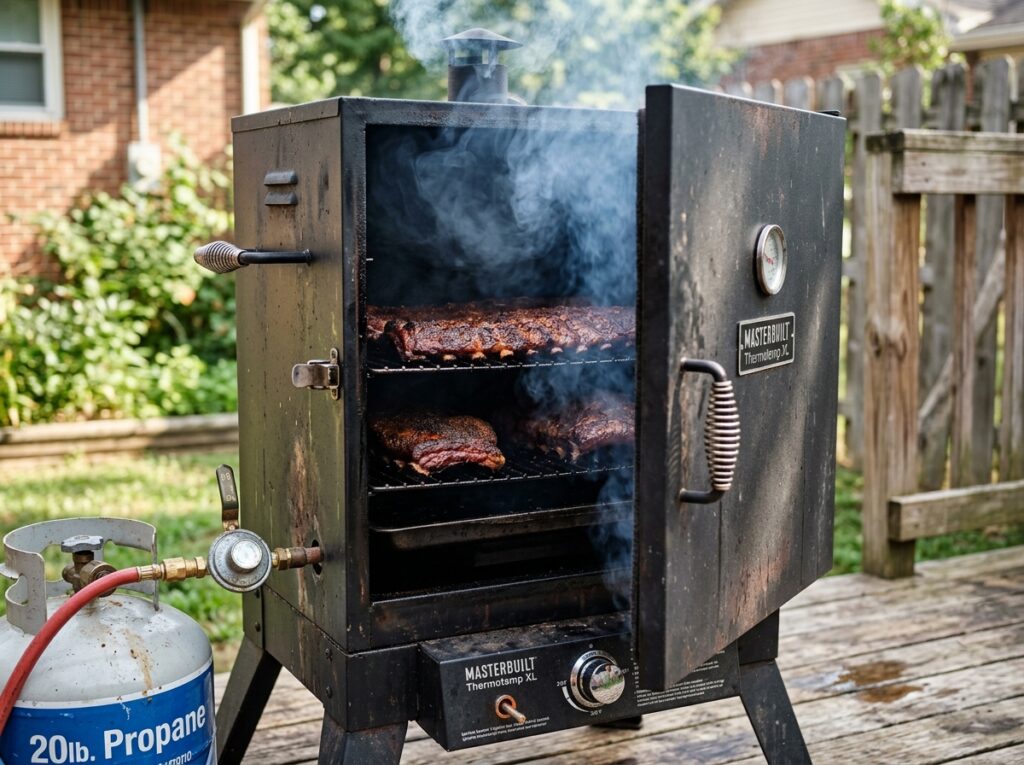
A propane smoker can turn out fall-off-the-bone ribs, juicy brisket, and perfectly smoked chicken — and you don’t need years of fire management experience to pull it off. That’s the beauty of these machines. You turn a dial, set your temp, add your wood chips, and let the smoke do its thing.
But here’s the catch: not every propane smoker on the market is built equally. Some leak heat like a screen door. Others burn through propane tanks faster than you’d believe. And a few? They’re genuinely excellent — reliable, well-insulated, and designed for people who care about real smoke flavor without the fuss.
I’ve spent hours digging into what’s actually worth buying right now. Below, you’ll find my honest picks for the best propane smokers in 2025, along with everything you need to know before spending your money. Whether you’re smoking your first rack of ribs or upgrading from an old cabinet smoker, this guide has you covered.
Why Choose a Propane Smoker Over Other Types?
Before we get into specific models, let’s talk about why propane smokers make sense for a lot of people. Because if you’re comparing options — pellet grills, offset smokers, electric smokers, charcoal setups — you need to understand where propane fits in.
Propane smokers give you something that’s surprisingly hard to find in the smoking world: simplicity with real smoke flavor. An electric smoker is easy to use, sure, but many BBQ enthusiasts feel the smoke flavor isn’t quite as deep. An offset smoker produces incredible results, but it demands constant attention — you’re babysitting the fire for hours.
A propane smoker sits right in the middle. You get a live flame (which helps produce better smoke from your wood chips or chunks), and you get a dial to control your temperature. No electricity needed, which means you can take it camping, tailgating, or anywhere with flat ground.
There are a few real advantages worth noting:
Portability — No power outlet required. Just a standard 20-lb propane tank, and you’re cooking.
Temperature control — Turn the dial up or down. It’s not as precise as a digital pellet grill, but it’s far easier than managing charcoal or wood fires.
Authentic smoke flavor — The open flame burns wood chips more aggressively than an electric element, which many pitmasters prefer.
Lower upfront cost — Quality propane smokers typically cost between $150 and $400, which is less than most pellet smokers or kamado-style grills.
Now, propane smokers aren’t perfect (I’ll get into their downsides later), but for a large portion of backyard smokers, they hit a sweet spot that’s hard to beat.
What to Look For in a Propane Smoker
Shopping for a propane smoker can feel overwhelming because the specs all start to blur together. So let me break down what actually matters — and what’s mostly marketing noise.
Build Quality and Insulation
This is the single most important factor, and it’s the one most people overlook. A propane smoker with thin steel walls will struggle to hold temperature, especially in cooler weather. You’ll burn more propane, and your cook times will be unpredictable.
Look for smokers with at least 18-gauge steel, though 16-gauge is better. Double-walled doors are a huge plus — they prevent heat from escaping through the front, which is the weakest point on most vertical cabinet smokers.
Pro Tip: If you live somewhere with cold winters and want to smoke year-round, insulation quality matters more than almost any other feature. A well-insulated smoker at $250 will outperform a poorly insulated one at $400.
Cooking Space
Think about what you’ll actually smoke. If it’s mostly ribs, chicken, and pork shoulders for a family of four, a smoker with 600–800 square inches of cooking space is plenty. That usually gives you 3–4 racks and enough room for a couple of pork butts at once.
If you’re cooking for bigger gatherings or want to do multiple briskets at once, look for models with 1,000+ square inches. Just keep in mind that bigger smokers use more propane and take longer to heat up.
BTU Rating
You’ll see BTU ratings on every propane smoker — typically ranging from 10,000 to 20,000 BTUs. A higher BTU number means the burner produces more heat, but that doesn’t always mean better performance.
What matters more is how the smoker uses those BTUs. A well-insulated 12,000 BTU smoker can maintain 225°F more efficiently than a leaky 18,000 BTU model. So don’t just chase the biggest number — look at the full picture.
Temperature Range and Control
Most propane smokers operate between 175°F and 350°F, which covers the ideal smoking range. The key question is how consistently they hold a set temperature. Cheap models with basic needle valves tend to swing 20–30 degrees in either direction. Better models with improved burner designs hold within 10–15 degrees.
A built-in thermometer is standard on most models, but here’s a reality check — stock thermometers on smokers are notoriously inaccurate. I’d strongly recommend picking up a separate wireless meat thermometer or a good instant-read thermometer to monitor both your meat and your chamber temp.
Wood Chip Tray and Water Pan
The wood chip tray should be easy to access so you can add chips without opening the main door (and losing all your heat). A side-loading chip tray is ideal. Some smokers have a tray directly above the burner, which works but requires you to open the door.
The water pan serves two purposes: it adds moisture to the cooking environment, and it acts as a heat diffuser, helping to even out temperature across the chamber. A bigger water pan generally means more even cooking. Some people skip the water pan entirely and use sand instead for thermal mass — that’s a trick worth experimenting with.
The 7 Best Propane Smokers for 2025
Alright, let’s get to the part you came here for. These are my top picks based on build quality, real-world performance, user feedback, and overall value.
1. Masterbuilt MPS 330G ThermoTemp XL — Best Overall
Masterbuilt has been in the smoker game for decades, and the MPS 330G shows why they’ve stayed relevant. This vertical cabinet smoker gives you 858 square inches of cooking space across four chrome-coated racks, and the ThermoTemp technology does a solid job of maintaining consistent temps.
What stands out is the thermostat control — you set your desired temperature, and the burner adjusts automatically. That’s a feature you usually see on electric or pellet smokers, not propane ones. It takes a lot of guesswork out of the equation, especially if you’re new to smoking.
The push-button ignition works reliably, and the side wood chip loading system means you can feed chips without opening the door. At around $250–$300, it’s hard to find better value in this category.
Best for: Anyone who wants a reliable, set-and-forget propane smoking experience.
Keep in mind: The door seal isn’t perfect out of the box. Adding a high-temp gasket (about $10 from any hardware store) makes a noticeable difference.
2. Camp Chef Smoke Vault 24 — Best for Serious Cooks
Camp Chef builds solid outdoor cooking equipment, and the Smoke Vault 24 is one of the best propane smokers you can buy if you’re willing to spend a bit more. The fully adjustable heat-control dials give you two dampers (top and bottom) for precise airflow management.
You get three adjustable smoking racks plus a jerky rack — totaling over 1,000 square inches of cooking space. The 18,000 BTU burner heats up fast and can push the internal temp high enough for grilling if you want that option.
The door has a really tight seal, which is something a lot of propane smokers struggle with. And the internal wood chip box sits right above the burner for efficient smoke production.
Best for: Intermediate to experienced smokers who want precise control and lots of space.
Keep in mind: It’s heavier than many competitors (around 65 lbs), so it’s not the most portable option.
3. Dyna-Glo DGY784BDP 36-Inch — Best Budget Pick
If you want a solid propane smoker under $200, the Dyna-Glo DGY784BDP deserves your attention. It offers 784 square inches of cooking space with four adjustable steel racks, and the 15,000 BTU cast iron burner does a dependable job.
The design is straightforward — no fancy tech, no auto-temp controls. You light it, set the gas valve, and manage your smoke manually. That might sound like a downside, but plenty of experienced smokers actually prefer this level of hands-on control.
There’s a removable porcelain-enameled steel wood chip box and a water pan that’s easy to clean. The dual-door design (small top door for checking food without losing all your heat) is a nice touch at this price.
Best for: Budget-conscious buyers who don’t mind a little hands-on management.
Keep in mind: The temperature gauge on the door reads a bit high, so use a separate thermometer. And the thin steel walls mean performance dips in cold or windy weather.
4. Cuisinart COS-244 Vertical Propane Smoker — Best Compact Option
Not everyone has space for a full-size cabinet smoker. The Cuisinart COS-244 is built for smaller patios, balconies (where allowed), and people who mostly smoke for 2–4 people.
It has two stainless steel racks with 548 square inches of total cooking space. That’s enough for a couple of racks of baby back ribs, a pork shoulder, or several chickens.
The twist-start ignition is simple, and the built-in temperature gauge sits at door level. At roughly $150–$180, it’s an affordable entry point into propane smoking. The 5,400 BTU burner is lower-powered than competitors, but the smaller chamber means it still maintains good temps.
Best for: Apartment dwellers, tailgaters, or anyone with limited space.
Keep in mind: You won’t fit a full packer brisket in here. And the lower BTU output means recovery time after opening the door is slower.
5. Pit Boss 4-Series Vertical Propane Smoker — Best for Large Batches
Pit Boss is mostly known for their pellet grills, but their propane smoker lineup is surprisingly good. The 4-Series model gives you over 1,000 square inches of cooking space — enough for multiple briskets, racks of ribs, and a turkey all at once.
The porcelain-coated steel construction holds heat well, and the dual-valve burner system lets you fine-tune your flame. It also comes with a sausage hanger, which is a nice touch if you’re into making your own smoked sausages or jerky.
The bottom-mounted wood chip tray is directly above the flame, so you get solid smoke production. And at around $200–$250, it’s a lot of smoker for the price.
Best for: Hosting duties — if you regularly cook for groups of 8+, this is your pick.
Keep in mind: The assembly instructions are… not great. Give yourself a couple of hours and maybe watch a YouTube video alongside.
6. Smoke Hollow 44241G2 — Best Dual-Door Design
Smoke Hollow has been making propane smokers for years, and the 44241G2 is a well-proven design. The key feature is the dual-door cabinet — a smaller top door lets you check on your food without exposing the wood chip tray and water pan below.
Why does that matter? Every time you open the main door on a single-door smoker, you lose heat and disrupt smoke production. The dual-door setup keeps things more stable.
You get 2,066 square inches of cooking space spread across four standard racks, a rib rack, and a sausage hanger. The 14,400 BTU stainless steel burner handles the large chamber well. The price typically sits around $200–$250.
Best for: Anyone who likes to peek at their food (no judgment) without wrecking the cooking environment.
Keep in mind: At this size, propane consumption goes up. Expect to use a full 20-lb tank during a long smoke session.
7. Camp Chef Smoke Vault 18 — Best Mid-Size Option
If the Smoke Vault 24 feels too big but you want that same Camp Chef quality, the Smoke Vault 18 is the sweet spot. You get 18,000 BTUs (same as the larger model), three adjustable racks, and excellent build quality in a more manageable package.
The top and bottom dampers give you airflow control, and the matchless snap-ignition makes starting up simple. The internal dimensions fit full racks of ribs without cutting, and there’s room for a decent-sized pork butt or a small brisket flat.
At around $200, the price-to-quality ratio is excellent.
Best for: Solo smokers or small families who want premium build quality without the bulk.
Keep in mind: The smaller size means less thermal mass, so temp fluctuations can be more noticeable in extreme weather.
Propane Smoker vs. Other Smoker Types — How Does It Stack Up?
This is a question I get asked a lot, and the answer depends entirely on what you prioritize. Here’s a quick, honest comparison.
Propane vs. Pellet Smokers — Pellet smokers offer digital temp control and a genuine wood smoke flavor (since they burn actual wood pellets). They’re more “set it and forget it” than propane. But they need electricity, cost more upfront, and pellet prices add up over time. If you’re curious about the pellet route, check out our picks for the best pellet grills. Propane smokers win on portability and cost.
Propane vs. Offset Smokers — Offset smokers are the gold standard for traditional BBQ flavor. They burn real wood or charcoal and produce incredible smoke. But they demand constant attention — you’re adjusting vents, adding fuel, and monitoring fire for the entire cook. A propane smoker gives you 80% of the flavor with 20% of the effort. Our offset smoker guide covers this in more detail.
Propane vs. Electric Smokers — Electric smokers are the easiest to use — plug in, set temp, walk away. But the smoke flavor is often milder because electric elements don’t burn wood chips as aggressively as a gas flame. Propane gives you a stronger smoke profile while still being pretty user-friendly.
Propane vs. Charcoal/Kettle Grills — A kettle grill can absolutely smoke food, but it’s more of a workaround than a dedicated solution. Propane smokers are purpose-built for low-and-slow cooking with much better capacity.
How to Get the Best Results from Your Propane Smoker
Buying a good propane smoker is half the battle. The other half is knowing how to use it well. Here are some practical tips that’ll make a real difference in your results.
Season Your Smoker Before the First Cook
This one’s non-negotiable. Before you put any food inside, coat the interior racks and walls lightly with cooking oil, crank the temperature to 275°F, and let it run for two hours. Add some wood chips during the last 30 minutes. This burns off any manufacturing residues and creates a thin protective layer inside the chamber.
Use Wood Chunks, Not Just Chips
Wood chips burn fast. That’s fine for short cooks, but for an 8-hour pork butt or a 12-hour brisket, you’ll be refilling constantly. Wood chunks burn slower and produce a steadier smoke. You can use a mix of both — chips for quick initial smoke, chunks for the long haul. Hickory, apple, cherry, and mesquite are all solid choices depending on the meat. If you’re smoking brisket, a 50/50 mix of oak and hickory chunks is hard to beat.
Don’t Over-Smoke
This is the most common mistake new propane smoker owners make. You don’t need thick, billowing white smoke for the entire cook. What you want is thin, almost invisible blue smoke — that’s the “clean” smoke that gives meat that delicious smoky flavor without making it bitter.
White, heavy smoke means the wood is smoldering, not burning cleanly. If you see this, open your top vent more to increase airflow. After the first 3–4 hours, most meat has absorbed all the smoke it’s going to. You can stop adding wood at that point and just let the heat finish the job.
Manage Your Water Pan
A full water pan helps stabilize temperature and adds humidity, which keeps the surface of your meat from drying out too quickly. Refill it with hot water (not cold — cold water drops your chamber temp). Some experienced smokers use apple juice or beer in the pan, but honestly, the difference in flavor is minimal. Water works just fine.
Did You Know? A full water pan can also reduce your propane consumption. The thermal mass of the water helps hold heat, so the burner doesn’t have to work as hard to maintain temperature.
Wind and Weather Adjustments
Wind is a propane smoker’s worst enemy. Even a moderate breeze can cause temperature swings. If possible, position your smoker against a wall or windbreak. You can also buy aftermarket insulation blankets designed for vertical smokers — they make cold-weather smoking much more manageable.
Understanding Propane Consumption
This is something most buyers don’t think about until they’re mid-cook and the tank runs out. So let’s put some real numbers on it.
A standard 20-lb propane tank holds roughly 4.7 gallons of propane. At typical smoking temperatures (225°F–250°F), a well-insulated propane smoker uses about 1–2 lbs of propane per hour. That means you can expect 10–20 hours of cooking from a single tank — depending on your smoker’s efficiency, the outdoor temperature, and how often you open the door.
My honest advice? Always keep a spare tank on hand. Running out of propane halfway through a 14-hour brisket cook is the kind of mistake you only make once. A 20-lb tank refill costs around $15–$25 depending on your area, so the ongoing cost is pretty reasonable.
Compare that to a pellet smoker, which might burn through $15–$30 worth of pellets for a long cook, and propane ends up being a solid value proposition over time.
Common Mistakes to Avoid with Propane Smokers
Let me save you some headaches by sharing the mistakes I see people make most often.
Opening the door too frequently — Every time you open that door, you lose 15–20 minutes of recovery time. Trust the process. Use a wireless thermometer to monitor your meat temp remotely.
Ignoring door seals — Smoke leaking around the door means you’re losing heat and flavor. If you see visible smoke streaming from the edges, apply high-temp gasket tape. It’s cheap and takes five minutes to install.
Not preheating — Give your smoker at least 15–20 minutes to reach your target temp before putting food inside. Putting cold meat into a cold smoker leads to uneven results.
Using soaked wood chips — There’s a persistent idea that soaking wood chips in water produces more smoke. What actually happens is the water has to evaporate first, which just delays smoke production and creates steam. Use dry chips and chunks. They ignite faster and produce cleaner smoke.
Placing food directly above the water pan — If a rack sits directly above the water pan, the meat on that rack will cook differently (slower, more moisture). Position your meat on the racks that have the most consistent airflow around them.
Accessories That Make Propane Smoking Easier
You don’t need a lot of extras to smoke great food on a propane smoker, but a few additions genuinely help.
A reliable meat thermometer is the single best investment you can make. Whether it’s a wireless model or a quick instant-read unit, accurate temp readings are what separate consistently good cooks from frustrating guesswork.
Good grill gloves are essential for handling hot racks, water pans, and meat. Don’t use regular oven mitts — they’re not designed for the extended heat exposure you get with a smoker.
A cover for your smoker will extend its life by years. Rain and UV damage are the two biggest killers of outdoor cooking equipment. Most manufacturers sell fitted covers, or you can find universal ones for $20–$30.
FAQ
How long does a propane tank last on a smoker?
A standard 20-lb propane tank lasts roughly 10–20 hours on a propane smoker at typical smoking temps (225°F–250°F). Variables include your smoker’s insulation quality, outdoor temperature, wind conditions, and how often you open the door. Budget one full tank per major cook session, and always have a backup ready.
Can you use a propane smoker in cold weather?
Yes, but performance drops noticeably below 40°F unless your smoker has good insulation. The burner works harder to maintain temps, so propane consumption increases. An insulation blanket, positioning the smoker out of the wind, and using a full water pan for added thermal mass all help significantly. Avoid smoking in rain without a shelter over the unit.
Is propane smoking healthy?
Propane burns very cleanly, producing mostly carbon dioxide and water vapor. The smoke itself comes from your wood chips, not the propane. Any health concerns related to smoked food apply equally to all smoking methods — propane, charcoal, wood, or pellet. Moderate consumption of smoked foods is generally considered safe. If you want to reduce potential compounds like PAHs, avoid charring meat and maintain clean, thin smoke throughout your cook.
What’s better — propane smoker or electric smoker?
It depends on your priorities. Electric smokers are easier to use and hold very steady temps, but the smoke flavor tends to be lighter. Propane smokers produce deeper smoke because the open flame burns wood chips more aggressively. Propane smokers also don’t need electricity, making them more versatile for outdoor use. If flavor is your top priority and you don’t mind slightly more hands-on management, propane wins.
Do I need to soak wood chips for a propane smoker?
No — and honestly, I’d recommend against it. Soaking delays ignition and mostly produces steam rather than smoke during the drying phase. Dry wood chips ignite faster, burn cleaner, and give you the thin blue smoke you’re after. If you want longer-lasting smoke, switch to wood chunks instead of relying on soaked chips.
Your Next Move
Picking a propane smoker doesn’t have to be complicated. If you want something reliable that just works right out of the box, the Masterbuilt MPS 330G is hard to beat for the money. If you want tighter build quality and more precise control, step up to the Camp Chef Smoke Vault series. And if budget is tight, the Dyna-Glo delivers honest performance under $200.
The real magic happens once you stop overthinking the equipment and start cooking. Get your smoker seasoned, pick up some quality wood chunks, grab a rack of baby back ribs or a pork butt, and give it a go. The first cook might not be perfect — but I promise you, it’ll be delicious. And by the third or fourth smoke, you’ll wonder why you didn’t start sooner.
Happy smoking. 🔥