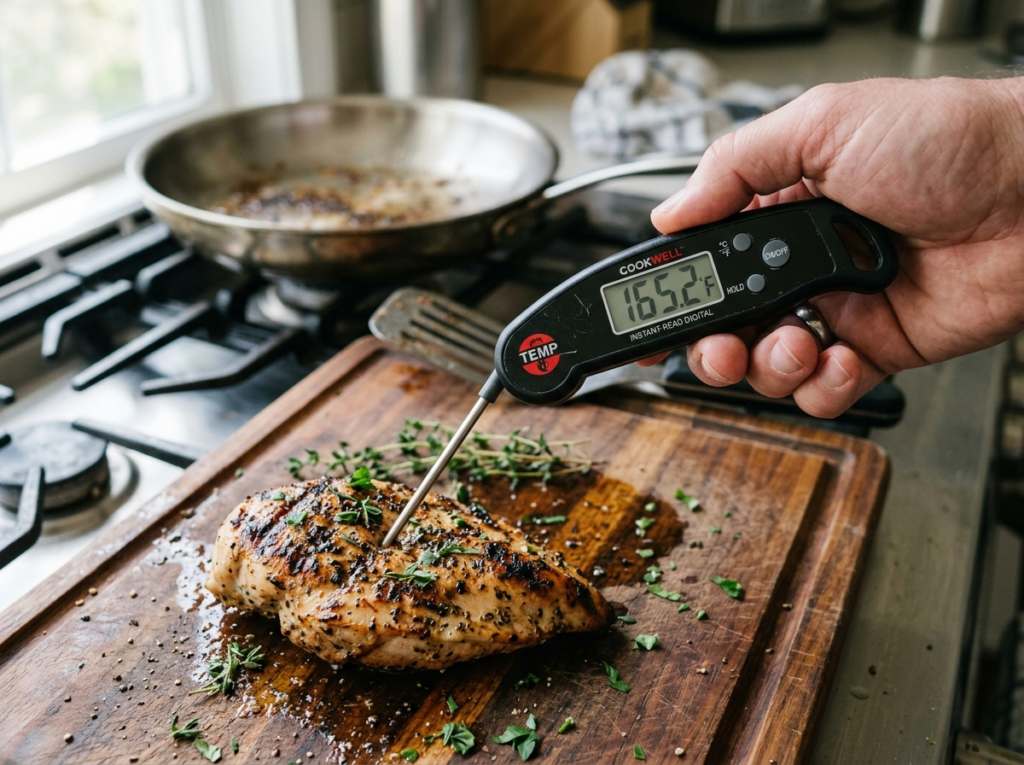
A overcooked chicken breast can ruin dinner. An undercooked pork chop can ruin your weekend. And yet, most home cooks still rely on the “poke it and hope” method — cutting into meat, guessing by color, or just setting a timer and praying. The fix costs less than a large pizza: a budget instant read thermometer.
You don’t need to spend $100 to get accurate temperature readings. Plenty of thermometers under $25 perform shockingly well, giving you readings within 1–2 degrees of models that cost four times more. The trick is knowing which ones to trust and which ones to toss back on the shelf.
This guide breaks down what to look for in an affordable instant read thermometer, which budget models actually deliver, and how to get the most out of whichever one you pick. Whether you’re grilling steaks, smoking brisket, or just making sure your Thanksgiving turkey isn’t a health hazard, you’ll find what you need here.
Why You Need an Instant Read Thermometer (Even a Cheap One)
Let’s get one thing straight — cooking without a thermometer is just guessing. And guessing leads to two outcomes: dry, overcooked food or undercooked food that could make someone sick.
The USDA recommends specific internal temperatures for different meats. Chicken needs to hit 165°F. Ground beef should reach 160°F. Pork sits at 145°F with a 3-minute rest. You can’t eyeball these numbers. Color isn’t a reliable indicator either — ground beef can turn brown before it’s safe, and chicken can look done while the center is still raw.
An instant read thermometer solves this in seconds. You stick the probe in, get your number, and make a confident decision. No cutting, no guessing, no “let me just cook it a little longer to be safe” — which is code for turning your steak into shoe leather.
Pro Tip: Temperature matters even more during low-and-slow cooking. If you’re smoking ribs using the 3-2-1 method, knowing your exact internal temp helps you nail that perfect tenderness every single time.
The real question isn’t whether you need a thermometer. It’s whether you need to spend a lot on one. And the honest answer? Not really.
What Makes a Good Budget Instant Read Thermometer?
Before you grab the cheapest option on Amazon, you should understand what separates a good budget thermometer from a frustrating one. Price alone doesn’t tell the whole story.
Speed of Reading
The word “instant” gets thrown around loosely. A true instant read thermometer should give you an accurate reading within 2–4 seconds. Many budget models hit this mark without any issue. Some older-style digital thermometers — the ones that look like a pen with a small screen — can take 8–15 seconds. That doesn’t sound like a big deal until you’re holding your hand over a 500°F grill, waiting for numbers to stop climbing.
Look for thermometers that advertise a 2–3 second read time. At the budget level, anything under 5 seconds is perfectly acceptable.
Accuracy
Here’s where things get interesting. Most budget instant read thermometers are accurate within ±2°F. High-end models like the ThermoWorks Thermapen ONE claim ±0.5°F accuracy. That’s a real difference on paper, but in your kitchen? You’ll never notice it.
Think about it this way — if your chicken breast reads 165°F on a budget thermometer and the actual temp is 166.5°F, does that change anything about your dinner? Not even a little bit.
Where accuracy does start to matter is at extreme temperatures. Some cheap thermometers drift a few degrees at very high temps (above 400°F) or very low temps (below 32°F). For normal cooking — grilling, roasting, smoking, frying — a ±2°F accuracy range is more than enough.
Build Quality and Durability
This is honestly where budget thermometers show their limitations the most. The probe might feel a little flimsy. The hinge (on folding models) might loosen after a year. The screen might not be as bright or as easy to read in direct sunlight.
None of these are dealbreakers for casual use. But if you’re grilling every weekend or running a pellet smoker three times a week, you’ll want something that can handle the wear and tear. A budget thermometer that lasts 2–3 years with regular use is a solid return on a $15–$20 investment.
Water Resistance
You’re going to get grease, juices, and marinades on your thermometer. You’ll probably wash it under running water. Some budget models handle this fine. Others? The screen fogs up, the buttons stop responding, or the battery compartment corrodes.
Look for an IP65 or IP67 rating if it’s listed. If there’s no rating mentioned, just be careful about submerging it. Wipe it clean with a damp cloth instead of running it under the faucet.
Backlit Display
Grilling at dusk? Smoking meat at night? A backlit screen goes from “nice to have” to “can’t live without” real fast. Some budget thermometers include backlighting, others don’t. It’s worth checking before you buy, especially if you do a lot of outdoor cooking.
Top Budget Instant Read Thermometers Worth Buying
Let’s talk about specific models that deliver performance well above their price point. These aren’t theoretical picks — they’re thermometers that real backyard cooks and home chefs rely on daily.
ThermoPro TP19H
This is the one most BBQ communities recommend as the best value under $25. The TP19H reads in about 2–3 seconds, which puts it close to thermometers costing three or four times more. It’s accurate to ±0.9°F — better than many “budget” competitors.
The design is smart too. It’s a folding probe style with a large, backlit display that auto-rotates depending on how you hold it. The probe locks open at any angle, which helps when you’re reaching into a smoker or checking a roast from a weird angle. It’s waterproof (IP65 rated), has a magnet on the back for fridge storage, and runs on a AAA battery that lasts a long time.
Did You Know? The ThermoPro TP19H consistently ranks among the top picks in blind accuracy tests conducted by BBQ reviewers and food science channels, often matching thermometers in the $50–$70 range.
KIZEN Digital Meat Thermometer
The KIZEN has been a budget favorite for years, and the updated version holds up well. It reads in about 3–4 seconds with ±1°F accuracy. The folding probe design is sturdy enough for regular use, and the large LCD screen is easy to read.
What makes the KIZEN stand out at its price point (usually under $15) is the included internal temperature guide printed right on the back of the unit. If you’re a beginner who doesn’t have USDA temps memorized, that little cheat sheet is genuinely helpful.
It’s not waterproof, though. So keep it away from direct water. Clean the probe with a damp cloth and you’ll be fine.
Habor 022 Instant Read Thermometer
At around $10–$12, the Habor 022 is about as cheap as you can go and still get reliable readings. It’s a pen-style thermometer (no folding probe) with a simple LCD display. Read time is a bit slower — around 4–6 seconds — and accuracy is ±2°F.
It’s basic. Really basic. No backlight, no auto-rotate, no magnet. But it works. For someone who needs a thermometer for occasional kitchen use — checking a roast, testing bread dough, or verifying oil temperature for frying — the Habor 022 gets the job done for the price of a fast food meal.
Alpha Grillers Instant Read Thermometer
This one sits right in the middle of the budget range, usually around $12–$18. It reads in about 4 seconds, has a folding probe, and comes with a nice little case. Accuracy is ±1°F, and it includes a hold function that freezes the reading on screen after you pull the probe out.
The hold function is underrated, by the way. When you’re pulling a probe from inside a smoker and can’t see the screen while your arm is fully extended, being able to lock the reading and check it after makes a real difference. It’s a small feature that shows someone actually thought about how people use these things.
ThermoWorks ThermoPop 2
Okay, this one pushes the budget definition a little — it usually costs around $35. But I’m including it because it’s made by the same company that produces the Thermapen, widely considered the gold standard. The ThermoPop 2 reads in 3–4 seconds with ±2°F accuracy. It has a rotating display, a backlit screen, and the build quality you’d expect from ThermoWorks.
If your budget stretches to $35, the ThermoPop 2 is worth considering. You’re getting a thermometer backed by a company with a serious reputation for accuracy and durability. It’s the “I want something better than the cheapest option but don’t want to pay premium prices” sweet spot. For a deeper look at more models across different price ranges, check out our full guide to the best instant read thermometers.
Budget vs. Premium: What Are You Actually Giving Up?
This is the question that keeps people hovering between the “Add to Cart” button on a $15 thermometer and the $100 Thermapen ONE. So let’s be honest about the differences.
Speed
A premium Thermapen ONE gives you a reading in about 1 second. A budget ThermoPro TP19H takes 2–3 seconds. That 1–2 second gap matters in a professional kitchen where you’re temping 50 steaks during dinner rush. At home, grilling four burgers for your family? You’ll never care about that difference.
Accuracy
The Thermapen ONE is accurate to ±0.5°F. Most budget options range from ±0.9°F to ±2°F. For home cooking, this gap is basically irrelevant. You’re not running a food science lab. You’re making dinner.
Durability
This is where premium really earns its price. A Thermapen is built to survive years of daily professional kitchen abuse — drops, splashes, extreme heat exposure. A $15 thermometer probably won’t survive being stepped on or tossed in a dishwasher. For casual home use, though, treat a budget thermometer with basic care and it’ll last you years.
Features
Premium thermometers often include things like auto-wake when you open the probe, auto-sleep to save battery, app connectivity, and waterproof ratings up to full submersion. Budget models give you the basics — temperature reading, maybe a backlight, maybe a hold button. Honestly? The basics are enough for 90% of people.
The Bottom Line: If you cook at home a few times a week and grill on weekends, a $15–$25 budget thermometer gives you everything you need. Save the premium price for upgrading your grill tools or picking up a set of quality grill gloves instead.
How to Get the Most Out of Your Budget Thermometer
Buying the right thermometer is step one. Using it correctly is where the real improvement happens. A few simple habits can make even the cheapest thermometer perform like a pro tool.
Check Accuracy with the Ice Bath Test
Fill a glass with crushed ice and add cold water. Stir it around for 30 seconds and insert your thermometer probe. It should read 32°F (0°C). If it’s off by more than 2 degrees, some thermometers let you calibrate — look for a small reset button or a calibration function in the instructions.
Do this test when you first get the thermometer and then every few months. It takes 60 seconds and tells you exactly how much you can trust your readings.
Insert the Probe Correctly
The temperature sensor on most instant read thermometers sits in the tip of the probe — roughly the last half-inch. You want that sensor in the thickest part of the meat, away from bone, fat, and gristle. Bone conducts heat differently than muscle, so probing near a bone gives you a misleading reading.
For thin cuts like burgers or chicken breasts, insert the probe from the side rather than straight down. This keeps the sensor in the center of the meat instead of poking through and reading the grill grate temperature.
Don’t Open the Lid Repeatedly
Every time you open your grill or smoker lid to check temperature, you lose heat. That extends your cook time. Get in the habit of opening the lid, inserting the thermometer, reading the temp, and closing the lid — all in one smooth motion. Budget thermometers with faster read times (2–3 seconds) make this easier than models that take 6–8 seconds to settle.
If you’re doing long smokes — like working toward that perfect brisket internal temp — pairing your instant read thermometer with a wireless meat thermometer gives you the best of both worlds. The wireless probe monitors ambient and meat temp continuously, and you use the instant read for quick spot checks.
Keep It Clean
Wipe the probe with a damp cloth or paper towel after every use. If you’re measuring chicken or pork, sanitize it properly — a quick wipe with a food-safe sanitizer or a dip in hot soapy water. Don’t submerge the whole unit unless it’s rated for it.
Residue buildup on the probe can actually slow down read times and affect accuracy. Keeping it clean isn’t just about hygiene — it’s about performance too.
When Should You Spend More?
A budget thermometer isn’t always the right call. Here are a few situations where investing in a mid-range or premium option makes sense.
You cook professionally or semi-professionally. If you’re catering, competing in BBQ competitions, or running a food business, accuracy, speed, and durability aren’t optional. Spend the money.
You grill or smoke multiple times a week. Heavy use wears out budget thermometers faster. A $50–$80 thermometer with a better build will save you from replacing a $15 unit every year.
You need extreme temperature range. Some budget thermometers max out at 400°F or 500°F. If you’re monitoring deep fryers (350–375°F is common) or super-hot pizza ovens, make sure your thermometer can handle the range. Higher-end models typically measure up to 572°F or beyond.
You want wireless or leave-in capabilities. Instant read thermometers are spot-check tools — you insert, read, and remove. If you want to monitor temperature over a long cook without opening the lid, you need a different tool entirely. A leave-in probe thermometer or wireless system is what you’re after, and those start at a different price point.
For everyone else — weekend grillers, weeknight dinner cooks, occasional smokers — a budget instant read thermometer is the right tool for the job.
Common Mistakes People Make with Cheap Thermometers
Even the best budget thermometer can give you bad results if you use it wrong. These are the mistakes I see most often.
Not waiting for the reading to stabilize. Just because numbers appear on the screen doesn’t mean they’re final. Wait until the reading stops changing for at least 2 seconds before you act on it. Pulling the probe too early gives you a reading that’s still climbing toward the actual temperature.
Checking temperature too early. If you put a steak on the grill 30 seconds ago and you’re already reaching for the thermometer, slow down. Let the cooking process actually happen before you start checking. For most grilled meats, don’t bother with the first temp check until you’re about 75% through the expected cook time.
Only checking one spot. A large piece of meat — like a pork butt or a whole chicken — can have different temperatures in different areas. Check the thickest section and at least one other spot to make sure you’re getting a full picture. That’s especially important when you’re smoking pork butt for hours — hot spots in your smoker can create uneven cooking.
Ignoring the battery. A dying battery can cause inaccurate readings. If your thermometer starts reading slow or showing inconsistent numbers, swap the battery before you blame the device. Most budget models use a single CR2032 or AAA battery that costs a couple bucks.
FAQ
Are budget instant read thermometers accurate enough for safe cooking?
Yes. Most budget models are accurate within ±1–2°F, which is more than sufficient for food safety. The USDA’s recommended temperatures include a built-in safety margin, so even if your thermometer is off by a degree or two, you’re still well within the safe zone. The key is to use the thermometer correctly — insert the probe into the thickest part of the meat and wait for the reading to stabilize.
How long do budget instant read thermometers last?
With proper care, a quality budget thermometer like the ThermoPro TP19H or Alpha Grillers can last 2–4 years of regular home use. The most common failure points are the probe hinge (on folding models), battery corrosion, and water damage. Keep it clean, store it properly, replace the battery when needed, and avoid submerging units that aren’t waterproof.
Can I use a budget instant read thermometer for grilling and smoking?
Absolutely. An instant read thermometer works great for spot-checking meat on the grill or in a smoker. For quick grilling sessions — burgers, steaks, chicken — it’s all you need. For longer smoking sessions, it’s best used as a companion to a leave-in probe thermometer. The instant read gives you quick verification, while the leave-in probe tracks temperature over hours without opening the lid.
What’s the best budget instant read thermometer under $20?
The ThermoPro TP19H is widely considered the best value under $25, offering 2–3 second read times and ±0.9°F accuracy. If you want to spend even less, the KIZEN Digital Meat Thermometer (usually under $15) and the Alpha Grillers model are both solid picks that deliver reliable performance for casual home cooking and grilling.
Do I need to calibrate a budget thermometer?
It’s a good idea to verify accuracy when you first buy it and every few months after. Use the ice bath method — a glass of ice water should read 32°F. Some budget models have a calibration function that lets you adjust if the reading is off. If your thermometer can’t be calibrated and it’s reading more than 3°F off, it’s time for a replacement.
Your Next Move
A $15–$20 instant read thermometer is one of the smallest investments you can make in your cooking, and it pays off immediately. No more guessing. No more cutting into meat to check if it’s done. No more serving chicken that’s either dry as cardboard or dangerously pink in the middle.
Pick up a ThermoPro TP19H or a KIZEN, run the ice bath test when it arrives, and start using it on everything you cook. You’ll notice the difference the very first time — perfectly cooked meat, exactly where you want it, every single time.
And once you’ve got temperature confidence, you’ll start taking on bigger projects. Maybe a full rack of baby back ribs. Maybe your first brisket. That little thermometer in your hand is the starting line for all of it.