I’ve never eaten at Smoketown USA. That matters, because this isn’t a review — it’s about what a real review looks like. Back on July 19, 2009, BBQ writer Chris Grove walked into a joint at 1153 Logan Street in Louisville, Kentucky, sat down with his wife, and came out with one of the best-written barbecue reviews of the blog era. He scored atmosphere, service, food, and value separately — four numbers that told you more in thirty seconds than a hundred “great food, 5 stars!” comments ever could.
Grove’s Smoketown USA review ended at an overall 4.6 out of 5. But the number isn’t the point. The method is. Here’s what each of those four scores teaches you about judging any BBQ joint — with Smoketown as the case study.
Atmosphere: 4 out of 5 — the room tells you half the story
Smoketown USA sits in a pair of antebellum buildings — a former grocery, a feed & seed store, and a livery, all Civil War-era. Owner Eric Gould and his wife Lynn bought them in 2002 and spent five years restoring them before opening the restaurant in 2007. That’s the kind of origin you can feel in the floorboards, and it’s the first thing a good review captures: is this character real or manufactured?
Then there’s the quirk. Grove’s review has my favorite line about any barbecue restaurant ever written: “Smoketown USA is what happens when a BBQ Restaurant collides with E-bay.” Lynn is an avid garage-sale enthusiast, so the dining room is stocked and decorated with finds from years of hunting — and everything is for sale. The chairs you’re sitting on. The salt and pepper shakers on your table. Anything on the walls that catches your eye.
That’s not a gimmick; it’s a tell. A restaurant confident enough to let you buy the furniture is a restaurant that’s not worried about the furniture. Grove gave the atmosphere 4 out of 5 and called it “casual” — not because the room was plain, but because it didn’t try to be anything except comfortable. When you judge a joint’s atmosphere, this is the test: does the room serve the food, or does it serve the Instagram photos?
Service: 5 out of 5 — the people running the pit tell you the other half
Grove’s visit opens with the owner walking up in overalls to say, “I’m a Jewish, redneck, massage therapist” to his wife. That’s Eric Gould, and whatever you think of the introduction, you don’t forget it. Over the course of the meal, the server visited. Then another server. Then Eric. Then David, the pitmaster.
Here’s where the review format earns its keep. A 5-out-of-5 service score needs evidence, and Grove gives it: David found out Grove was a BBQ enthusiast and gave him a full tour of the kitchen — and more importantly, the two wood-fired smokers out back. They were loaded with chicken and rib tips at the time. David talked through each cooker, its good qualities, its hot spots, and possible future modifications on one of them. Then the two of them stood around discussing their personal smokers at home, their preferences for cooking Q for themselves.
Grove’s line: “It felt like we were hanging out on a friend’s deck while they finished up getting dinner ready.” That’s the trust signal most reviews never name. A pitmaster who’ll talk hot spots and modifications with a customer isn’t performing hospitality — he actually likes the food. If you want a quick read on any BBQ joint, skip the menu for five minutes and try to have a conversation about the cookers. What you get back tells you everything.
Food: 4.5 out of 5 — order like a local and read the chalkboard
One of Grove’s most useful practical notes: the online menu was limited compared to what you could really get. The daily chalkboard menu carried many more options — a small piece of intelligence that separates a review written for readers from one written for the writer. A good joint review always tells you how to order.
Then, the unusual part: “A bit unusual, this BBQ joint has actual valid vegetarian options, not just sides.” In 2009, in a Kentucky smokehouse, that was genuinely strange. Grove’s wife Alexis ordered the Cuban — which he described as “a very liberal bbq spin on a Cuban” — with mixed greens the server recommended, and he called the Cuban the best he’d ever had. The greens, he noted, had “that perfect mustardy bite you expect.”
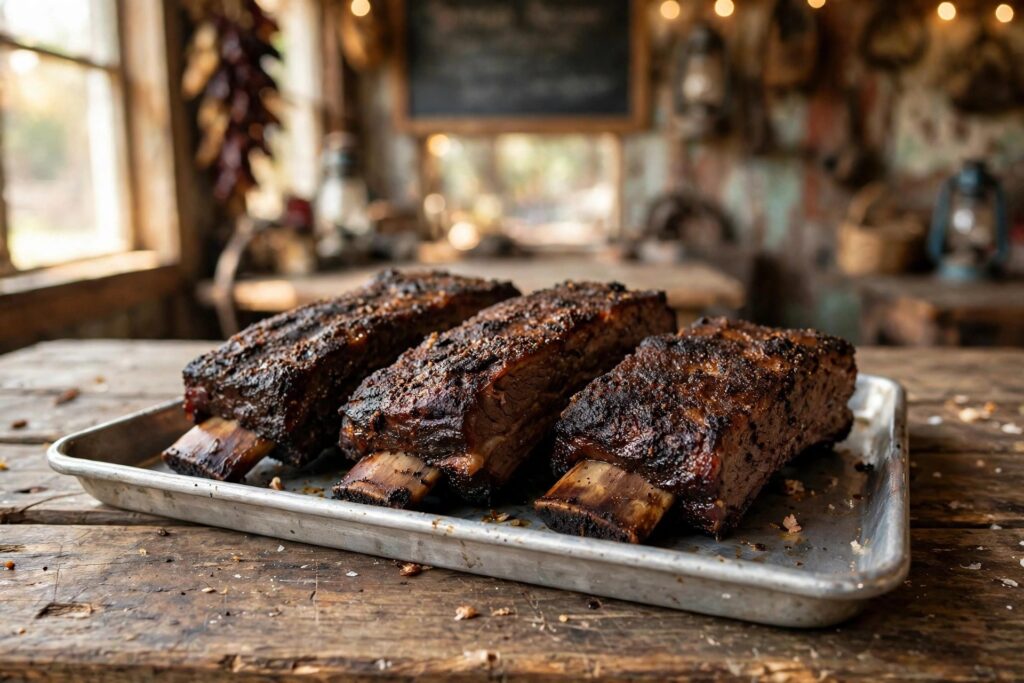
But the meal’s highlight was what Grove called the “Flintstone ribs” — huge beef ribs. David told him the rub was just salt and pepper, and then they stayed out of the way, letting the meat and smoke do their own magic. The result: a crisp bark covering a smoke ring, meat that melted in the mouth — “like a chuck roast on a bone.” Grove didn’t sample the pork ribs, butt, or chicken because the order was so filling, and said they’d be back in the fall to check out the rest of the menu.
While waiting, David had brought out a sample of an off-menu lamb stew — “hearty and full of flavor.” The tex-mex pintos, mac and cheese, and jalapeño cornbread all earned a “good.” Notice what Grove did here: he named the dishes, named who recommended them, and separated the great from the merely good. That’s what the food score rests on. If you’ve ever wondered how to size up a plate of beef ribs before you cook them yourself, our walkthrough of smoking dino bones — BBQ beef plate ribs covers the cut, the bark, and the cook. And if David’s smoker tour piqued your curiosity, the fuel side of the story is in our smoking wood and meat pairing guide.
Value: 5 out of 5 — the score most reviews forget to give
Food 4.5, value 5. That split is the whole argument for scoring value separately. A joint can serve excellent food at prices that make you wince, or decent food at prices that make the whole table order seconds. Smoketown managed the rare thing: near-top food and top marks for value.
Customer reviews on ActiveDiner over the years back the picture up independently: regulars mentioning the “three amigos” sandwich (beef, pork, and chicken), a catfish sandwich one reviewer called the best they’d had anywhere in the South, praised greens, and catering orders delivered to downtown Louisville offices. More than one mentioned Eric sitting down to visit with guests. One wrote, quoting Schwarzenegger, “I’ll be back.”
Value scoring keeps a review honest in a way prose alone doesn’t. It forces the reviewer to answer a question diners actually ask: is this worth my money and my drive? Separate the number from the food number, and you can’t hide behind adjectives.
The footnote that keeps this honest
Everything above comes from Grove’s 2009 review and years of customer reports since — not from my own table, because I’ve never sat at one. And honesty demands one more thing: at the time of writing, Google’s listing marks Smoketown USA as permanently closed, while the restaurant’s own website is still live. Check before you drive to Logan Street.
But here’s why the piece endures even if the joint doesn’t. Grove’s review gave you the address and phone number, the owner’s name, the pitmaster’s name, the building’s history, the ordering strategy, the standout dishes by name, and four separate scores with reasons. That format — atmosphere, service, food, value, each defended in plain language — is still the best way I know to judge a barbecue joint. Borrow it the next time you review one yourself.
Leave a Reply