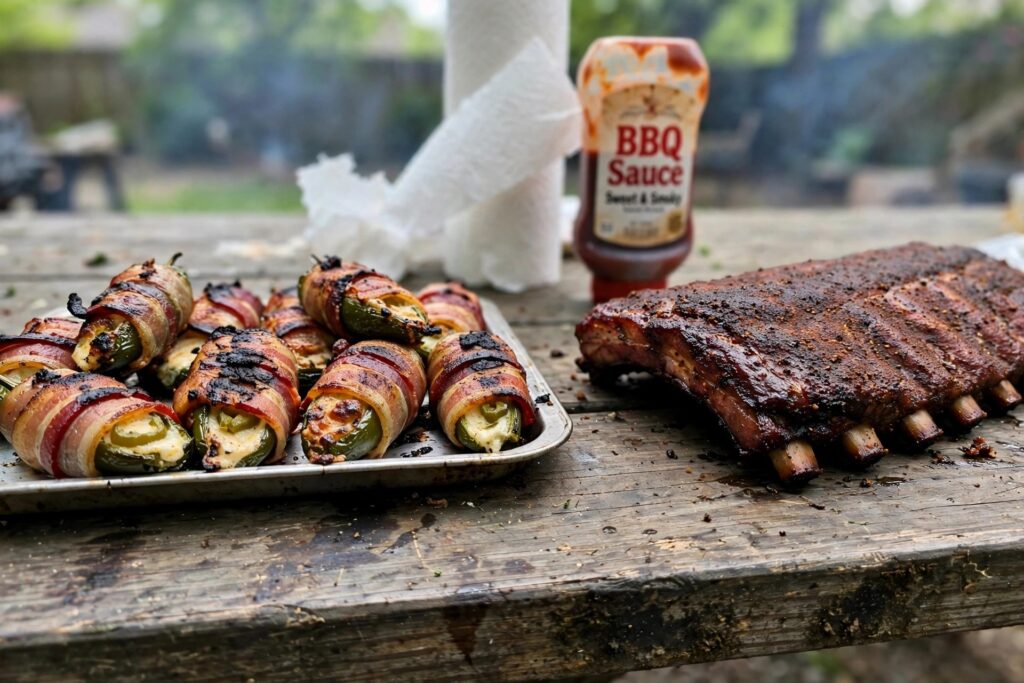
Every backyard cook has a dish that disappears before the main event is even off the smoker. For a lot of barbecue people, that dish has the worst name in all of grilling: the Atomic Buffalo Turd. Say it out loud at a cookout and somebody laughs, somebody winces, and somebody asks what it is. Then they eat three of them and ask for the recipe.
There is no buffalo in it. It is not, strictly speaking, atomic either. What it is, is a jalapeño stuffed with cheese, wrapped in bacon, and smoked until the pepper softens and the bacon crisps — creamy, spicy, and savory all at once. It came up through backyard barbecue forums, back when cooks were trading ideas for cheap, crowd-sized appetizers that could ride along on a smoker already running for ribs. That pairing is no accident: the poppers and the ribs belong on the same cook.
Start with the popper, because it teaches you patience
The classic build is almost embarrassingly simple. Split jalapeños lengthwise and scrape out the seeds and the white pith inside. That pith, more than the seeds, is where most of the heat lives, so how much you leave behind is really a heat dial, not a right-or-wrong choice. Fill each half with softened cream cheese, often mixed with a little shredded Monterey Jack or cheddar and a pinch of chili powder or garlic. Some cooks tuck a little smoky sausage or a spoonful of pulled pork on top of the cheese. Then wrap the whole thing in a half slice of bacon — thin-cut works better here than thick, because it actually crisps in the time the pepper needs — and pin it with a toothpick if the wrap feels loose.
Wear gloves for this part — it sounds fussy until you rub your eye hours after handling a dozen jalapeños. Wash the board and knife before they touch anything else, too.
On the smoker, the usual route is indirect heat at around 225°F for a couple of hours, until the bacon is browned and the pepper has gone tender. Some cooks run them hotter at the end — a short finish around 350 to 375°F — to sharpen the bacon without drying the cheese out. Either way, the tell is not the clock. It is the bacon: rendered, browned at the edges, and firm enough to hold its shape when you pick the popper up. Pale, floppy bacon means it needs more time. Burnt, shrunken bacon means the heat was too high for too long, and the pepper underneath probably went to mush.
Mild fruit woods suit these best. Apple and cherry add a gentle sweetness that plays well with cream cheese, where a heavy dose of mesquite can bulldoze the whole bite. Our smoking wood and meat pairing guide walks through why that matters, and which woods tend to overpower smaller cuts and appetizers. If you want to go deeper on the rib side of that same cook, the wood conversation continues there.
The ribs are the main event, and they leave clues
This is where the “CSI” half of the old title comes in, and it is a better joke than it first sounds. A rack of ribs tells you exactly where it is in the cook if you know what to look for — you just have to stop staring at the clock and start reading the meat.
First, the prep clue. Peel the thin silver membrane off the bone side of the rack. It comes off with a butter knife and a paper towel for grip, and it is worth the minute it takes: left on, it blocks smoke and seasoning and turns leathery in the finished rack. Then a simple rub — salt, black pepper, paprika, garlic, a little brown sugar if you like a sweeter bark — applied an hour or so before the cook, long enough to draw out a little moisture and settle onto the surface.
On the smoker at 225 to 250°F, spare ribs typically run about six hours in the well-known 3-2-1 rhythm: three hours unwrapped in the smoke, two hours wrapped in foil with a splash of apple juice or a few pats of butter, and a final hour unwrapped to set the bark and, if you want it, the sauce. Baby backs are leaner and thinner, so they usually finish faster — many cooks shorten the schedule to something closer to 2-2-1 rather than forcing a small rack through a big rack’s timeline. That adjustment matters more than any single number in the method, because a rack cooked to a schedule instead of to feel is how good ribs go mushy.
Here are the clues that actually mean something. The meat pulls back from the ends of the bones by about a quarter to a half inch as the cook progresses. The surface turns deep mahogany and the bark firms up instead of feeling wet. Lift the rack from one end with tongs and it bends — a clean bend of roughly 45 degrees with the surface starting to crack, not a rack that flops in half (overdone) or one that stays stiff as a board (not there yet). A toothpick or probe slid between the bones should meet little resistance, like pushing into soft butter. If you want a number alongside all that feel, the meat between the bones generally reads around 195 to 203°F when the collagen has melted into tenderness. That is well above the 145°F safety floor for pork — ribs are not about safe, they are about tender, and tenderness lives higher up the thermometer.
Putting both on one cook without ruining either
The practical beauty of this pairing is timing. Ribs are a long, slow commitment; poppers are a short, forgiving one. Put the ribs on first, let them run through their unwrapped smoke phase, and slide the poppers on during the last couple of hours, when the smoker is already steady and the ribs are wrapped or nearly done. The poppers pick up the same smoke, the ribs never get disturbed at the moment they need steady heat most, and the appetizers come off just as people start hovering around the pit asking when dinner is ready.
That hovering is the other thing the old forum cooks understood. A cookout has a dead hour after the ribs go on when guests arrive and there is nothing to eat yet. ABTs exist to fill exactly that hour: cheap, easy to scale by halving more peppers, and assemblable a day ahead so the host is not stuffing jalapeños with one hand and tending a fire with the other.
For the finish, you have a choice that says a lot about your barbecue loyalties. Sauce the ribs in the last stretch of the cook, brushed on thin and left to set into a tacky glaze, or leave them dry and let the rub and smoke carry the whole rack. The dry route is the Memphis way, and our Memphis style dry ribs piece explains how that tradition works and why some championship cooks never sauce at all. There is no wrong answer here, only a rack that tastes like you meant it — and poppers that are gone before you get a chance to decide.
What to do when it goes sideways
Most ABT failures are bacon failures, and they are easy to diagnose. Floppy bacon means the heat was too low or the cook too short; finish hotter next time, or start the poppers earlier. Cheese leaking everywhere usually means the pepper was overfilled or the bacon wrap was too loose — fill to just below the rim and wrap snugly, seam side down. Peppers that are still crunchy while the bacon is done mean the peppers were unusually thick or the heat never really got to them; smaller, even-sized jalapeños cook far more evenly than a mixed bag of giants and runts.
Rib failures are slower and more forgiving. A dry rack probably spent too long unwrapped, or the smoker ran hotter than the dial claimed — a second thermometer at grate level settles that fast. A rack that falls apart into shreds spent too long in the wrap; shorten that phase next time, or switch from foil to butcher paper, which breathes a bit and protects the bark. And a rack with no smoke flavor usually means the wood ran out early or the smoke was thick and white instead of thin and blue.
None of this requires competition gear. It requires a thermometer you trust, a rack you actually look at instead of timing blindly, and a tray of badly named little poppers that remind everyone why they came.
Leave a Reply