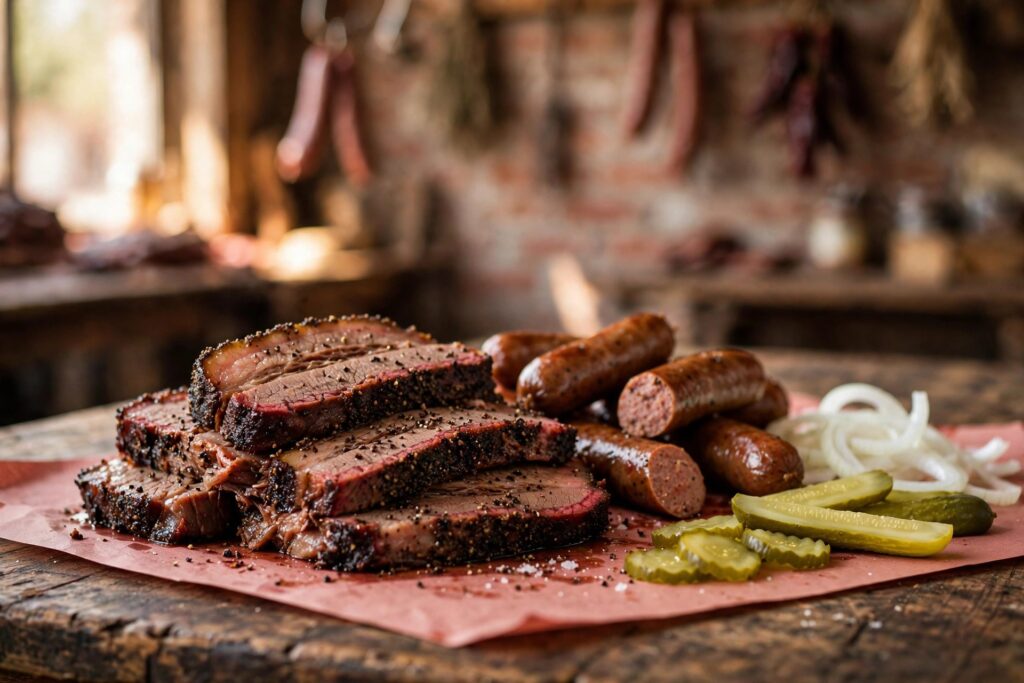
There is a town in Central Texas where a family argument became a barbecue institution, and the barbecue institution became a pilgrimage. Lockhart sits about half an hour south of Austin, and in 1999 the Texas Legislature gave it a title no other town can claim: the Barbecue Capital of Texas. That same year, the town’s most famous barbecue family split in two, and the split is the reason Lockhart is worth a full day of your life rather than a quick lunch stop.
On one side stands Kreuz Market (pronounced “krites”), in a big barn-like building at the north end of town. On the other stands Smitty’s Market, in the old building downtown where Kreuz Market cooked for nearly a century. They are run by the same family, they cook the same way, and for more than twenty-five years barbecue lovers have argued about which one is better — an argument that once played out on national television, with a blind taste test and local judges, in an episode of the Travel Channel’s Food Wars.
This is the story of how one restaurant became two, what actually differs between them, and how to eat your way through both in a single afternoon.
How a Meat Market Became a Barbecue Legend
The story starts on January 17, 1900, when Charles Kreuz Sr. bought a small meat market in Lockhart from Jesse Swearingen for $200. It was a butcher shop first and a barbecue joint second, and that order of operations explains almost everything about the place. Smoking meat began as a practical way to use up older cuts and tougher pieces — brisket most of all — before they spoiled.
By the 1920s the business had settled into its building on South Commerce Street, and it stayed there for the better part of a century. In 1948, the Kreuz family sold the business to Edgar Schmidt, a man everyone called Smitty. He ran it for decades, and under him the place hardened into the rituals that still define it: meat ordered at the pit, served on pink butcher paper, eaten with your hands at long communal tables. No plates to speak of. No forks. No sauce.
That austerity was not a gimmick. In the old Central Texas meat-market tradition, the meat was the entire argument. Sauce was something you put on meat that needed help, and Kreuz meat did not need help. The brisket came off post oak fires, seasoned simply, sliced thick, and handed over still steaming.
The Split: One Family, Two Restaurants
When Smitty died, his will divided the inheritance in a way that guaranteed trouble: the barbecue business went to his sons, Don and Rick, while the building that housed it went to his daughter, Nina. For a while the arrangement held. Then it did not. The siblings fell out — the grievances remain a family matter — and in 1999 Rick Schmidt made a decision that turned a private rift into Texas barbecue lore.
He moved Kreuz Market out. Not far — a new, larger building a short drive up the road at 619 North Colorado Street — but far enough that the break was final. And he did not leave the fire behind. On moving day, pitmaster Roy Perez and Lehman Schmidt carried a metal tub of live coals from the old pits on South Commerce Street to the new building, and used those coals to light the new pits. The flame, literally, never went out.
Nina, meanwhile, looked at the building her father had kept standing for fifty years and decided it was still built for barbecue. She opened Smitty’s Market in the original Kreuz building at 208 South Commerce Street, naming it for her father and carrying the tagline “Since 1948” — the year Smitty bought the place. So the town that the Legislature had just crowned the Barbecue Capital of Texas now had two restaurants, one family, one tradition, and a rivalry that television crews could not resist.
The Food Wars Verdict — and Why It Settled Nothing
The Travel Channel’s Food Wars built each episode around a simple premise: two rival restaurants serving the same food, judged in a blind taste test by locals. The Lockhart episode was different from the others because the rivalry was not really about food at all. It was about a brother and a sister who used to run a restaurant together.
Kreuz Market won that televised showdown, its brisket and sausage declared the better of the two by the local judges. If you like a clean answer, there it is. But almost nobody in Lockhart barbecue circles treats it as final, because the two restaurants are not really serving different food. They come from the same pits, the same tradition, the same family recipes, and the differences are matters of degree — a little more pepper here, a slightly different cut there, the mood of the pit on a given day — not the kind of gap a single afternoon’s judging can permanently settle. Texas brisket rivalries rarely produce a final winner, as our Franklin vs. Snow’s head-to-head shows, and the brisket itself is a cut that punishes impatience, as our smoked beef brisket guide explains.
What the show did settle was Lockhart’s place in barbecue culture. After Food Wars, the Kreuz-versus-Smitty’s question became the standard first conversation for anyone planning a Central Texas barbecue trip. The rivalry became part of the meal.
What It Is Actually Like to Eat at Each Place
Walk into Kreuz Market’s current building and the first thing you notice is the scale of it: a huge, open hall, the pits visible, the smell of post oak smoke settled into the wood. You order at the counter by the cut and by the pound, the meat lands on butcher paper, and you carry it to a long table. The brisket is the headliner — fatty brisket that gives under the knife, and shoulder clod, a leaner cut that regulars swear by. The pork chops have their own devoted following, and the prime rib, served medium-rare, is the kind of thing that makes first-timers rethink what a barbecue joint is allowed to serve. One concession to modernity: Kreuz now serves sides, beans and German potato salad among them, which old-timers will tell you is practically a scandal and everyone else will tell you is a welcome one.
Smitty’s is a different kind of room. The building itself is the experience — a century-old meat market with the pits right there, the whole operation feeling closer to the way Kreuz Market felt before the move. The ordering ritual is the same, the butcher paper is the same, and the no-sauce, no-forks ethos is the same. Regulars will tell you the sausage at Smitty’s has a snap and seasoning that rewards the trip on its own, and that the brisket eats a touch leaner and more pepper-forward than its sibling across town. Others will tell you the opposite. That disagreement is the point.
Honest advice: do not try to settle it in one visit. Barbecue varies by the day and by the pit. The people who love Lockhart most are the ones who go to both places in the same afternoon, order the same things at each, and argue about it all the way home.
The Ending Nobody Expected
Here is the part of the story that rarely makes it into the rivalry retellings: the family came back together. Ask the Schmidts about the “barbefeud” now and they will tell you the same thing — family outweighed the rest of it. Today the third generation carries the tradition forward on three fronts: Keith Schmidt at Kreuz Market, Nina Schmidt Sells at Smitty’s Market, and Susie Schmidt Franks, who with her husband Chad runs Schmidt Family Barbecue in Bee Cave, outside Austin. Three restaurants, one bloodline, and a feud that burned hot enough to make national news and then cooled into something closer to a family joke.
That is why the Kreuz-versus-Smitty’s story endures when most restaurant rivalries fade. It is not a marketing stunt and it never was. It is a real family, a real break, and a real reconciliation, all of it seasoned with post oak smoke. Lockhart has other great barbecue too — Black’s Barbecue, on the town square, is the third leg of the classic Lockhart crawl and deserves its own visit — but the Kreuz and Smitty’s story is the one you will still be telling at dinner.
So go hungry, go early, and go to both. Order brisket and sausage at each, eat it with your hands, skip the sauce, and join the argument. It has been running since 1999, and it shows no signs of ending. If you want to understand why Texas barbecue inspires this kind of devotion, there is no better classroom than a town where one family loved the craft enough to fight over it — and then kept cooking anyway.
Leave a Reply