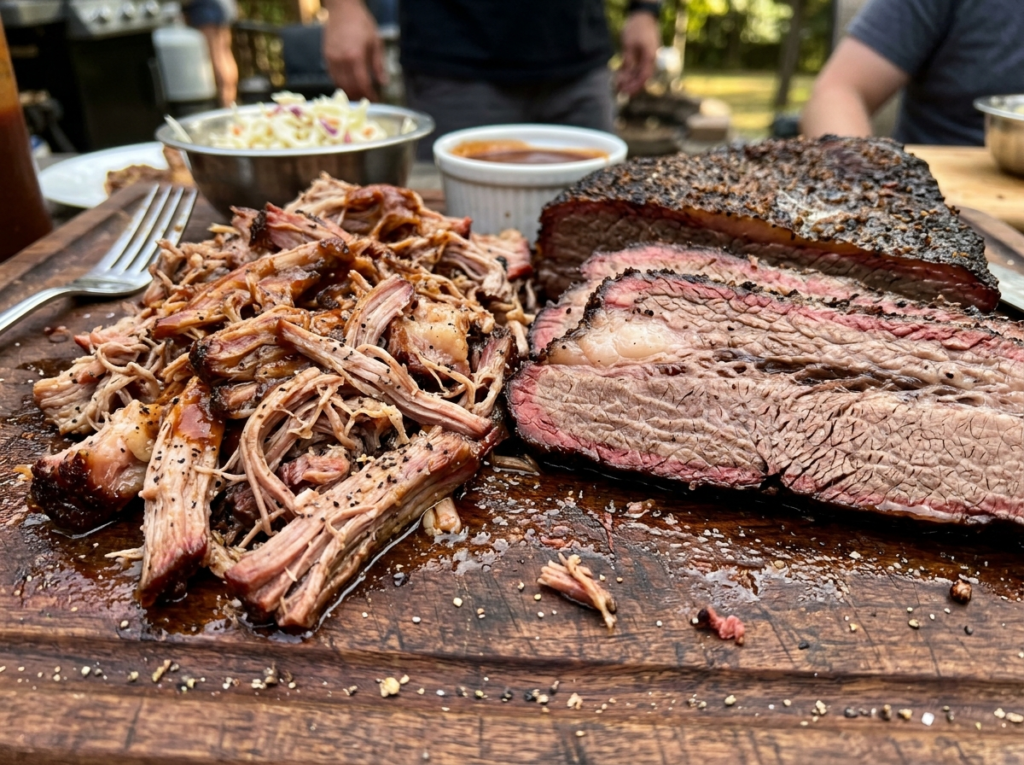
A whole pork butt costs about $1.50 to $2.50 per pound. A whole packer brisket? You’re looking at $4 to $8 per pound, sometimes more for USDA Prime or Wagyu. That price gap alone tells you these two BBQ heavyweights play very different games — and the differences don’t stop at your wallet.
If you’ve ever stood in the meat aisle, phone in hand, trying to decide between a brisket and a pork butt for your weekend cook, you’re not alone. This is one of the most common debates in the backyard smoking world. Both cuts are low-and-slow legends. Both can feed a crowd. And both can make you feel like a pitmaster hero when they come out right.
But they aren’t interchangeable. The time, skill, cost, and even the stress level involved are genuinely different. So let’s break it all down — honestly, no fluff — so you can pick the right one for your situation.
What Exactly Are These Two Cuts?
Before we compare anything, let’s make sure we’re talking about the same thing, because naming conventions get confusing fast.
Brisket comes from the lower chest of a cow. It’s a large, tough muscle that the animal uses constantly, which means it’s packed with connective tissue. A full “packer” brisket includes two parts: the flat (leaner, more uniform) and the point (fattier, more marbled). A whole packer typically weighs between 12 and 20 pounds. You can also buy just the flat, which is smaller and more common at grocery stores, though most serious smokers prefer the full packer for better moisture and flavor. If you’re curious about the differences between these sub-cuts, this brisket point vs flat breakdown explains it well.
Pulled pork comes from the pork butt (also called pork shoulder or Boston butt). Despite the name, it’s actually from the upper part of the pig’s front shoulder. It’s a well-marbled, forgiving cut that weighs between 6 and 10 pounds on average. The heavy intramuscular fat keeps it moist during long cooks, and when it’s done, the meat practically falls apart — you “pull” it into shreds with forks or your hands.
Both cuts need low-and-slow cooking to break down collagen into gelatin. That’s what transforms tough, chewy meat into something tender and succulent. But the journey to get there? Pretty different.
The Flavor Profile: How Do They Actually Taste?
This is where personal preference runs the show, but there are real, objective differences worth understanding.
Brisket has a deep, beefy flavor. Think rich, savory, almost buttery when the fat renders properly. The bark (that dark, flavorful crust) on a well-smoked brisket is one of the most celebrated things in all of BBQ. A great brisket slice should hold its shape, have a pink smoke ring, and melt on your tongue. The seasoning is usually simple — salt and black pepper (the famous “dalmatian rub” from Texas BBQ tradition) — because the beef flavor is the star.
Pulled pork is sweeter, more forgiving in flavor, and acts like a sponge for whatever rub or sauce you put on it. Pork shoulder has a milder, slightly sweeter base flavor compared to beef. That’s why you’ll see pulled pork paired with everything from vinegar-based Carolina sauces to sweet Kansas City-style BBQ sauce to Alabama white sauce. It’s a crowd-pleaser precisely because it adapts to so many flavor profiles.
Here’s the honest truth: brisket has a higher flavor ceiling. A perfectly smoked brisket is a transcendent eating experience. But pulled pork has a higher flavor floor — even a mediocre pulled pork is still pretty good eating. That difference matters a lot depending on your skill level and confidence.
Difficulty Level: Which One Is Harder to Smoke?
Let’s not sugarcoat this. Brisket is significantly harder to cook well.
Pork butt is often called the “beginner’s cut” in smoking circles, and there’s a reason for that. The high fat content and collagen give you a massive margin for error. Overshoot your temperature by 10 degrees? The pork butt probably won’t punish you for it. Forget to spritz for an hour? It’ll likely be fine. Open the lid too many times? You’ll add some cook time, but the end result will still be tender and pullable.
Brisket is a different animal — literally and figuratively. The flat section is lean, which means it can dry out quickly if your temperature runs too high, if you don’t wrap at the right time, or if you slice it wrong. The difference between an incredible brisket and a disappointing one often comes down to small details: maintaining consistent smoker temperature, knowing when to wrap (the Texas Crutch), nailing the internal temperature, and letting it rest long enough.
Pro Tip: If you’re smoking brisket for the first time, don’t practice on the day of your big party. Do a test run first. Seriously. The learning curve is real, and knowing your specific smoker’s hot spots and behavior makes all the difference. Having a reliable instant-read thermometer is also non-negotiable for brisket — you need to check multiple spots in the flat and point to know when it’s truly done.
Pulled pork? You can absolutely cook it for your first-ever smoking session and impress everyone. It’s that forgiving.
Time Commitment: How Long Are We Talking?
Both of these are long cooks, but the time investment isn’t identical.
A pork butt typically takes 10 to 14 hours at 225°F, depending on its size. An 8-pound butt might finish in 12 hours; a 10-pounder could push 14 or beyond. You’ll almost certainly hit “the stall” — that frustrating period around 150-160°F where the internal temperature seems to stop rising for hours. You can push through it, or wrap the pork in foil or butcher paper to speed things up.
A full packer brisket takes 12 to 18 hours at 225°F, sometimes longer for really large cuts. A 15-pound packer brisket can easily be an 18-hour commitment. The stall hits brisket hard too, usually around 150-165°F, and wrapping is almost standard practice for most home cooks.
Here’s what those numbers really mean in practice: if you want brisket ready for a 5 PM dinner, you might need to start at midnight or even earlier. Many experienced brisket cooks start the night before and manage the cook overnight. With pork butt, a 4 or 5 AM start usually gets you to dinnertime comfortably.
Both cuts benefit enormously from resting after cooking — at least one hour, ideally two or more, wrapped in butcher paper and towels inside a cooler. This lets the juices redistribute and actually makes the meat more tender. Factor that rest time into your planning.
Quick Fact: Pulled pork actually holds at serving temperature better than sliced brisket. You can hold a wrapped pork butt in a cooler for up to 4 hours and it’ll still be fantastic. Brisket can hold too, but sliced brisket dries out faster once it’s cut, so timing your slice is important.
Cost and Value: What’s the Real Damage?
This is where pulled pork wins convincingly for most people, especially those cooking for a crowd.
As of 2024-2025, pork butt typically runs $1.50 to $3.00 per pound at most grocery stores and warehouse clubs like Costco or Sam’s Club. Brisket prices vary a lot more. A USDA Choice whole packer brisket usually costs $4.00 to $7.00 per pound, and USDA Prime can go higher. Wagyu brisket from brands like Snake River Farms? You could be looking at $10+ per pound.
But raw price per pound doesn’t tell the whole story. You also need to think about yield — how much cooked, edible meat you get from the raw weight.
Pork butt has a cooked yield of roughly 60-65%. So a 10-pound butt gives you about 6 to 6.5 pounds of pulled pork. At $2.50/lb raw, that’s about $25 for enough pulled pork to feed 12-15 people generously (especially with buns and sides).
Brisket has a cooked yield of roughly 50-55%, sometimes less. A 15-pound packer brisket might give you 7.5 to 8 pounds of sliced meat. At $5.50/lb raw, that’s about $82.50 for enough brisket to feed roughly the same number of people.
The math is pretty clear. For feeding a crowd on a budget, pulled pork gives you more bang for your buck. That’s not a knock against brisket — it’s just a reality of the cut.
Pairing either one with great BBQ side dishes stretches your meat even further, regardless of which cut you choose.
Cooking for a Crowd: Which One Scales Better?
If you’re hosting 20, 30, or 50 people, this is a critical question.
Pulled pork scales beautifully. You can smoke three or four pork butts at the same time on most full-sized smokers, and since the cut is so forgiving, managing multiple pieces isn’t much harder than managing one. The shredded meat goes into a big aluminum pan, you add sauce, and people serve themselves on buns. It’s practically a self-service meal.
Brisket doesn’t scale as easily. Fitting multiple whole packers on a smoker requires a large cooking chamber. Each brisket might behave slightly differently — one might finish two hours before the other. And the slicing process requires attention and skill. You need to slice against the grain, adjust your slicing direction when you transition from flat to point, and serve relatively quickly so it doesn’t dry out.
For big parties, potlucks, and tailgates, pulled pork is the practical choice about 90% of the time. Brisket works better for smaller gatherings where you can give it the attention it deserves and really showcase your skills.
Versatility: What Can You Do With Leftovers?
Both cuts shine here, but in different ways.
Pulled pork leftovers are ridiculously versatile. You can use them in tacos, quesadillas, loaded nachos, fried rice, pizza toppings, mac and cheese, stuffed baked potatoes, sliders, breakfast hash, and even eggs Benedict. The shredded texture and mild flavor profile mean it blends into almost any cuisine. Leftover pulled pork freezes well too — portion it into zip-lock bags, and you’ve got quick weeknight meals for a month.
Brisket leftovers are delicious but slightly less flexible. Chopped brisket works great in tacos, chili, baked beans, and sandwiches. Sliced brisket reheats well if you do it right (low and slow in the oven with some beef broth, covered tightly). Burnt ends — those caramelized, cubed pieces from the point — are a whole separate delicacy on their own.
Both freeze well, but pulled pork reheats with better consistency. Because brisket slices can dry out during reheating, you need to be more careful with the process.
The Stall: How Each Cut Handles It
Both brisket and pork butt experience the stall, but your strategy for dealing with it can differ.
The stall happens because moisture evaporating from the surface of the meat creates a cooling effect (think of it like sweat cooling your body). The internal temperature plateaus, sometimes for 2-4 hours. It tests your patience like nothing else in cooking.
For pork butt, many cooks just ride it out. The fat content protects the meat, and whether you wrap or not, the end result is usually juicy and pullable. Some folks wrap in foil around 160°F to push through faster, and that works great.
For brisket, wrapping during the stall is almost a standard move for home cooks. Most people wrap in butcher paper (which lets the bark “breathe”) or foil (which speeds things up more but can soften the bark). The lean flat is at risk of drying out during a prolonged stall, so getting through it efficiently matters more with brisket. Finding the best temperature for smoking brisket and sticking to it consistently helps reduce stall drama.
Equipment: Do You Need Different Gear?
Honestly, you can smoke both cuts on the same equipment. A pellet grill, offset smoker, kamado, or even a basic kettle grill with indirect heat setup will work for both brisket and pulled pork.
That said, brisket benefits from a smoker that holds temperature very consistently. Fluctuations of 25-50 degrees aren’t a big deal for pork butt, but they can affect brisket quality. If your smoker runs hot or has inconsistent temps, pork butt is a safer bet until you learn to manage your fire better.
A good wireless meat thermometer helps with both cooks but is especially valuable for brisket, where you’re monitoring temperature over 14+ hours and don’t want to keep opening the lid.
If you’re shopping for a smoker and plan to cook both cuts regularly, a quality pellet grill is hard to beat. Set-it-and-forget-it temperature control takes a lot of the stress out of long cooks, especially brisket.
Which One Should You Choose? A Practical Framework
Rather than just saying “it depends” (the most unhelpful answer possible), here’s how to think about it based on your actual situation.
Go with pulled pork if: you’re newer to smoking, you’re feeding a big group, you’re on a tighter budget, you want less stress during the cook, or you need something that plays well with lots of different sauces and serving styles. It’s also the better choice if you’re not sure about your smoker’s temperature consistency yet.
Go with brisket if: you’ve got some smoking experience under your belt, you’re cooking for a smaller group who’ll appreciate the craft, you’re willing to invest more time and money, and you want that “wow factor” that a perfectly sliced brisket delivers. It’s a showpiece, and when you nail it, there’s nothing quite like it in BBQ.
Go with both if: you have the smoker space, the time, and you want to be the absolute legend of your neighborhood. Put the brisket on first (since it takes longer), then add the pork butt a few hours later. They cook at similar temperatures, so running them together on the same smoker is totally doable.
A Word About Wood Choice
This is a detail that often gets overlooked in the brisket vs pulled pork conversation, but it matters.
Brisket pairs best with stronger smoking woods. Post oak is the classic Texas choice. Hickory works beautifully too. Mesquite can work but it’s intense — use it sparingly or blend it with a milder wood. The bold beef flavor can stand up to heavier smoke.
Pulled pork works with a wider range of woods. Apple and cherry give a sweeter, milder smoke that complements pork’s natural sweetness. Hickory is a classic pairing that gives pulled pork a more traditional BBQ flavor. Pecan is another excellent middle-ground option — nutty and mild.
Using the wrong wood won’t ruin your cook, but using the right one elevates it noticeably.
FAQ
Is brisket or pulled pork better for beginners?
Pulled pork is the better choice for beginners, hands down. Pork butt is a very forgiving cut because of its high fat and collagen content. Even if your temperature fluctuates or you open the lid too often, you’ll still end up with tender, pullable meat. Brisket demands more precision with temperature control, wrapping timing, and slicing technique, making it better suited for someone with a few cooks already under their belt.
How much brisket or pulled pork do I need per person?
Plan for about 1/3 pound of cooked meat per person for a regular meal, or 1/2 pound if your guests are big eaters or there aren’t many side dishes. Since pork butt loses about 35-40% of its weight during cooking and brisket loses about 45-50%, you’ll need roughly 1/2 pound raw pork butt per person or about 2/3 pound raw brisket per person. Always round up — leftovers are never a problem with either cut.
Can you smoke brisket and pulled pork at the same temperature?
Yes. Both cuts smoke beautifully at 225°F to 250°F. That’s what makes them great candidates for cooking together on the same smoker. Start your brisket first since it takes longer, then add the pork butt a few hours later. Both reach doneness based on internal temperature and feel (probe tenderness) rather than a fixed clock time, so monitor each one individually.
Which has more protein — brisket or pulled pork?
They’re fairly close. A 3-ounce serving of cooked brisket has about 28 grams of protein. The same serving of pulled pork has about 22-24 grams. Brisket edges ahead on protein, but pulled pork is no slouch. If you’re choosing purely based on macros, brisket is slightly leaner (especially the flat), though the difference isn’t dramatic enough to be the deciding factor for most people.
Does pulled pork or brisket reheat better?
Pulled pork reheats more easily and consistently. Because it’s already shredded and has plenty of rendered fat mixed in, it bounces back well in the microwave, oven, or even a slow cooker with a splash of apple juice or broth. Brisket slices can dry out if reheated too aggressively. The best way to reheat brisket is in a 275°F oven, tightly wrapped in foil with a bit of beef broth, for about 20-30 minutes.
Pick Your Cut and Fire Up the Smoker
There’s no wrong answer between brisket and pulled pork — only the right answer for your specific day, budget, and crowd. Pulled pork is the reliable, budget-friendly, crowd-feeding champion that makes everyone happy without keeping you up all night stressing over temperature swings. Brisket is the craft project, the showstopper, the cut that rewards your patience and skill with something truly special.
If you haven’t tried smoking either one yet, start with a pork butt. Learn your smoker, get comfortable with the process, and build your confidence. Then, when you’re ready for a challenge, grab a whole packer brisket and go for it. The BBQ community has a saying that fits perfectly here: “The best BBQ is the one you’re smoking right now.”
So pick your cut, choose your wood, set your temp, and get cooking. Your backyard is about to smell incredible.