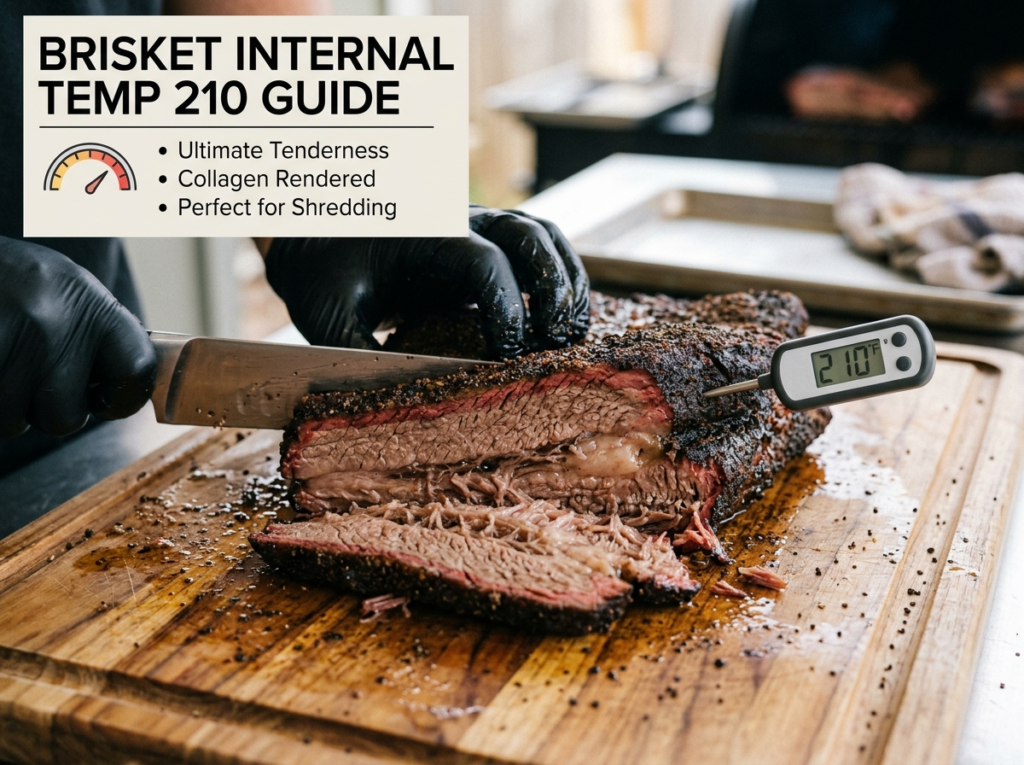
A perfectly smoked brisket can make grown adults tear up with joy. But here’s what separates a jaw-dropping brisket from a tough, chewy disaster — a few degrees of internal temperature. Most competition pitmasters and backyard legends agree that pulling your brisket at an internal temp around 210°F gives you that fall-apart, buttery texture everyone chases. Not 190. Not 225. Right around that 210 mark.
But why 210? What’s so special about this number? And does every brisket need to hit exactly 210°F to be perfect?
Let’s break all of that down. If you’ve been struggling with dry brisket, stalling temps, or just trying to figure out when to actually pull the meat off your smoker, this is the guide you’ve been looking for.
What Happens Inside Brisket at 210°F
To really understand why brisket internal temp 210 matters, you need to know a little bit about what’s going on inside that big cut of beef while it cooks.
Brisket is packed with collagen — a tough connective tissue that runs through the muscle fibers. At lower temperatures, this collagen stays intact, and that’s exactly why a brisket pulled at 180°F feels like you’re chewing on a shoe. It hasn’t broken down yet.
The magic starts around 190°F. Collagen begins to convert into gelatin at this point. Gelatin is what gives properly smoked brisket that moist, almost jiggly texture. But here’s the thing — this conversion doesn’t happen instantly. It’s a gradual process that gets better as you push toward 200°F, 205°F, and eventually 210°F.
By the time your brisket hits 210°F internally, most of that stubborn collagen has fully rendered into gelatin. The fat has also had enough time to distribute evenly through the meat. You end up with slices that hold together but pull apart with almost zero effort.
Think of it like caramelizing onions. You could stop at 10 minutes and they’d be soft. But give them 30–40 minutes and they become something completely different — sweet, rich, deeply flavored. That’s what those extra degrees do to brisket.
Is 210°F the Only “Right” Temperature?
Here’s where things get interesting. If you ask ten different pitmasters what internal temp they pull brisket at, you’ll probably get seven different answers.
Some swear by 195°F. Others won’t touch it until it reads 210°F. A few legendary names in the BBQ world have admitted to pulling briskets at 203°F and being perfectly happy.
So what gives?
The truth is, there’s no single “perfect” number. Brisket is a living, breathing (well, not anymore) piece of meat, and every cut is a little different. Fat content, marbling, the thickness of the flat versus the point, the grade of beef — all of these affect when your specific brisket reaches its ideal tenderness.
That said, 210°F is widely considered the upper sweet spot where you’re almost guaranteed tender results. It’s a safe target, especially if you’re still building your brisket confidence. Here’s a rough breakdown of what different temps tend to produce:
195°F–200°F: Collagen is still breaking down. Can work for leaner briskets with good marbling, but there’s a higher risk of toughness, especially in the flat.
200°F–205°F: A solid range. Many competition cooks pull here if the probe test feels right. You’ll get good tenderness but need to rely on the feel test (more on that shortly).
205°F–210°F: The comfort zone. Collagen conversion is nearly complete. Fat is fully rendered. This is where backyard smokers see the most consistent results.
Above 210°F: You’re entering risky territory. The flat can start drying out, and the point might become mushy. It’s possible to go to 212°F or even 215°F with some cuts, but proceed with caution.
The key takeaway? Use 210°F as your target, but don’t treat your thermometer as the final judge. Your best tool after temperature is the probe test — and we’ll talk about that next.
The Probe Test: Your Secret Weapon Beyond Temperature
If you’ve been around BBQ forums or watched any pitmaster videos, you’ve probably heard the phrase “probe tender.” It’s the single most important concept for nailing brisket, and it matters just as much (maybe more) than the number on your thermometer.
Here’s how it works. When your brisket is approaching the 200°F–210°F range, take a thermometer probe or a toothpick and slide it into the thickest part of the meat. You want it to feel like you’re pushing into warm butter or a jar of peanut butter. There should be almost no resistance.
If you feel the probe catch or require pressure to push through, the brisket isn’t ready — even if the thermometer says 210°F. And on the flip side, if the probe slides in like butter at 203°F, that brisket might be done even though it hasn’t hit 210.
Pro Tip: Test multiple spots on the brisket, not just one. The flat and the point cook at different rates because of their different fat content and thickness. Your flat might be probe tender at 205°F while the point needs another 5–7 degrees.
This is exactly why experienced pitmasters say “cook to feel, not to temp.” The temperature gets you in the right neighborhood. The probe test tells you which house to stop at.
If you’re using a basic probe thermometer and want something more reliable, check out our guide on the best instant read thermometer that can make a real difference in your cook accuracy.
How Your Smoker Temperature Affects the Final Internal Temp
Let’s talk about the other temperature that matters — your smoker temperature. Because the temp inside your cooker directly influences how your brisket reaches that 210°F internal target, and it affects the texture you get once it arrives there.
Low and Slow: 225°F–250°F
This is the classic approach. Running your smoker between 225°F and 250°F gives the collagen maximum time to render slowly. The result is typically a more tender, juicier brisket because the fat and connective tissue break down gradually rather than being forced out by aggressive heat.
At these smoker temps, expect your cook to take roughly 1 to 1.5 hours per pound. A 14-pound packer brisket could take anywhere from 14 to 18 hours, sometimes more. That’s a long cook, but the results speak for themselves.
If you want a deeper understanding of optimal smoker temperatures, our article on the best temp to smoke brisket covers this topic in detail.
Hot and Fast: 275°F–325°F
The hot-and-fast method has gained popularity in recent years, and for good reason. Running your smoker at 275°F or even up to 300°F–325°F can cut your cook time significantly — sometimes by 4–6 hours.
You can absolutely hit an internal temp of 210°F with this method. The brisket will still be tender. The bark might even be better in some cases because the higher heat creates more Maillard reaction on the surface.
The tradeoff? There’s less margin for error. The flat can dry out faster at higher smoker temps because the moisture doesn’t have as much time to redistribute. If you’re going hot and fast, wrapping your brisket during the stall becomes even more important.
Which Method Gets You Better Results at 210°F?
Both can produce outstanding brisket at 210°F internal. The low-and-slow method is more forgiving for beginners. Hot-and-fast rewards attention and experience. Pick the one that fits your schedule and skill level.
No matter which smoker temp you choose, a reliable cooker makes the job easier. If you’re shopping for one, we’ve reviewed the best offset smokers and best pellet smokers to help you decide.
The Stall: Why Your Brisket Gets Stuck Before 210°F
If you’ve never experienced the stall, let me save you some panic. Somewhere around 150°F–170°F internal temp, your brisket will seemingly stop cooking. The temperature will flatline or even drop slightly. This can last for hours.
The first time it happens, you’ll think something is wrong with your thermometer. You’ll check the batteries. You’ll open the smoker lid (don’t). You’ll consider turning up the heat (hold on).
What’s actually happening is completely natural. As the brisket’s internal temp rises, moisture inside the meat reaches the surface and starts evaporating. This evaporation cools the meat, working against the heat from your smoker. It’s the same principle that makes sweating cool your body on a hot day.
The stall eventually breaks when most of the surface moisture has evaporated or when the rendering fat creates a barrier that slows evaporation. Then the temperature starts climbing again toward your 210°F target.
How to Push Through the Stall
You have two options:
Wait it out. Just be patient. Keep your smoker steady and let the brisket do its thing. You’ll get a thicker bark this way because the surface stays exposed to smoke and heat longer. This is the old-school Texas approach.
Wrap it. This is the more popular method. When your brisket hits the stall (usually around 160°F–170°F), wrap it tightly in butcher paper or aluminum foil. Wrapping traps moisture and steam, which pushes the internal temp through the stall much faster.
Butcher paper is the preferred choice among most pitmasters because it breathes slightly, preserving some bark integrity. Foil works faster but can make the bark softer — some people call this the “Texas crutch.”
Either way, once you wrap and push past the stall, your brisket will climb more steadily toward that 210°F internal target.
Brisket Flat vs. Point: They Don’t Hit 210°F at the Same Time
This is something a lot of guides skip, and it causes real frustration for home cooks.
A whole packer brisket has two muscles — the flat and the point. They’re layered on top of each other, separated by a thick seam of fat. And they cook differently.
The flat is leaner, thinner, and more uniform. It reaches temperature faster and is more prone to drying out. The point is thicker, fattier, and takes longer to render fully. It’s also more forgiving because all that intramuscular fat keeps it moist even if you overshoot slightly.
What does this mean for your 210°F target? Your flat might hit 210°F while your point is still at 200°F. Or your point could be probe tender at 207°F while the flat feels tough.
Here’s what smart cooks do:
Monitor both sections with separate probes if you can. A wireless meat thermometer makes this much easier because you can track multiple spots without opening the smoker.
When the flat reaches 200°F–205°F, start doing probe tests on both muscles. If the flat feels probe tender before the point, it’s usually better to pull the whole brisket and rest it longer. The carryover heat during the rest will push temps up another 5°F–10°F, which can finish off the point.
If you’re curious about how these two sections differ and when you might want to smoke them separately, our breakdown of brisket point vs flat has everything you need.
The Rest Period: Don’t Skip This After Hitting 210°F
You’ve done it. Your brisket hit 210°F internal. The probe slides in like butter. You’re ready to slice.
Stop.
Resting your brisket is non-negotiable. If you slice into it right off the smoker, all those beautiful juices will pour out onto your cutting board instead of staying in the meat. You’ll end up with drier slices and a soggy board.
Here’s why resting works. When brisket cooks, the muscle fibers tighten and push moisture toward the center. Resting allows those fibers to relax and reabsorb the juices evenly throughout the meat. The result is a noticeably juicier slice.
How Long Should You Rest Brisket?
Minimum: 1 hour. This is the bare minimum for a decent rest.
Ideal: 2–4 hours. Most pitmasters rest their briskets for at least 2 hours, and many go up to 4. Competition teams often rest briskets in insulated coolers (called “faux Cambros”) for 4+ hours with great results.
Maximum: Don’t go past 8 hours. After that, you risk the brisket dropping into the danger zone below 140°F, where bacteria can grow.
To rest, wrap your brisket in butcher paper (if it’s not already wrapped), then in old towels, and place it in a cooler with the lid closed. No ice — you want it to stay warm. The internal temp will initially rise a few degrees from carryover cooking, then slowly drop over time.
Did You Know? A well-rested brisket can actually be juicier at 145°F internal (after resting) than a just-pulled brisket at 210°F. The rest redistributes moisture so effectively that every bite tastes better.
Common Mistakes When Targeting 210°F
Even experienced cooks make these errors. Knowing about them ahead of time can save your next brisket.
Opening the smoker too often. Every time you lift that lid, you lose heat and add time to your cook. Trust your thermometer probes and resist the urge to peek. There’s a reason people say, “If you’re lookin’, you ain’t cookin’.”
Relying only on temperature. A brisket that reads 210°F but fails the probe test isn’t done. And a brisket that’s probe tender at 203°F is done even if it hasn’t hit your target number. Temperature is a guideline, not gospel.
Not accounting for carryover cooking. Your brisket’s internal temp will rise 5°F–10°F after you pull it from the smoker. If you wait until it reads 210°F to pull, it might actually finish resting at 215°F–220°F. Some experienced cooks pull at 205°F and let carryover do the final work.
Cooking all briskets the same way. A Select grade brisket from the grocery store and a Prime grade from a specialty butcher are very different animals (literally the same animal, but you know what I mean). A leaner Select brisket might be better pulled at 205°F, while a well-marbled Prime can handle 210°F or even slightly above without drying out.
Skipping the rest. Already covered this, but it’s worth repeating. No rest = dry brisket. Period.
What If Your Brisket Goes Past 210°F?
Don’t panic. Going a few degrees over 210°F isn’t an automatic disaster, especially if you’re smoking a fatty packer brisket with good marbling.
If your brisket reaches 212°F–215°F, it’s probably still fine. The point section, with all its fat, can handle it. The flat might be slightly drier than ideal, but a good rest will help recover some of that moisture.
If you’ve pushed past 220°F, you’re in trouble. The flat is likely dry and the texture of the point might be overly mushy. At this stage, your best bet is to separate the point from the flat, chop the flat for sandwiches (add some sauce or au jus to compensate for dryness), and enjoy the point as burnt ends.
Speaking of which, burnt ends — those crispy, caramelized cubes from the point — are one of BBQ’s greatest gifts. If your brisket point has pushed to a higher temp, turning it into burnt ends is actually a better move than trying to slice it.
Pro Tip: If you’re pairing your brisket with sides, our roundup of the best BBQ side dishes has some crowd-pleasing options that complement smoked beef beautifully.
Choosing the Right Brisket for a Perfect 210°F Cook
Not all briskets are created equal, and the one you pick at the store plays a huge role in how it performs at 210°F.
USDA Prime briskets have the most marbling. That intramuscular fat keeps the meat moist as it climbs to 210°F and makes it very forgiving if you overshoot by a few degrees. If you can afford it, Prime is the way to go.
USDA Choice is the most common grade you’ll find. It has decent marbling and produces great results if you manage your cook well. Most backyard smokers use Choice briskets and turn out fantastic BBQ.
USDA Select is the leanest option. It’s cheaper, but it’s the hardest to smoke well. Less fat means less insulation against heat, so the flat can dry out faster. If you’re using Select, consider pulling a bit earlier — around 200°F–205°F — and wrapping for a longer rest.
For the cut itself, always go for a full packer brisket (both flat and point together) rather than just a flat. The point section provides fat that bastes the flat during cooking, and you get more forgiving results overall. We’ve written about the differences in our brisket flat vs packer guide if you want the full comparison.
A Simple Timeline for Smoking Brisket to 210°F
Let’s put it all together with a realistic timeline. This assumes a 12–14 pound packer brisket smoked at 250°F.
The night before: Trim excess fat (leave about ¼ inch cap), apply your rub, and let it sit uncovered in the fridge overnight. The dry brine helps with bark formation and seasoning penetration.
Hour 0: Place brisket fat-side up (or down — this depends on your smoker’s heat source location) on the smoker. Insert probes into the thickest part of the flat and point.
Hours 1–5: The brisket builds bark and absorbs smoke. Internal temp climbs steadily from room temperature to around 150°F–160°F. Don’t open the smoker unless you need to spritz.
Hours 5–8: The stall hits. Temp flatlines somewhere between 150°F–170°F. If you’re wrapping, do it once the bark looks set and the color is a deep mahogany.
Hours 8–12: After wrapping (or after the stall breaks naturally), the temp climbs more steadily. Start probe testing once you hit 195°F.
Hours 12–14: Brisket reaches 205°F–210°F and passes the probe test. Pull it off the smoker.
Hours 14–18: Rest in a cooler for 2–4 hours. Then slice, serve, and accept compliments gracefully.
This is a rough guide — your brisket will follow its own schedule. That’s part of the charm (and the frustration) of smoking meat. Every cook is a little different.
FAQ
Can you eat brisket at 190°F internal temp?
You can, and it’ll be safe to eat, but the texture won’t be what you’re hoping for. At 190°F, a lot of the collagen hasn’t fully converted to gelatin yet. The result is usually chewy, tough slices — especially in the flat. You’re better off pushing to at least 200°F and using the probe test to confirm tenderness.
Why is my brisket tough even at 210°F?
Two likely reasons. First, you might not have rested it long enough. Even a perfectly cooked brisket will seem tough if you slice it right away because the juices haven’t redistributed. Rest for at least 1–2 hours. Second, the grade of beef matters. A lean Select grade brisket with minimal marbling can feel tough at 210°F because there isn’t enough intramuscular fat to create that moist, tender mouthfeel.
Should I pull brisket at 205 or 210?
Both can work beautifully. The real answer depends on your specific brisket and how it feels during the probe test. If the probe slides in with zero resistance at 205°F, pull it — there’s no reason to push further. If it still has some resistance at 205°F, let it ride until 210°F. Remember that carryover heat during the rest will add another 5°F–10°F, so factor that into your decision.
How accurate does my thermometer need to be?
Very. A thermometer that’s off by even 5°F could be the difference between a perfect brisket and a dry one. Calibrate your thermometer regularly using the boiling water test (it should read 212°F at sea level). If you’re using a cheap probe, consider upgrading to something more reliable — a budget instant read thermometer can be surprisingly accurate without breaking the bank.
Does wrapping brisket change when it reaches 210°F?
Wrapping doesn’t change the target temperature, but it changes how quickly your brisket gets there. A wrapped brisket pushes through the stall faster and retains more moisture, which means the meat tends to be juicier when it hits 210°F compared to an unwrapped cook. The tradeoff is bark texture — foil can soften the bark significantly, while butcher paper preserves it better.
Your Brisket, Your Rules
Here’s what I want you to take away from all of this. The number 210°F is a fantastic target, and it’ll serve you well for most briskets. But temperature alone doesn’t make great BBQ. The probe test, a proper rest, and understanding your specific cut of meat — those things matter just as much.
Start with 210°F as your goal. Use it as your compass. But let your hands and your probe tell you when the brisket is truly ready. After a few cooks, you’ll start to develop a feel for it. You’ll know by the way the probe slides in, by the way the brisket jiggles when you pick it up, by the way the bark cracks just slightly when you press on it.
That’s the moment you stop being someone who follows recipes and start becoming someone who actually understands brisket. And honestly? There’s no better feeling than pulling a brisket off the smoker, resting it for a few hours, slicing into it, and seeing that perfect smoke ring with juices pooling on the cutting board.
Go fire up that smoker. You’ve got this.