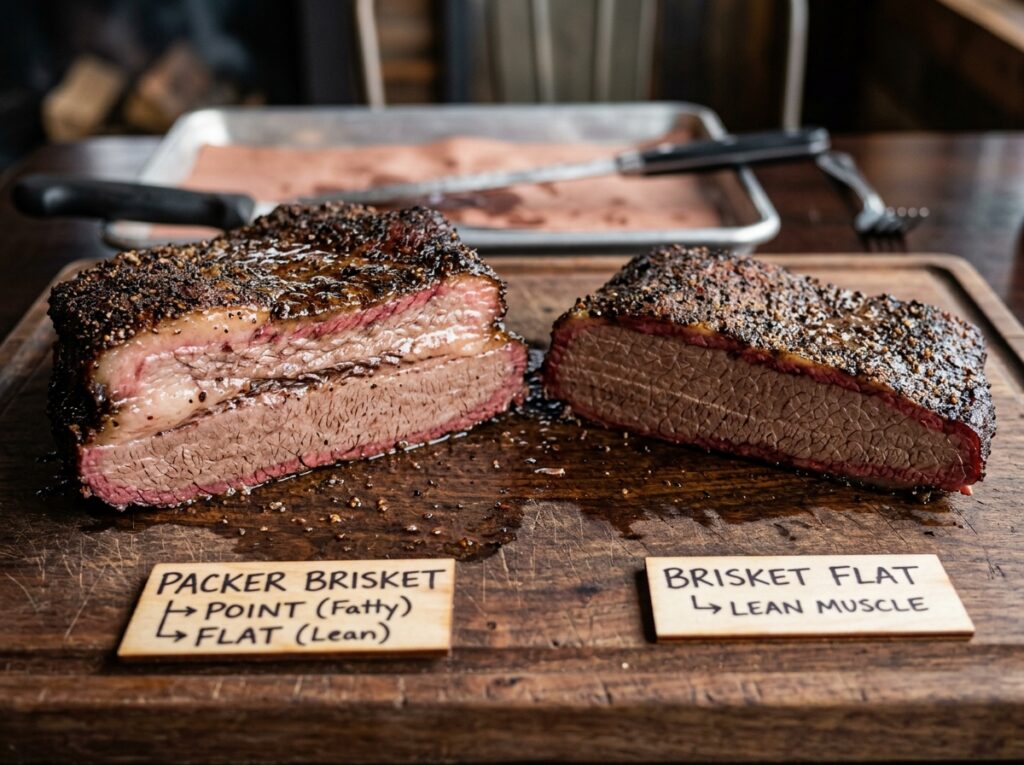
If you’re smoking brisket low and slow, a whole packer brisket usually gives you the best shot at juicy, tender barbecue. It has more fat, more marbling, and more room for error.
A brisket flat makes sense when you want a smaller cut, leaner slices, a shorter cook, or a lower total checkout price. The trade-off is simple: it dries out faster and asks for more care.
| Factor | Brisket Flat | Whole Packer Brisket |
|---|---|---|
| What you get | Only the flat muscle | Flat + point together |
| Typical size | 4–8 pounds | 10–18 pounds |
| Fat level | Leaner | Fattier overall |
| Moisture | Easier to dry out | More forgiving |
| Flavor | Beefy, clean slices | Richer, deeper BBQ flavor |
| Burnt ends | Not ideal | Great option |
| Cost per pound | Usually higher | Usually lower |
| Best for | Small meals, lean portions | Classic smoked brisket |
Quick fact: A packer brisket isn’t a special breed or fancy grade. It simply means the full brisket, usually vacuum packed by the meat processor, with both main muscles still attached.
What Each Cut Actually Is
Before you decide, it helps to know what you’re buying.
Brisket comes from the lower chest of the cow. These muscles work hard, so they’re full of connective tissue. That’s why brisket can feel tough if you cook it fast, but turn silky and tender after a long smoke.
The brisket flat
The flat is the leaner, more even-looking half of the brisket. Some butchers call it the first cut.
It’s the part that gives you those neat, uniform slices you see on a platter. It looks tidy. It fits easier on smaller smokers. It also has less internal fat, which is great if you want lean beef, but not so great if you overcook it by even a little.
A flat often looks less scary in the store because it’s smaller and cleaner. That can fool people. Smaller doesn’t always mean easier.
The whole packer brisket
A whole packer includes both major muscles: the flat and the point.
The point sits on top of part of the flat and carries more fat and marbling. That richer section is where burnt ends often come from. Between the two muscles, you’ll also find a seam of fat.
That mix matters a lot during a long cook. The extra fat helps protect the meat. The point brings more richness. The flat still gives you slices. So with a packer, you get the full brisket experience in one cut.
If you want a closer look at how those two muscles behave, this breakdown of brisket point vs flat helps clear it up.
The Real Differences That Matter on Cook Day
A brisket label tells you the cut. It doesn’t tell you how the day will go. For that, you need to think about moisture, flavor, cost, yield, and how much room you have on your smoker.
Fat and moisture: this is the big one
If you remember one thing from this article, remember this: fat gives you breathing room.
A brisket flat doesn’t have much internal fat compared with a whole packer. That means the margin for error is small. Miss the finish point, trim too aggressively, or rest it poorly, and the slices can turn dry.
A whole packer has more protection. The point carries extra marbling, and the full cut tends to cook more evenly over a long smoke. That doesn’t make it foolproof, but it does make it more forgiving.
That’s one reason many Texas-style pitmasters still prefer whole packers for traditional barbecue. They want that balance of lean slices from the flat and rich, juicy meat from the point.
Flavor, bark, and burnt ends
A flat gives you clean, beef-forward slices. If your family likes lean meat, that can be a real plus.
A packer gives you more range. The flat still slices nicely, but the point adds a richer, softer, more buttery bite once the fat renders. You also get more exterior surface for bark and the option to turn the point into burnt ends.
So what tastes better?
Most BBQ fans will pick the packer because it delivers more of the classic brisket experience. You get lean and rich in the same cook. A flat can still taste great, but it rarely matches the depth and variety of a well-cooked whole packer.
Price, trim loss, and real value
This part trips people up all the time.
At the store, a flat often looks cheaper because the total price is lower. A 6-pound flat costs less than a 14-pound packer, so your brain says, “That’s the budget option.”
But look at price per pound, not just the sticker total.
In 2026, exact prices still swing a lot by region, store, and USDA grade. Even so, whole packers usually cost less per pound than flats. Why? Because the butcher has done less trimming, and you’re buying the full cut with more fat and waste built in.
Here’s a simple example:
A 6-pound flat at $8.99 per pound costs about $54.
A 14-pound packer at $4.99 per pound costs about $70.
The flat wins on total spend that day. The packer wins on per-pound value.
Now add shrink.
Brisket loses weight from trimming and cooking. A whole packer can lose around 30 to 40 percent, sometimes more, depending on how it’s trimmed and how much fat renders out. Flats also lose weight, though usually a bit less if they were already trimmed heavily.
Warning: Don’t buy brisket by sticker shock alone. The cheaper-looking cut can be the more expensive one on a per-pound basis, while the bigger cut can lose more raw weight before dinner.
Serving yield
If you’re feeding people, yield matters more than internet bragging rights.
A whole packer gives you more total food, but some of that raw weight is fat you’ll trim or render away. A flat gives you a more direct path to lean slices, yet the finished meat can still shrink more than expected if the cut is thin.
For most backyard meals, a good rule is:
- About 1/2 pound cooked brisket per adult
- If you have lots of sides, you can plan closer to 1/3 pound cooked
- If you want leftovers, buy more than you think
That means a whole packer is often the smarter move for a party, while a flat fits better for a smaller dinner.
Cook time and smoker space
This is where many home cooks choose the flat.
A brisket flat is smaller, so it often cooks faster. That doesn’t always mean “fast,” though. You’re still dealing with brisket. A 5- to 7-pound flat can easily take most of the day once you count smoke time and resting time.
A whole packer is a longer project. Depending on size, grade, pit temperature, and how the meat behaves through the stall, you may be looking at 10 to 16 hours or more from start to serving.
Space matters too.
A flat fits more easily on smaller pellet grills, kettles, or compact kamados. A big packer needs room to breathe. If you’re shopping for a cooker that can handle brisket comfortably, these picks for the best pellet grill and the best offset smoker are a good place to start.
Which One Should You Buy?
This is the part most people care about. Not the anatomy. Not the theory. Just the call: which cut belongs in your cart?
Buy a brisket flat if your day looks like this
You’re cooking for four to six people. Your smoker isn’t huge. You want neat slices, not burnt ends. You’d rather spend less money upfront. And maybe you know your crowd prefers lean beef over rich, fatty bites.
That’s a good flat day.
A flat also makes sense if you’re practicing your slicing game, making sandwiches, or planning to finish the meat with au jus, broth, or beef tallow after the smoke.
Still, be picky at the butcher counter.
A good flat should look thick and even, not long and skinny. Thin ends dry out fast. If I had to choose between two flats, I’d pick the thicker one every time, even if it weighs a little more.
Pro tip: On a flat, shop for thickness before anything else. A thick Choice or Prime flat usually beats a cheap, thin one with no marbling.
Buy a whole packer if you want the best BBQ result
If you’re feeding a bigger group, chasing that classic smokehouse texture, or just want the better odds of a juicy cook, buy the packer.
Yes, it’s bigger.
Yes, it costs more total.
Yes, it takes longer.
And yes, it’s usually worth it.
A packer is the better pick if you want bark, slices, richer meat, and the option for burnt ends. It also gives you more leftovers, which is not a bad problem. Brisket freezes well if you slice it, vacuum seal it, and save some juices with it.
Real-life examples
Let’s make it practical.
Backyard dinner for five on a medium pellet grill:
A 5- to 6-pound flat is totally reasonable. You’ll spend less, it’ll fit easily, and you won’t be buried in leftovers.
Football party for twelve:
Go with a 12- to 15-pound whole packer. You’ll get a better mix of textures and a safer cushion against drying out.
You want to learn real brisket barbecue:
Buy a packer. It teaches you more about trimming, bark building, resting, and slicing. It’s the better classroom.
How to Smoke Each Cut Without Drying It Out
No cut saves you from bad technique. Still, each one wants a slightly different approach.
How to smoke a brisket flat
A flat needs a gentle hand. Think of it like cooking a chicken breast versus a chicken thigh. The leaner piece can be excellent, but it doesn’t forgive sloppy timing.
Here’s a simple approach that works for many backyard cooks:
- Buy better meat if you can. USDA Choice is a good starting point. Prime is even better. Select flats can be tough to keep juicy.
- Leave some fat cap on it. About 1/4 inch is plenty. Don’t shave it down to nothing.
- Cook around 250°F. That temp gives you solid bark and a manageable cook without dragging the day forever.
- Wrap once the bark is set. Many flats benefit from wrapping in butcher paper or foil somewhere around the 160°F to 175°F internal range.
- Start checking for tenderness before you trust a finish number. A flat may be ready around 195°F, or it may want a little more time.
If one end of the flat is very thin, tuck it under or trim it off before cooking. That little move can save you from one dry, overdone edge.
Some cooks add a spoonful of beef tallow or a splash of broth inside the wrap for extra insurance. That can help, especially with lean flats.
How to smoke a whole packer brisket
A packer takes more prep, but the cook itself often feels less nerve-racking because the meat has more internal protection.
A good home method looks like this:
- Trim the hard fat and ragged edges. Leave about 1/4 inch of fat cap.
- Season simply. Salt, pepper, and maybe garlic powder still work great on brisket.
- Mark the grain before you season. Just shave off a small corner on the raw flat so you remember how to slice later.
- Cook between 225°F and 275°F. Many backyard cooks get great results right around 250°F.
- Wrap after the bark sets and the color looks right. Paper keeps bark firmer. Foil speeds things up but softens the bark.
- Probe the flat for tenderness, not just the point. The flat is the part most likely to dry out first.
After the brisket is tender, rest it well. A whole packer often gets even better with a long hold of two to four hours in a warm cooler or low oven.
Did you know? The grain runs in different directions on the flat and the point. That’s why slicing a whole brisket can confuse people. Marking the grain before the rub goes on is one of the easiest “why didn’t I do that sooner?” tricks in barbecue.
Temps, wrapping, and resting
You’ll see a lot of magic numbers online.
203°F.
205°F.
210°F.
Those numbers can be useful as rough markers, but they are not the finish line by themselves. Brisket is done when the thickest part of the flat feels tender and the probe slides in with very little resistance.
If you want a full breakdown of pit settings, this guide on the best temp to smoke brisket explains how different smoker temps affect the cook.
A good wireless meat thermometer also makes a huge difference. You won’t need to keep lifting the lid and guessing through the stall.
And if you’ve heard people swear that every brisket must hit 210°F, read this take on brisket internal temp 210. It clears up why tenderness matters more than chasing one exact number.
Common Confusion Around Brisket Flat vs Packer
A few ideas keep floating around barbecue forums, and they cause more trouble than they should.
“Flat is easier, so it’s better for beginners”
I get why people think this. A flat is smaller, cheaper, and less intimidating.
But smaller doesn’t always mean easier.
A flat has less fat, less marbling, and less room for error. If your fire runs hot or your timing slips, the flat tells on you fast. A whole packer gives you more cushion.
So if by “easier” you mean “shorter and smaller,” the flat wins. If by “easier” you mean “better chance of juicy brisket,” the packer usually wins.
“Packer is too big unless I’m feeding a crowd”
Not really.
You can cook one packer and eat brisket three different ways: sliced the first night, chopped sandwiches the next day, and freezer packs for later. Good leftovers make a big brisket much more practical than it seems.
You can also find smaller packers in the 10- to 12-pound range, especially at warehouse clubs and larger butcher counters.
“A higher finish temp guarantees better brisket”
Nope.
A brisket can be dry at 210°F and perfect at 198°F. It can also still feel tight at 203°F. Every cut is a little different because the fat, connective tissue, grade, and thickness all vary.
Use temperature as a map, not a law.
One more thing: packer doesn’t mean better grade. A Prime flat can beat a dry Select packer every day of the week. Cut type matters, but grade and marbling still count.
4. FAQ Section
FAQ
Is a brisket flat the same as a whole packer brisket?
No. A brisket flat is only the lean flat muscle. A whole packer brisket includes both the flat and the point together. If you want the full brisket with richer meat and better burnt end potential, you want a packer.
Which is better for beginners: brisket flat or packer?
If your smoker has enough space and your budget allows it, a whole packer is often better for beginners because it’s more forgiving. A flat is smaller and cheaper, but it can dry out fast if you miss the timing or run too hot.
Is a brisket flat good for smoking?
Yes, a brisket flat can smoke very well. You just need to treat it carefully. Buy a well-marbled flat, keep some fat cap on it, cook at a steady temp, wrap once the bark is set, and don’t skip the rest. Thin, cheap flats are the ones that usually disappoint people.
How much brisket should I buy per person?
Plan for about 1/2 pound cooked brisket per adult. Since brisket loses weight during trimming and cooking, that often means roughly 3/4 to 1 pound raw brisket per person, especially with a whole packer. If you’re serving lots of sides, you can aim a bit lower.
Why is whole packer brisket often cheaper per pound than flat?
Because you’re buying the full cut with more exterior fat and less butcher trimming already done. A flat takes more labor to portion and trim, so stores usually charge more per pound for it. Even so, the packer usually costs more total because it’s much larger.
5. Conclusion
If you want the safest path to juicy, classic smoked brisket, buy a whole packer brisket. If you want a smaller, leaner cut for a modest meal, a brisket flat can still be a smart pick.
So your next step is simple: count how many people you’re feeding, check the size of your smoker, and decide how much risk you want on cook day. Match the cut to the job, and brisket stops feeling like a mystery. It starts feeling like dinner.