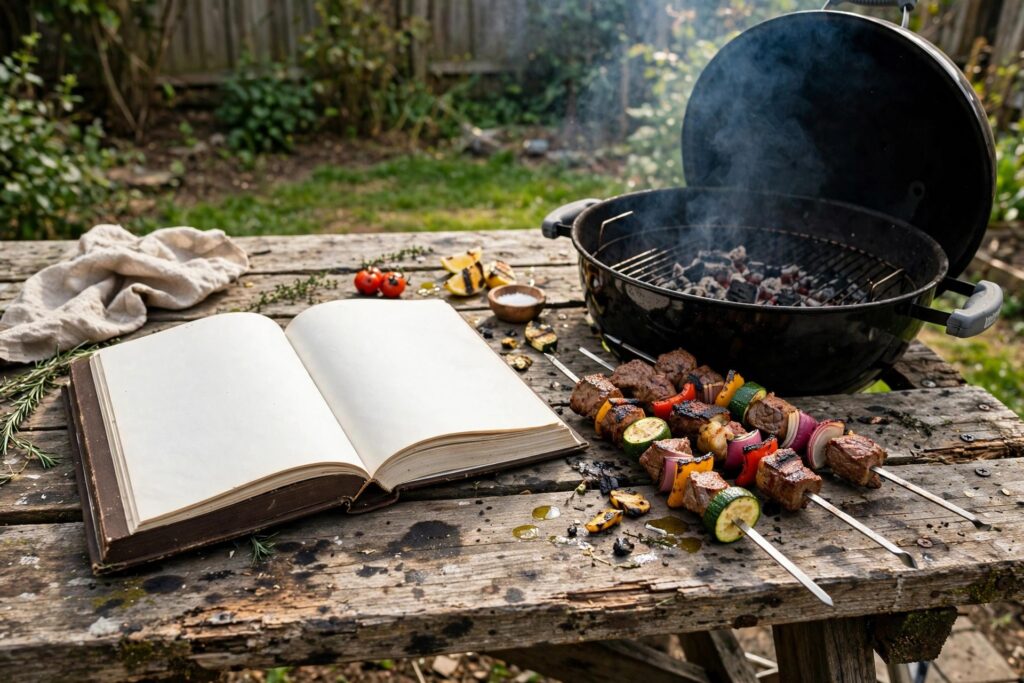
Most grilling cookbooks are the same forty recipes in different fonts. Then there’s Steven Raichlen. Publishers Weekly once called him the “Tolstoy of Tabasco,” and the nickname stuck for a reason — after the 425-recipe BBQ USA and the 500-recipe Barbecue! Bible, his 2010 release Planet Barbecue! (Workman, May 2010) went global: 309 recipes from 60 countries, gathered across what the back cover describes as a live-fire tour of six continents.
I want to be straight about how I read this one. I worked through the book’s contents the way its best reviewers did — Chris Grove’s 2010 review on NibbleMeThis, which tested recipes on his own Big Green Egg, the Publishers Weekly editorial review, and Maureen Clancy’s cooking write-up. What follows is a genuine evaluation of what the book is and what a barbecue cook actually gets out of it — not a press release.
This isn’t a cookbook. It’s a field guide.
Grove opened his review with the line that sold me: he normally tabs recipes he wants to try, but with Planet Barbecue! he quit tabbing after page 41 because he was literally tabbing every page. “To call Planet Barbecue! a ‘cookbook’ doesn’t do it justice,” he wrote. “It is a barbecue and grilling resource.”
The resource part comes from structure, not recipe count. Every recipe carries a “The Scoop” side panel — a quick Where, What, How, and Just The Facts. And every country gets a two-page profile: first a narrative of the food and culture, then a bulleted breakdown of The Grills, The Fuel, The Flavorings, Must Try Dishes, The Condiments, How To Eat It. As Grove put it, “You actually learn about the food, you aren’t just copying a recipe.”
That distinction matters. A recipe teaches you one dish. A country profile teaches you how an entire cuisine thinks about fire — what burns under the food, what goes on it, and what it gets eaten with. Read enough of those profiles and your own cooking changes, because you stop thinking in recipes and start thinking in systems.
Sixty countries, arranged by meat instead of map
Here’s the book’s cleverest editorial decision: the chapters are arranged by what you’re cooking rather than where it comes from. Publishers Weekly noted the effect — Serbian bacon-grilled prunes seated next to jalapeño poppers, Laotian grilled fish next to Canadian trout grilled on a log. It sounds like a gimmick until you cook from it. Grouped this way, the book argues that techniques rhyme across borders: a prune wrapped in bacon and a pepper stuffed with cheese are the same idea in different accents.
That arrangement also quietly teaches the single most important lesson in the book: fuel and method travel. What a country burns — and how it seasons — shapes its grilling more than any single recipe does. If you want to think about fuel the way Raichlen’s country profiles do, our own smoking wood and meat pairing guide is a good domestic starting point for the same question: what goes under the food, and why.
The book is also full of people. Raichlen profiles what he calls Fire Starters — grill masters met on his travels. Clancy’s review names a few: the Bonfire Brothers, two Brazilian restaurateurs lured to Texas by none other than George W. Bush; the Barbecue Queen of the Philippines, famed for her spit-roasted pig; Madam Djan and Miss Panin, the grilled fish divas of Laos. The book opens with “Two Million Years of Barbecue History” and closes out techniques like tying a surgeon’s lock knot so a bird or roast doesn’t fall off the spit. These aren’t decorations around the recipes — they’re the argument that barbecue is a human tradition before it’s a cooking method.
Doable without going soft
World-recipe collections usually fail in one of two ways. Either every country gets its most boring classic, or the editor chases the most outlandish dish and fills the book with ingredients you can’t buy. Grove flagged exactly this worry — and said Raichlen dodged both traps. The recipes are “appetizing and doable,” with the authentic method presented first and substitution advice where ingredients are hard to find.
The showcase is his Puerto Rican Grilled Pork Chops, which Grove cooked at home: the chops take a simple Spanish-Caribbean rub (salt, oregano, garlic, pepper, sage), then get glazed with annatto oil while cooking. Raichlen explains what annatto seeds are, where to find them, and advises that a blend of turmeric and sweet paprika works as a substitute — which is what Grove used. He grilled them on a Big Green Egg for 8 minutes total, flipped in 2-minute intervals, at 375°F. Verdict: “spectacular,” made again, and the same rub and glaze was headed for a spiral-cut pork loin next. Raichlen also offered a “Sparkling Barbecue Sauce” — 7-Up doctored into BBQ sauce — and Grove’s verdict was that the chops were so good they didn’t need it, though he drizzled it anyway.
That recipe is the book in miniature: authentic technique, honest substitutions, clear instructions, and a cook’s judgment call at the end. The range around it is enormous — Kenyan grilled crocodile with garlic walnut lime sauce, Singaporean grilled pork belly, Kuwaiti chili shrimp, kangaroo kebabs, Australian lamb cooked on a shovel, Cambodian coconut-grilled corn, Argentine asado with chimichurri, Tuscan grilled toasts, Romanian garlic steak. And tucked in the margins are Raichlen’s “20 secrets” to the perfect burger — Clancy reports one hint: the fat content of the two cuts of beef must be exactly 22 percent.
What a barbecue cook actually takes home
So what changes in your cooking after this book? Three things, in my read. First, you start thinking in fuels and flavorings instead of dishes — the country profiles rewire that reflex. Second, you learn to substitute with intent rather than apology; the annatto-for-turmeric-and-paprika move is a lesson in how flavor roles work, not just a swap. Third, you get a reference shelf’s worth of ideas that aren’t competing with your brisket — this is a grilling book, live fire, and it sits alongside low-and-slow barbecue rather than replacing it.
Clancy’s review noted something worth repeating: the photos are of real people doing real cooking with real passion, not stylist-perfect still-lifes. That aesthetic matches the book’s philosophy. Raichlen, in her telling, is “one of the most intelligent, creative and thorough” cookbook authors working, and the book is written in a breezy, conversational tone that whisks you through the material instead of lecturing.
The verdict
Who is this for? The griller who’s burned through the domestic repertoire — ribs, chicken, burgers, the whole backyard canon — and wants a new world to explore without buying sixty books. The person who reads “The Fuel” sections for fun. The family looking for a gift for the griller who has everything. Grove’s recommendation stands: if you’re looking for something different from the usual grill fare, pick up a copy.
Who can skip it? If you want one cuisine in real depth, get a book about that cuisine — this is a survey by design, two pages per country, and it doesn’t pretend otherwise. And if your fire is exclusively a low-and-slow smoker, know this is a grilling book first; you’ll steal ideas from it constantly, but it’s not a barbecue manual in the brisket-and-ribs sense.
Sixteen years after publication, Planet Barbecue! holds up for exactly the reason Grove identified in 2010: it isn’t really a cookbook. It’s a barbecue and grilling resource — and resources age better than recipes do.
Leave a Reply