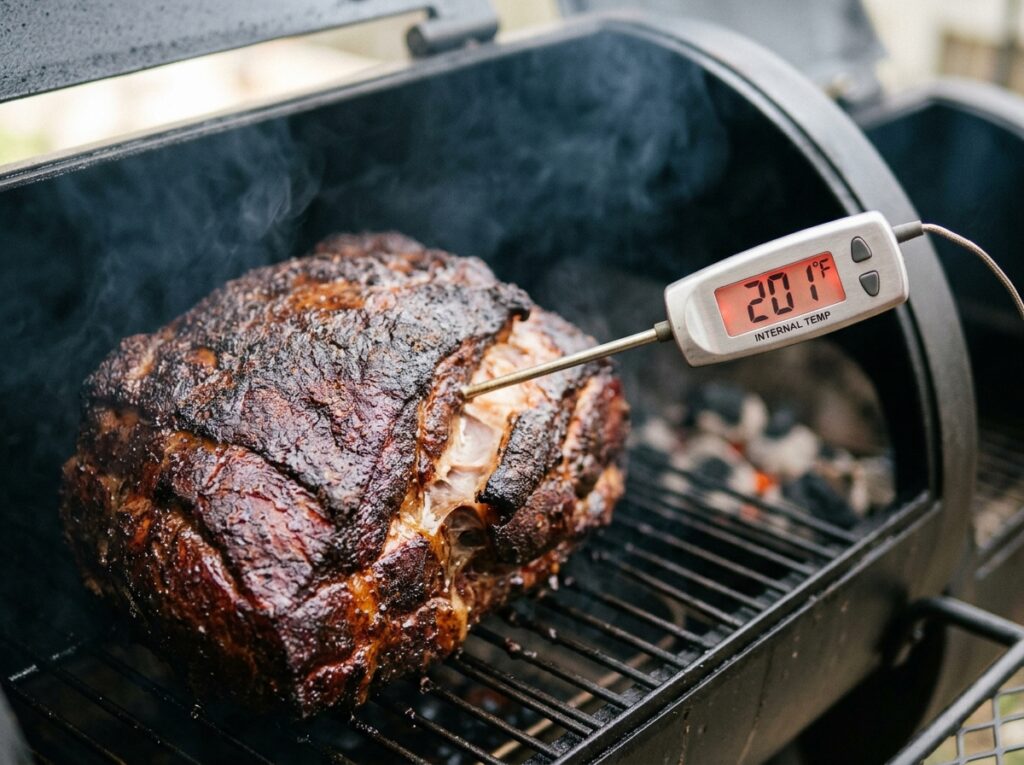
Here’s the simple answer first: smoke pork butt at 250°F.
That temp gives you the best middle ground between smoke flavor, bark, fat rendering, and total cook time. You can absolutely smoke it at 225°F. You can also run at 275°F and still get great pulled pork. But if you want one temp that works well on a pellet grill, offset smoker, kamado, or even many charcoal setups, 250°F is the sweet spot.
For the finish, don’t judge doneness by smoker temp alone. Pork butt is usually ready to pull when the internal temperature lands between 195°F and 205°F, and the meat feels probe tender. A lot of cooks aim for about 203°F, but tenderness matters more than the exact number.
Quick facts:
- Best smoker temp: 250°F
- Good working range: 225°F to 275°F
- Wrap around 160°F to 170°F if you want to push through the stall
- Start checking for tenderness at 195°F
- Most pork butts feel ready near 203°F
- Rest at least 1 hour, and 2 hours is even better
Did you know? Pork butt doesn’t come from the rear of the pig. It’s part of the upper shoulder, often sold as Boston butt.
Why 250°F works so well
Smoke flavor and bark stay in balance
At 250°F, the pork spends enough time in the smoker to pick up good wood flavor, but not so long that your whole day turns into a waiting game.
Think of it like brewing tea. Leave it too short, and it tastes weak. Leave it too long, and it gets harsh. Pork butt works in a similar way. You want enough time for smoke to build flavor and for the outside to form bark, but you don’t need to drag the cook out just to prove it was “low and slow.”
A steady 250°F also helps the outside dry just enough to build bark without turning it tough. That matters if you love those darker, crusty bits mixed into your pulled pork.
Fat and collagen need time, not magic
Pork butt has plenty of fat, collagen, and connective tissue. That’s why it shines in the smoker. Those tough parts slowly melt down and turn the meat soft, juicy, and easy to pull.
At 250°F, you’re still cooking low enough to let that change happen gently. You’re just not stretching it longer than needed.
A common mix-up happens here. People hear “low and slow” and assume lower is always better. Not really. Pork butt doesn’t get extra points for taking 18 hours instead of 11. It gets better when the fat renders and the collagen loosens. 250°F does that very well.
250°F fits real life
Most home cooks aren’t running a restaurant pit in central Texas. You’ve got weather, errands, hungry guests, and maybe one thermometer you half trust.
That’s another reason 250°F is such a smart target. It gives you room.
An 8-pound bone-in pork butt at 250°F might take around 10 to 14 hours total, including the stall and resting time. That range still sounds wide, because it is. Meat size, shape, bone, fat content, smoker type, outside temp, and wind all affect the cook.
Still, 250°F keeps the day more predictable than 225°F.
Pro tip: Finish early if you can. Resting a pork butt in a dry cooler for a couple of hours is much less stressful than serving two hours late.
225°F vs 250°F vs 275°F
Is 225 or 250 better for pork butt?
For most people, 250°F is better.
At 225°F, you’ll get a traditional low-and-slow cook. That can work great. The smoke time is longer, and some people like the pace of it. The downside is simple: it usually takes more time, and that extra time doesn’t always give you a better final result.
At 250°F, you still get classic barbecue texture and flavor. You just trim some of the dead time out of the cook.
If you’ve ever stared at a pork butt stalled in the 160s for what feels like forever, you already know why 250°F wins so often.
Can you smoke pork butt at 275°F?
Yes, you can. In fact, 275°F is a solid choice if you’re a little short on time.
Some backyard cooks act like 225°F is the only “real” barbecue temperature. That’s not true. Plenty of great pitmasters cook shoulders and briskets hotter than online comment sections would have you believe.
At 275°F, the pork butt will usually finish faster. You can still get tender pulled pork and nice bark. You just need to watch the outside a bit more closely, especially if your rub has a lot of sugar.
If I had to give a simple rule, it would be this:
- 225°F if you want the longest, slowest cook and you’ve got plenty of time
- 250°F if you want the best all-around result
- 275°F if your schedule matters and you still want very good barbecue
Best temp by smoker type
Your smoker can nudge the answer a bit.
Pellet grills: 250°F is usually the best place to start. Pellet cookers run clean and steady, but the smoke flavor can be lighter than charcoal or wood. Some people start at 225°F for the first hour or two, then move to 250°F. That’s a nice move if you want a touch more smoke. If you’re still comparing cookers, our picks for the best pellet smokers for backyard cooking can help.
Offset smokers: Many offsets like to cruise at 250°F to 275°F with a clean fire. That hotter range often gives you better airflow and cleaner smoke than trying to choke the fire down.
Kamado grills: A kamado can hold 250°F like a champ once it’s settled in. If that’s your setup, these smart ways to light a kamado grill can make temperature control easier from the start.
Charcoal smokers: 250°F is still the easy answer. Just trust your grate-level reading more than the lid thermometer.
What internal temperature should pork butt reach?
Safe and done are not the same thing
This part trips up a lot of people.
The USDA says whole cuts of pork are safe to eat at 145°F with a rest. That’s true for pork chops or pork loin. But a pork butt at 145°F is nowhere close to pulled pork texture.
For pulled pork, you need the tough connective tissue to break down. That usually happens much later in the cook.
So yes, 145°F is safe. But 195°F to 205°F is where pork butt becomes shreddable.
That’s why people say pork butt is “done” around 203°F. They don’t mean food safety. They mean texture.
What is the stall?
The stall is the point where the meat’s internal temperature seems to stop rising, often somewhere between 150°F and 170°F.
Why does that happen? The surface moisture cools the meat as it evaporates. It’s a lot like sweat cooling your skin on a hot day.
Nothing is wrong when the stall hits. Your smoker didn’t fail. Your thermometer probably didn’t fail either. It’s just part of the cook.
You’ve got two choices:
Leave it unwrapped and wait it out.
Or wrap it and move faster.
Rest before pulling
A pork butt isn’t ready the second it hits your target temp.
Once it feels probe tender, pull it from the smoker and let it rest at least 1 hour. Two hours is even better if you’ve got the time.
Resting lets the juices settle and the hot rendered fat calm down a bit. Shredding too soon can make the meat seem wetter on the board and drier in your sandwich.
Warning: Don’t cook by number alone. A pork butt can hit 203°F and still need more time. If your probe still feels tight, keep cooking.
A good thermometer makes this whole process easier. A reliable instant-read thermometer for barbecue cooks helps you check different spots, and a wireless meat thermometer for long smokes can save you a lot of back-and-forth trips.
How to smoke pork butt step by step
Prep the meat
Start with a bone-in Boston butt if you can. Bone-in cuts are forgiving and easy to find. Boneless works too, but it can cook a little differently and may need tying if it’s loose.
Trim only the thick, hard fat. You don’t need to shave it bare. Leaving about 1/4 inch on the outside is plenty.
Season it well. Salt, pepper, paprika, garlic, onion, and a little sugar make a solid rub. If you like a mustard binder, use it. Just know the binder doesn’t matter nearly as much as the seasoning and the cook.
If you can season the pork a few hours ahead, or even overnight, great. If not, don’t sweat it. A same-day rub still works well.
Set up the smoker
Bring your smoker to 250°F and let it settle before the meat goes on.
For wood, pork butt plays nicely with hickory, oak, apple, cherry, or pecan. Hickory and oak give you a stronger barbecue profile. Apple and cherry are a little sweeter and lighter.
You want clean smoke, not heavy white clouds. Thin blue smoke is the goal.
Put the pork on the grate with the fat cap facing the heat source. That’s a better rule than saying fat side up every time.
On many pellet grills and charcoal smokers, heat comes from below, so fat side down often makes sense. On some offsets, the main heat may hit more from the side, so placement matters too.
Cook, wrap, and finish
Leave the lid closed as much as you can early on. The meat can’t cook if you keep checking on it like it owes you money.
After a few hours, once the bark starts to set, you can spritz lightly if the surface looks dry. Apple juice, diluted apple cider vinegar, or even plain water can work. Keep it light. You’re not washing the bark.
Around 160°F to 170°F internal, you can wrap if you want.
Foil will move the cook along faster and soften the bark a bit. Butcher paper breathes more and keeps the bark firmer. For pulled pork, foil is totally fine. A lot of that bark gets mixed back into the meat anyway.
Then cook until the thickest part feels soft when you slide in a probe. Think warm butter, not peanut butter.
Once it’s done, rest it wrapped for at least an hour. After that, pull the bone, shred the meat, and mix the bark through the softer inside pieces.
A real timing example
Let’s say you have an 8-pound pork butt and you want dinner at 6 p.m.
A smart plan would be to get it on the smoker around 6 or 7 a.m. at 250°F.
It may hit the stall near noon. You might wrap it around 1 p.m. It could finish anywhere from 3 to 5 p.m., then rest until dinner.
That sounds early, but early is your friend with pork butt.
If it finishes ahead of schedule, wrap it tight, set it in a dry cooler, and let it hold. It will stay hot for quite a while.
Pork butt is one of the few barbecue cuts that actually rewards you for finishing early.
Pro tip: Plan the meal around a long rest, not a last-second finish. Your guests will never complain that the pork rested too well.
If you’re already thinking about what to serve with it, these BBQ side dishes that go well with pulled pork can round out the plate.
Mistakes that make pork butt dry or tough
Chasing time instead of tenderness
A lot of recipes throw out time-per-pound charts like they’re laws of nature.
They’re not.
One pork butt may breeze through the stall. Another one may park there forever. Two cuts with the same weight can cook very differently if one is tall and compact and the other is flatter.
Use time as a rough plan. Use tenderness as the real finish line.
Opening the lid too much
Every lid check dumps heat and adds time.
People love to spritz, mop, poke, rotate, and inspect every hour. Most of the time, that just slows things down.
Let the cooker work. Set your probes, trust your fire, and leave the pork alone.
Pulling too soon or resting too little
A pork butt that comes off at 185°F will often slice better than it shreds. It may even taste okay. But it won’t have that loose, juicy pulled pork texture most people want.
The other mistake is shredding it right after it comes off the pit. Resting is part of the cook. Skip it, and the pork usually pays the price.
One more thing worth clearing up: the bone sliding out clean is a nice sign, but it isn’t the only sign. Probe tenderness still tells you more.
4. FAQ Section
FAQ
What is the best temp to smoke pork butt?
The best temp to smoke pork butt is 250°F for most backyard cooks. It gives you a strong mix of smoke flavor, bark, tenderness, and a manageable cook time.
Is 225 or 250 better for pork butt?
250°F is usually better. It shortens the cook without hurting the final texture. Use 225°F if you want a longer, slower cook and you’ve got extra time.
Can I smoke pork butt at 275°F?
Yes, absolutely. 275°F works well, especially if you need dinner on time. Watch the bark a little more closely, and don’t rely on temp alone. Pull it when it’s probe tender.
What internal temp is pork butt done?
Pork butt is usually done for pulled pork between 195°F and 205°F. Most cooks start checking around 195°F, and many butts feel ready near 203°F. The real test is tenderness.
Do I need to wrap pork butt?
No, you don’t need to wrap it. Wrapping is optional. It helps push through the stall and speeds up the cook. Foil is faster and softer. Butcher paper keeps bark a bit firmer.
Fat side up or down for pork butt?
Put the fat side toward the heat source. On many pellet grills and charcoal smokers, that means fat side down. There isn’t one universal rule for every cooker.
How long does it take to smoke a pork butt at 250°F?
A pork butt at 250°F often takes about 1.25 to 1.75 hours per pound, but that’s only a rough estimate. An 8-pound butt may take 10 to 14 hours total, especially once you include the stall and resting time.
5. Conclusion
If you want one easy answer you can trust, set your smoker to 250°F and cook the pork butt until it’s probe tender around 195°F to 205°F. That combo gives you the best shot at juicy pulled pork without turning the cook into an all-day guessing contest.
So the next step is simple: pick your wood, get your thermometer ready, and give yourself more time than you think you need. Pork butt is forgiving, and once you learn how it feels when it’s truly done, the whole cook gets a lot less stressful.