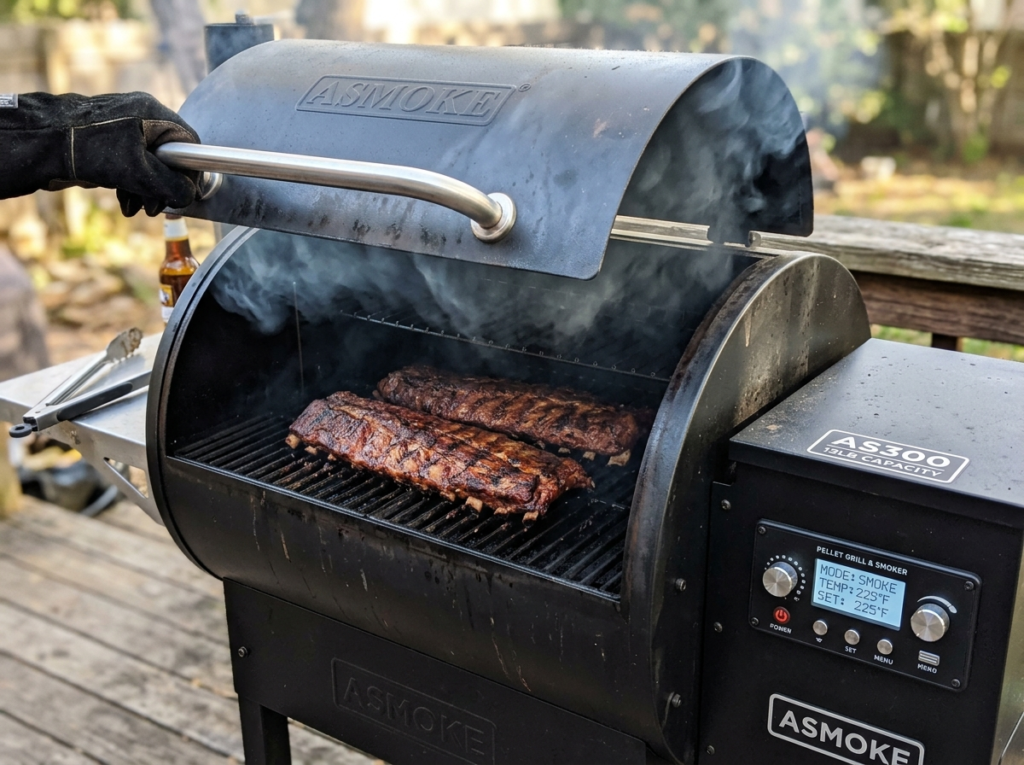
Most pellet grill brands want you to spend $800 or more before you can even think about Wi-Fi control or decent temperature accuracy. ASmoke showed up and basically said, “We can do that for less.” Bold move. But does the grill actually deliver on that promise, or is it just clever marketing hiding a mediocre cooker?
I’ve spent real time with the ASmoke AS300 and AS660 models — cooking briskets, smoking ribs, grilling burgers, and even baking pizza on them. This ASmoke pellet grill review isn’t based on spec sheets alone. It’s built on grease-stained hands and actual cook sessions. If you’re eyeing an ASmoke and wondering whether to pull the trigger, here’s what you actually need to know.
What Is ASmoke and Who’s Behind It?
ASmoke is a relatively newer player in the pellet grill space. The brand is backed by ASMOKE Inc., a company based in California that focuses on wood pellet grills and related accessories. They entered the market targeting a gap that many BBQ enthusiasts had been complaining about for years: good pellet grills cost too much, and cheap ones perform terribly.
Their most popular models — the AS300 (portable) and the AS660 (full-size) — aim to bring features like Wi-Fi connectivity, PID temperature controllers, and solid build quality into a price bracket that doesn’t make your wallet cry.
The brand also makes its own line of wood pellets called ASCA wood pellets, which are apple-wood based. They push hard on the idea of an “all-in-one” ecosystem, where the grill, pellets, and accessories all come from one place.
Now, a newer brand always raises eyebrows. Can they really compete with established names like Traeger, Camp Chef, or Pit Boss? Let’s break it down piece by piece.
ASmoke AS660: The Full-Size Workhorse
The AS660 is ASmoke’s flagship model, and the one most people ask about. It’s a mid-size pellet grill designed for someone who wants enough cooking space for a family or a small backyard party without needing a massive commercial-style setup.
Build Quality and Design
Right out of the box, the AS660 feels surprisingly solid. The body is made of heavy-gauge steel with a powder-coated finish that looks clean. The legs are sturdy — no wobble, no flex. The lid closes with a satisfying snugness, and the seal is tight enough to hold smoke without major leaks.
One design choice I appreciate: the hopper lid doubles as a side shelf. Small thing, but it’s genuinely useful when you’re juggling tongs, a spray bottle, and a plate of seasoned meat.
The grill grate is porcelain-coated cast iron. It retains heat well and gives you respectable sear marks if you crank the temperature up. The total cooking area is about 515 square inches on the main grate, with an additional warming rack pushing it closer to 662 square inches total. That’s enough room to smoke a full brisket and a rack of ribs simultaneously.
One thing worth noting: the paint on the exterior can chip if you’re rough with it. It’s not a deal-breaker, but if you leave it outside without a cover, weather will take its toll faster than you’d expect.
Temperature Control and PID Controller
Here’s where ASmoke genuinely impresses. The AS660 uses a PID (Proportional-Integral-Derivative) controller, which is the same type of temperature management system you’ll find on grills costing twice as much. Instead of simple on/off cycling, the PID controller makes micro-adjustments to the fan speed and pellet feed rate to maintain a consistent temperature.
During my tests, the AS660 held temperature within about ±10°F of the set point after the initial stabilization period (usually 10–15 minutes). That’s excellent for a grill in this price range. For context, cheaper pellet grills without PID controllers can swing 25–30°F in either direction — and that kind of fluctuation can wreck a long brisket smoke.
The temperature range runs from 180°F to 500°F, which covers everything from low-and-slow smoking to hot-and-fast grilling. You can smoke pork shoulder at 225°F all day, then crank it up to 450°F to sear steaks. If you’re curious about the ideal temperatures for specific cuts, this guide on the best temp to smoke brisket is a solid reference.
Wi-Fi and App Connectivity
The AS660 comes with built-in Wi-Fi and connects to the ASmoke app (available for iOS and Android). You can monitor grill temperature, adjust settings, and check the internal meat probe reading — all from your phone.
Does it work perfectly? Mostly, yes. The connection is stable once it pairs, and the app is straightforward. It doesn’t have the polish of the Traeger or Weber apps, but it does what it needs to do. You set a temperature, you get alerts, and you monitor your cook.
Pro Tip: The Wi-Fi range is limited. If your grill is more than about 30 feet from your router, the connection can drop. A simple Wi-Fi extender solves this if your backyard setup is farther out.
The app also stores a few preset recipes and cooking profiles. They’re basic, but helpful if you’re new to pellet grilling and want a starting point.
Pellet Consumption and Efficiency
The AS660 hopper holds about 20 pounds of pellets, which is generous for a grill this size. In my experience, smoking at 225°F burns roughly 1 to 1.5 pounds of pellets per hour. That means a full hopper gives you around 14–16 hours of continuous low-and-slow cooking before you need to refill.
At higher temperatures (400°F+), pellet consumption jumps to about 2.5–3 pounds per hour. So if you’re doing mostly grilling rather than smoking, you’ll go through pellets faster.
ASmoke pushes their own ASCA apple wood pellets, and honestly, they’re decent. The flavor is mild and slightly sweet — great for poultry and pork. But you’re not locked into their brand. Any standard food-grade hardwood pellets work fine. I’ve used Lumberjack, Bear Mountain, and CookinPellets in the AS660 without issues.
ASmoke AS300: The Portable Option
If the AS660 is the stay-at-home workhorse, the AS300 is the grab-and-go companion. It’s designed for tailgating, camping, or anyone who doesn’t have space for a full-size grill.
Size and Portability
The AS300 weighs about 48 pounds and has a handle on top for carrying. It’s not feather-light, but one person can move it without much trouble. The cooking area is about 256 square inches — enough for 8–10 burgers, a couple of racks of ribs (if you use a rib rack), or a small pork butt.
The legs fold in, so it packs down relatively flat for transport. I’ve fit it in the back of an SUV alongside a cooler and lawn chairs with room to spare.
If you’re specifically shopping for something you can take on the road, you should also check out the roundup of the best portable pellet grill smokers to see how the AS300 stacks up against competitors like the Green Mountain Davy Crockett or the Traeger Ranger.
Performance on the Go
The AS300 also uses a PID controller, and its temperature range matches the AS660 (180°F–500°F). In practice, the smaller cooking chamber actually stabilizes faster because there’s less air volume to heat. I noticed it held temp within ±8°F during a 6-hour pork butt smoke — slightly tighter than the larger model.
The hopper is smaller at about 8 pounds, so you’ll get roughly 6–8 hours of low-and-slow cooking on a full load. For a portable unit, that’s pretty reasonable. Most tailgate or campsite cooks don’t run longer than that anyway.
One drawback: the smaller firebox means the heat can be less evenly distributed at very low temperatures (below 200°F). I noticed a slight hot spot near the firepot during a cold-smoking attempt. For regular smoking and grilling, though, it performs well.
What I Cooked (And How It Turned Out)
Reviews that only talk about specs bore me. Here’s what actually came off the grill.
Smoked Brisket (AS660)
I ran a 12-pound whole packer brisket at 225°F for about 14 hours. The ASmoke held temperature steady through the night — I checked the app a few times from bed and never saw it drift more than 12°F. The bark developed beautifully, the smoke ring was about a quarter-inch deep, and the flat was moist without being mushy.
Compared to results I’ve gotten from mid-range Pit Boss and Camp Chef grills, the ASmoke was right there with them. Not better, not worse — just solidly consistent. If you’re working on your brisket game, understanding the difference between brisket flat vs packer matters just as much as the grill you use.
Baby Back Ribs (AS300)
I did a modified 2-2-1 method for baby back ribs on the portable AS300. Two hours of smoke at 225°F, two hours wrapped in foil with butter and brown sugar, and one hour unwrapped with sauce. The ribs came out with a nice pull-back from the bone, tender but not falling apart. The apple wood pellets gave them a subtle sweetness that paired well with a vinegar-based sauce.
Seared Steaks (AS660)
Cranking the AS660 to 500°F, I seared two thick-cut ribeyes for about 3 minutes per side. The cast iron grates did their job — good sear marks and a nice crust. But let’s be real: a pellet grill at 500°F doesn’t match the searing power of a charcoal grill or a dedicated gas burner running at 700°F+. The steaks were good, not great, in the sear department. For everyday grilling, you won’t complain. For steakhouse-level crust, you’ll want a different tool.
Pros and Cons — The Honest List
I’ll keep this tight. No fluff.
What ASmoke Gets Right:
- PID temperature control at a price point that undercuts many competitors
- Wi-Fi and app connectivity that actually works
- Solid build quality for the money
- Versatile temperature range (smoke, grill, bake, roast)
- The AS300 is genuinely one of the better portable pellet grills available
- Generous hopper size on the AS660
Where ASmoke Falls Short:
- Exterior paint durability is mediocre — buy a cover
- The app works but lacks the polish and recipe library of Traeger’s or Weber’s apps
- Searing performance tops out at 500°F, which isn’t enough for a competition-level crust
- Customer service can be slow to respond (this has been a consistent complaint across user forums)
- Availability of replacement parts can be tricky since it’s a smaller brand
- The included meat probe is basic — you’ll want to upgrade to a reliable wireless meat thermometer for serious cooks
How Does ASmoke Compare to the Competition?
This is the question everyone’s really asking. So let’s put it in context.
ASmoke vs Traeger
Traeger is the biggest name in pellet grills. Their Pro series (like the Pro 575) competes directly with the AS660. Feature for feature, the ASmoke matches Traeger on Wi-Fi, PID control, and cooking area — but typically costs $100–$200 less. Traeger wins on brand reputation, app ecosystem, accessory availability, and customer support. ASmoke wins on value for money.
If brand loyalty and a massive accessory market matter to you, go Traeger. If you want similar performance and you’d rather keep the extra cash, ASmoke makes a strong case.
ASmoke vs Pit Boss
Pit Boss is known for offering large cooking areas at lower prices. Their grills often have more square inches per dollar than ASmoke. But many Pit Boss models in the same price range lack Wi-Fi and use basic temperature controllers instead of PID systems. If you prioritize precise temperature control and connectivity, ASmoke has the edge. If you want maximum cooking space on a budget, Pit Boss might suit you better.
ASmoke vs Camp Chef
Camp Chef (especially the Woodwind series) is probably ASmoke’s toughest competition. Camp Chef offers features like the Slide and Grill system for direct-flame searing, which ASmoke simply doesn’t match. Camp Chef also has better ash cleanout systems. But Camp Chef costs more. If your budget is firm and you don’t need direct-flame capability, ASmoke holds its own.
For a broader comparison of the top options on the market right now, the best pellet grill roundup covers everything from budget picks to premium models.
Who Should Buy an ASmoke Pellet Grill?
Not every grill is right for every person. Here’s who I think the ASmoke lineup genuinely fits.
The AS660 makes sense if you’re a home cook or backyard BBQ enthusiast who wants solid pellet grill performance without paying Traeger or Camp Chef prices. It’s also a great option if this is your first pellet grill and you don’t want to invest $800+ before you even know if pellet grilling is your thing.
The AS300 is ideal if you need something portable — for tailgates, RV trips, camping, or a small balcony. It’s one of the few portable pellet grills that doesn’t feel like a toy.
Who should skip it? If you’re a competition pitmaster or someone who demands the absolute best sear, ash management, and accessory ecosystem, ASmoke probably isn’t your endgame. You’d be happier with a Camp Chef Woodwind, a RecTeq, or investing in a proper offset smoker for that authentic stick-burner flavor.
Tips to Get the Most Out of Your ASmoke Grill
After running multiple cooks on both models, here are a few things I learned that’ll save you time and frustration.
Season it properly. Before your first cook, run the grill at 350°F for about 45 minutes with the lid closed. This burns off any manufacturing residues and seasons the interior. Skip this step and your first few cooks might taste a little off.
Don’t trust the stock probe blindly. The included meat probe is functional but not the most accurate. I’ve seen it read 5–8°F off compared to my ThermoWorks instant-read. For long smokes where a few degrees matter — like brisket or pork butt — use a dedicated instant-read thermometer to verify doneness.
Clean the firepot regularly. Ash buildup in the firepot can cause temperature swings, failed ignitions, and even flameouts during long cooks. After every 3–4 cooks, vacuum out the ash. It takes two minutes and prevents headaches.
Use a cover. I mentioned the paint issue earlier. A good-fitting cover extends the life of this grill significantly. ASmoke sells their own covers, but any universal grill cover that fits the dimensions will work.
Experiment with pellet blends. The ASCA apple wood pellets are fine, but mixing in some hickory or mesquite pellets can add depth to beef and game meats. A 70/30 blend of apple to hickory is my go-to for pork ribs.
FAQ
Is the ASmoke pellet grill worth the money?
Yes, for most home cooks and BBQ hobbyists. You’re getting PID temperature control, Wi-Fi, and decent build quality at a price point that’s hard to beat. It won’t outperform premium brands like Camp Chef or RecTeq on every feature, but dollar for dollar, it delivers strong value.
Can you use any wood pellets in an ASmoke grill?
Absolutely. ASmoke markets their own ASCA pellets, but any food-grade hardwood pellets will work. Avoid softwood pellets (pine, cedar, spruce) — they produce harmful resins and aren’t safe for cooking. Stick with brands like Lumberjack, Bear Mountain, CookinPellets, or Traeger pellets.
How long does the ASmoke AS660 last?
With proper maintenance — regular ash cleanup, using a cover, and keeping the grill dry — you can expect 5–7 years of solid use. The main components that wear over time are the firepot, igniter rod, and temperature sensor, all of which are replaceable. The biggest risk to longevity is rust from moisture exposure, so keep it covered.
Does the ASmoke grill work in cold weather?
It does, but with caveats. In temperatures below 35°F, the grill takes longer to reach target temp and burns pellets faster. You might also notice slightly wider temperature swings. Using an insulated blanket (ASmoke sells one, or you can find third-party options) helps a lot in cold climates.
What’s the warranty on ASmoke grills?
ASmoke offers a 3-year warranty on most components, which is standard for the pellet grill industry. The warranty covers defects in materials and workmanship but doesn’t cover normal wear items like the firepot or igniter. Keep your receipt and register the grill on their website to make any claims easier.
Final Thoughts
ASmoke isn’t trying to be the flashiest brand on the market. They’re not running Super Bowl ads or sponsoring BBQ competitions. What they’re doing is building a pellet grill that punches above its weight class on the features that actually matter — temperature consistency, connectivity, and usable cooking space — and selling it at a price that makes sense for regular people.
Is it perfect? No. The paint could be tougher, the app could be slicker, and the customer service needs work. But for someone who wants to smoke a proper rack of ribs on a Saturday, throw burgers on during the week, and maybe tackle a brisket once a month without draining their bank account — the ASmoke AS660 or AS300 is a genuinely solid choice.
Your best next move? Figure out whether you need the full-size or portable model, grab a good set of grill tools, stock up on pellets, and start cooking. That’s where the real fun begins.